InAppStory bundles communication and games. Digia adds the AI layer and native CEP integration.
Digia vs InAppStory: In-App Engagement
InAppStory is a managed in-app communication and gamification platform built around stories, in-app messages, SMART banners, and a 12-mechanic mini-game library, with published MAU-based pricing. Digia Engage is a broader in-app engagement layer: nudges, widgets, surveys, native gamification, and video, built to render inside the CEP you already run, with AI across segmentation, creative generation, and campaign review. The architecture difference is what decides which one fits.
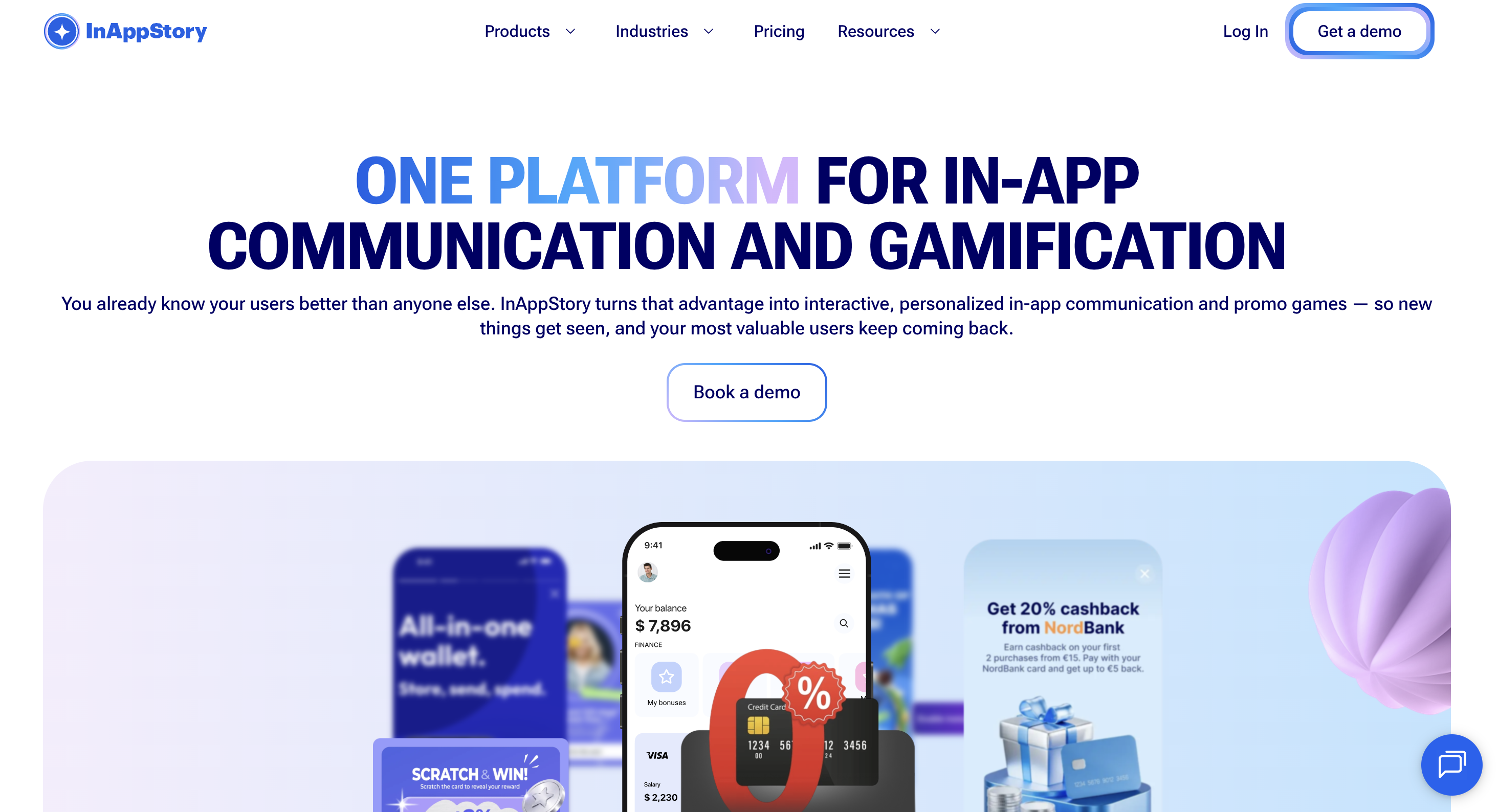
InAppStory is a managed in-app communication layer covering stories, pop-ups, modals, bottom sheets, toast messages, full-screen prompts, in-app landing pages, SMART banners, scratch cards, and 12 pre-built mini-games, with published MAU-based pricing starting around $399/month. Digia Engage is an in-app engagement layer covering nudges, widgets, surveys, native gamification, and video, alongside its own stories, built to render inside the customer engagement platform (CEP) you already run. This page compares the two on format breadth, architecture, and pricing, using each company's own published materials, plus a look at three of InAppStory's other named competitors.
What this comparison found, in short
- InAppStory's published feature set spans stories, in-app messages (pop-ups, modals, bottom sheets, toast, full-screen, ScrollView), SMART banners, scratch cards, and 12 pre-built mini-game mechanics. It does not publish a segmentation or creative-generation AI layer.
- InAppStory publishes tiered, MAU-based pricing, roughly $399–$999+/month, and StorifyMe publishes tiered, usage-based pricing from $400/month, two of the few platforms in this comparison set that do. Digia and Storyly do not publish list pricing.
- InAppStory self-reports a 5.0/5 G2 rating across 61 reviews. The company was founded in 2021 and is headquartered in Lisbon, Portugal.
How this comparison was put together
Every claim about InAppStory, Storyly, StorifyMe, and AppStorys on this page traces to each company's own published pages, pricing pages, or, in InAppStory's case, its own published feature comparison against Storyly directly. Every claim about Digia traces to Digia's own published product pages. This is not a hands-on SDK integration test of any of the four platforms, and it is not billed as one.
Scope and limitations. Ratings and pricing figures are self-reported by each company or aggregated from public review platforms and have not been independently re-measured here. Where a row in the table below has no confirmed public figure for one side, it is marked "not published" rather than filled in with a guess.
Disclosure. Digia sells Digia Engage, which competes directly with InAppStory on in-app engagement. This comparison was written and published by Digia. It is not independent, and it is not sponsored by or affiliated with InAppStory, Storyly, StorifyMe, or AppStorys. It differs in method from Digia's SDK-tested comparisons, such as the MoEngage comparison, which is based on a direct integration test rather than published materials alone.
Compiled by the Digia team. . Something out of date? Email info@digia.tech and we'll correct it.
To be clear: InAppStory is a highly rated in-app communication platform, self-reporting a 5.0/5 rating across 61 G2 reviews. Its combination of stories, a wide in-app messaging library, and a 12-mechanic mini-game library in one dashboard, with published MAU-based pricing, is a genuine differentiator most competitors in this set don't match. This page is about architecture and AI depth, not a broad case against the platform.
At a glance
Feature comparison across in-app content and engagement tools
A high-level market map based on each platform's published positioning and documentation, reviewed August 2026. Product packaging varies by plan and region.
| Feature / Capability | Digia Engage | InAppStory | Storyly | StorifyMe | AppStorys |
|---|---|---|---|---|---|
| Best fit | Mobile teams that already run a CEP and want a broader native in-app engagement layer | Teams that want one workspace covering stories, messages, banners, and mini-games, with published pricing | Commerce and retail brands wanting AI-personalized, shoppable stories and content flows | Teams wanting the same stories/shorts engagement layer live on both their app and website | India-first teams wanting a full no-code engagement suite without an Enterprise-only price tag |
| In-app format library | Nudges, tooltips, bottom sheets, banners, widgets, stories, surveys, video, gamification | Stories, in-app messages (pop-ups, modals, bottom sheets, toast, full-screen, ScrollView), SMART banners, mini-games | Stories, video feeds, swipe cards, canvas, banners | Stories, Shorts (vertical video), Snaps (UGC), Ads, plus an AI content assistant | Stories, reels, PiP video, banners, floaters, widgets, coachmarks, spotlights, bottom sheets |
| Gamification | Scratch cards, spin-to-win, streaks, milestones, badges, quizzes | Scratch cards, plus 12 pre-built mini-game mechanics | Not published as a native format | Not published as a standalone format; interactivity built into stories (polls, quizzes, sliders) | Scratch cards and quizzes |
| Architecture | Renders inside the CEP you already run (CleverTap, MoEngage, WebEngage) | Standalone managed communication layer, one dashboard for all formats | Standalone content experience platform, personalization powered by Amazon Personalize | Standalone SDK for both mobile app and website, same content reused across both | Standalone no-code suite, also covers push, email, WhatsApp, and SMS |
| AI | Natural-language segmentation, on-brand creative generation, pre-launch campaign review | Not a primary published capability | Contextual personalization via the Amazon Personalize recommendation engine | AI content assistant for generating stories; personalization and segmentation at Enterprise tier | AI-assisted campaign design inside its drag-and-drop editor |
| Pricing | Custom quote | Published tiers, roughly $399–$999+/month, MAU-based | Custom quote, not published | Published tiers, Growth from $400/month, Enterprise from $1,000/month, usage-based | Custom quote, scoped to app size and selected features |
InAppStory vs Storyly
InAppStory and Storyly both start from the same format: full-screen, swipeable stories with shoppable product cards. InAppStory maintains its own published feature-by-feature comparison against Storyly directly, which is the clearest source for this section. InAppStory's advantage shows up once the job moves past stories into banners, in-app messages, and mini-games; Storyly's advantage shows up in AI-driven personalization, which InAppStory does not publish.
The clearest differences, per InAppStory's own published table:
- Shoppable stories: Both platforms publish shoppable stories, product tags, and checkout logic, with InAppStory additionally listing Full HD video support.
- In-app messaging: InAppStory publishes pop-ups, modals, bottom sheets, toast messages, full-screen prompts, and in-app landing pages (ScrollView). Its own comparison lists these formats as not available on Storyly.
- Personalization: Storyly publishes AI-driven personalization via the Amazon Personalize recommendation engine. InAppStory does not publish a comparable AI layer.
- Where Digia differs: Digia organizes similar territory into five product lines (nudges, widgets, surveys, gamification, video) and adds AI-assisted segmentation and campaign review that neither InAppStory nor Storyly publish.
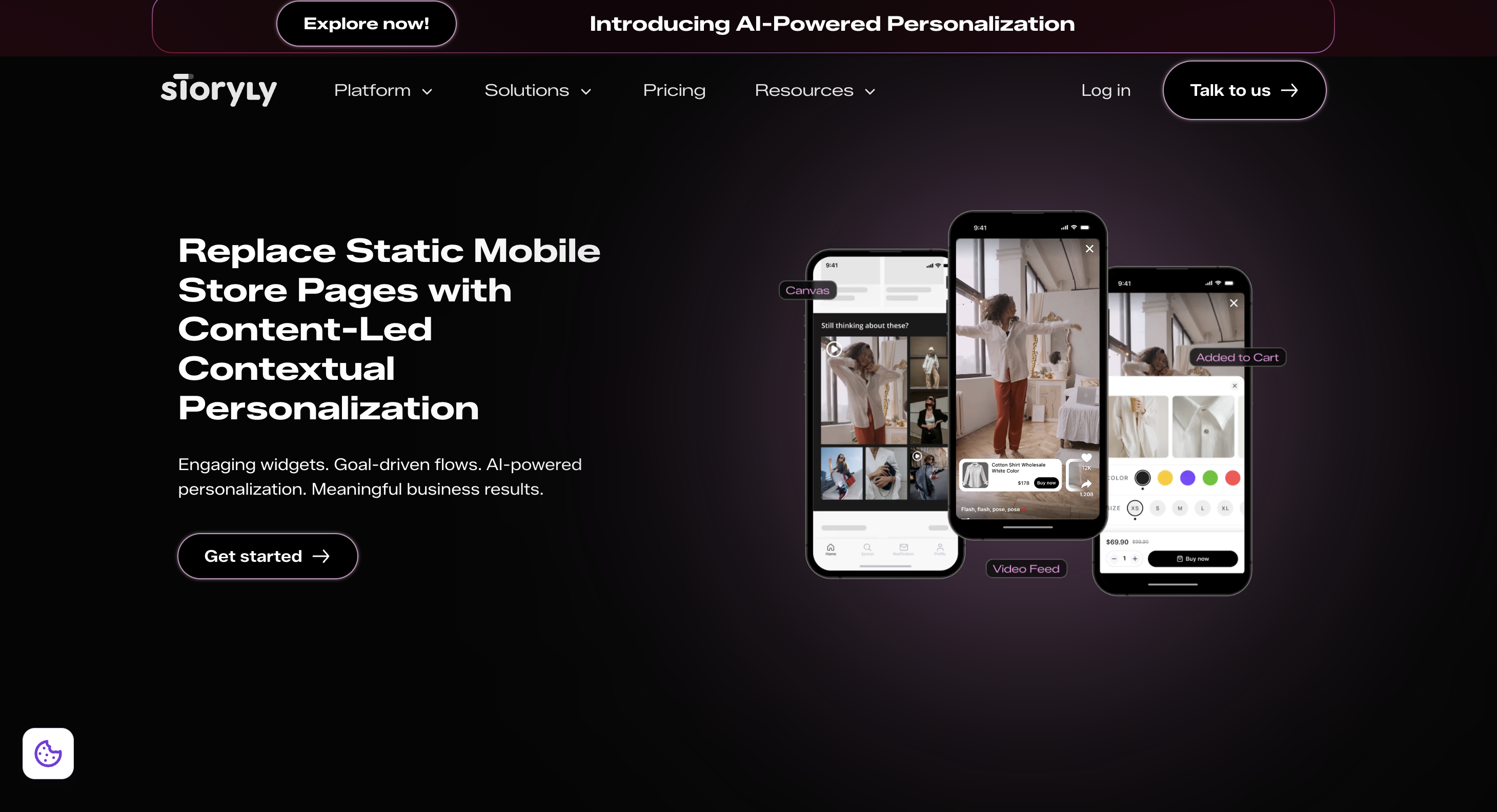
| Feature / Capability | InAppStory | Storyly |
|---|---|---|
| App stories | Available | Available |
| Shoppable stories / video | Available, including Full HD video | Available |
| Pop-ups, modals, bottom sheets | Available | Not published |
| Mini-games | 12 pre-built mechanics | Not published |
| AI personalization | Not a primary published capability | Amazon Personalize recommendation engine |
| Best fit | Full in-app communication and campaign control | Commerce-led shoppable content |
Choose InAppStory if:
You need pop-ups, bottom sheets, full-screen messages, in-app landing pages, or mini-games alongside stories, from one dashboard with published pricing.
Choose Storyly if:
Commerce-led shoppable content and AI-personalized product discovery are the priority, and stories plus banners cover your use case.
InAppStory vs StorifyMe
InAppStory and StorifyMe are the two platforms in this set that both publish pricing directly, which makes them easier to compare head to head than most. The main difference is scope: InAppStory covers stories, a wide in-app messaging library, and gamification inside a live mobile app; StorifyMe covers stories, video, monetization, and content generation across both app and web.
The scope difference, based on each company's own published pricing and feature pages:
- Surface: StorifyMe publishes support for both mobile apps and websites from one SDK. InAppStory's public positioning centers on the mobile app, with in-app messages, banners, and mini-games.
- In-app messaging: InAppStory publishes pop-ups, modals, bottom sheets, toast messages, full-screen prompts, and in-app landing pages. StorifyMe's public feature list does not include an equivalent standalone messaging library.
- Gamification: InAppStory publishes scratch cards and 12 pre-built mini-game mechanics. StorifyMe's interactivity is built into stories themselves (polls, quizzes, sliders, CTAs) rather than published as separate mini-games.
- Pricing: StorifyMe's Growth plan starts at $400/month for 100,000 views; InAppStory's published tiers run roughly $399 to $999+/month, MAU-based. Both are usage-based and scale with volume.
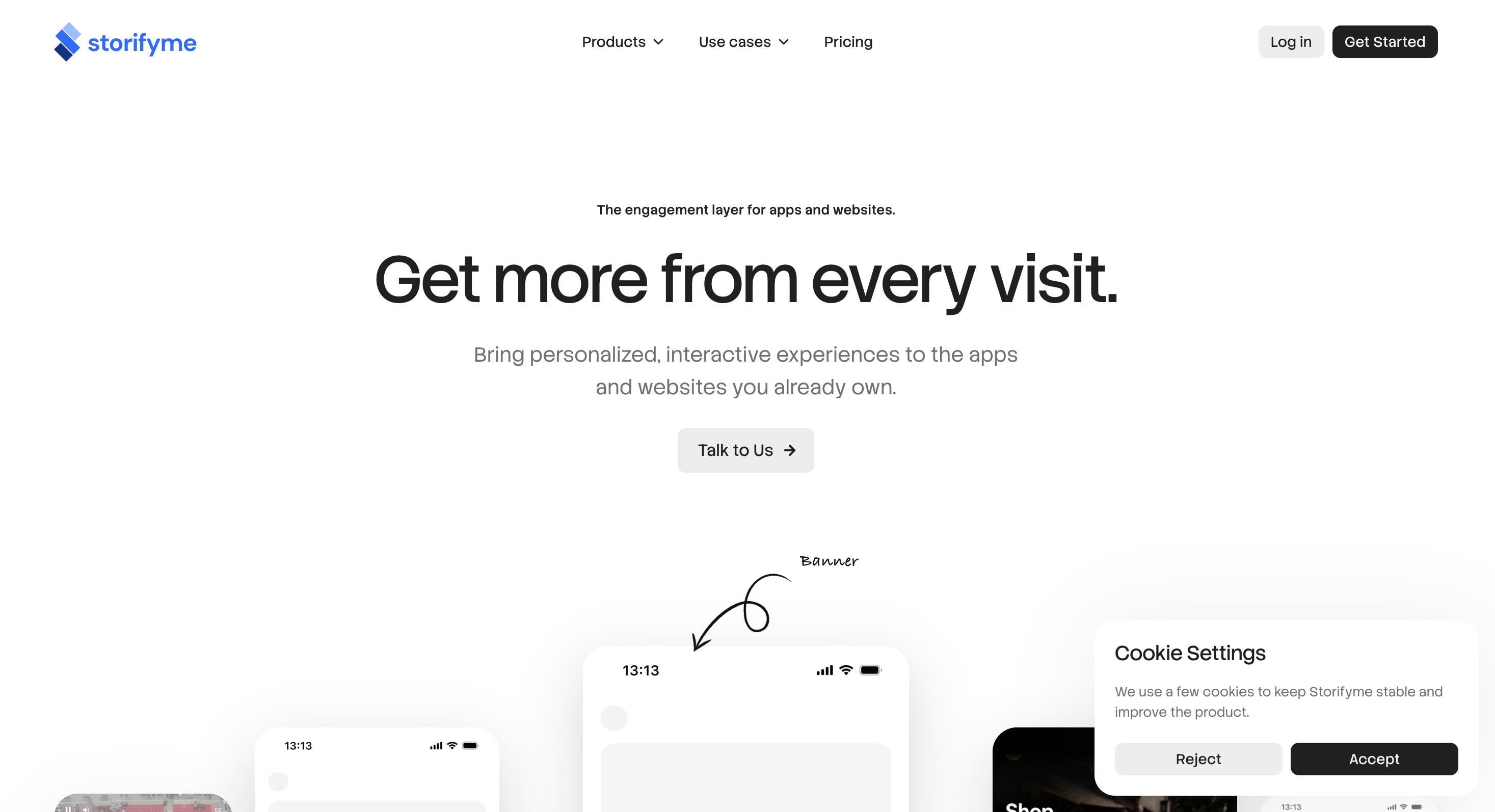
| Feature / Capability | InAppStory | StorifyMe |
|---|---|---|
| Core format | Stories, in-app messages, banners, and mini-games, rendered via SDK | Stories, Shorts, Snaps (UGC), Ads |
| Surface | Mobile app, live SDK integration | Mobile app and open web, same SDK |
| Gamification | Scratch cards, plus 12 pre-built mini-game mechanics | Interactive elements inside stories (polls, quizzes, sliders) |
| AI | Not a primary published capability | Content-generation assistant; personalization at Enterprise tier |
| Pricing | Published tiers, roughly $399–$999+/month | Published tiers from $400/month |
Choose InAppStory if:
You need pop-ups, bottom sheets, full-screen messages, or a deep mini-game library alongside stories, purpose-built for the mobile app.
Choose StorifyMe if:
You want the same engagement layer live on both your website and app, plus a monetization product and AI content generation.
InAppStory vs AppStorys
InAppStory and AppStorys are both broader in-app engagement suites rather than narrow stories tools, but they diverge on scope. AppStorys publishes a wider format list plus outbound channels (push, email, WhatsApp, SMS) that InAppStory does not offer; InAppStory publishes a deeper, dedicated mini-game library and transparent MAU-based pricing that AppStorys does not.
The scope difference, based on each company's own published pages:
- Format breadth: AppStorys publishes stories, reels, PiP video, banners, floaters, widgets, coachmarks, spotlights, bottom sheets, scratch cards, quizzes, surveys, and CSAT feedback in one suite. InAppStory's public list centers on stories, in-app messages, SMART banners, scratch cards, and 12 pre-built mini-game mechanics.
- Outbound channels: AppStorys publishes push, email, WhatsApp, and SMS alongside its in-app formats. InAppStory's public positioning stays in-app.
- Mini-game depth: InAppStory publishes 12 pre-built mini-game mechanics specifically. AppStorys publishes scratch cards and quizzes, without a comparably sized dedicated mini-game library.
- Pricing: InAppStory publishes explicit MAU-based tiers, roughly $399–$999+/month. AppStorys quotes pricing scoped to app size and selected features, positioned against Enterprise-only competitor tiers.
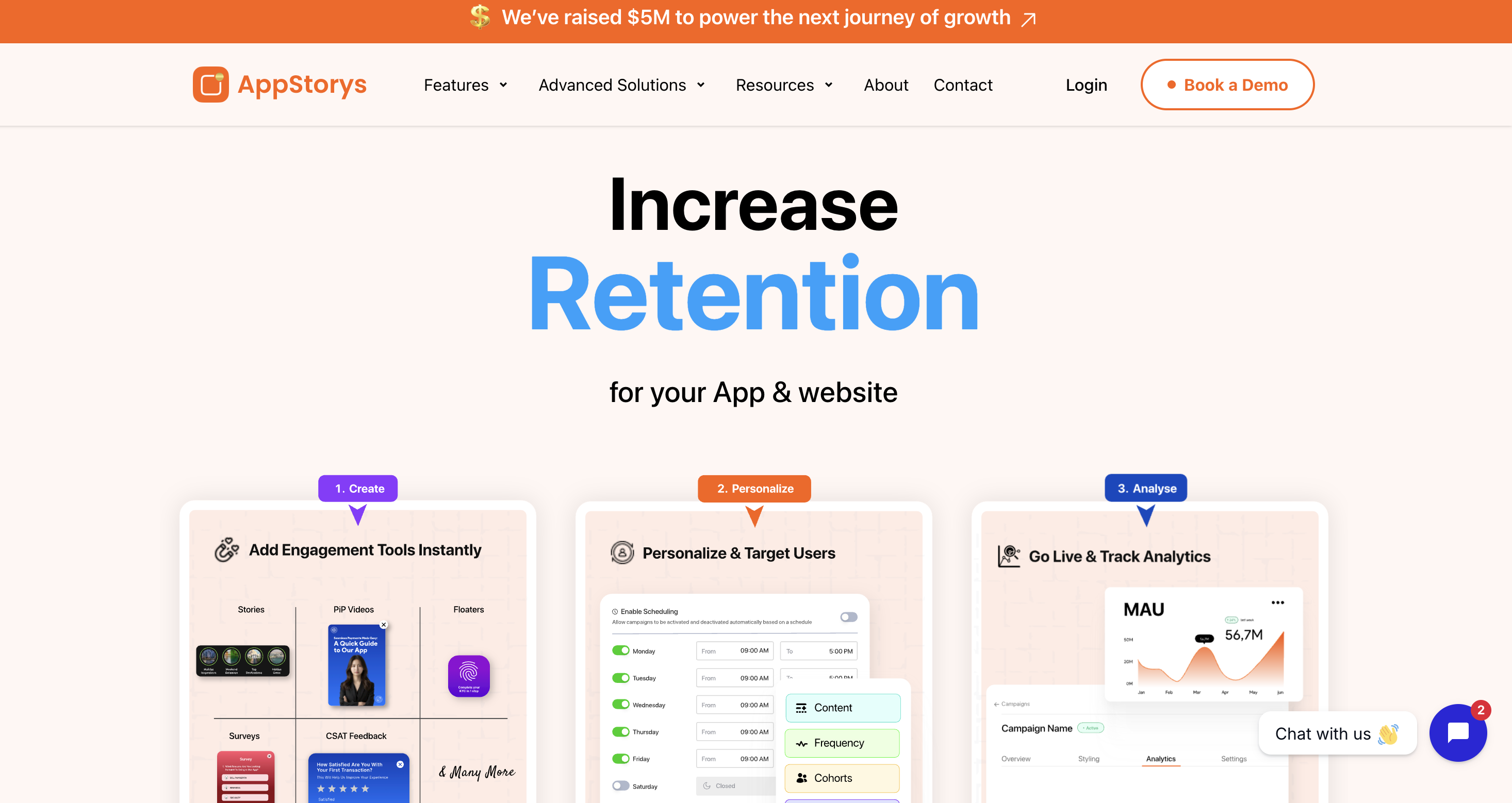
| Feature / Capability | InAppStory | AppStorys |
|---|---|---|
| Format library | Stories, in-app messages, SMART banners, scratch cards, 12 mini-games | Stories, reels, PiP video, banners, floaters, widgets, coachmarks |
| Outbound channels | Not published as a core capability | Push, email, WhatsApp, SMS |
| Mini-game depth | 12 pre-built mechanics | Scratch cards, quizzes |
| Pricing | Published tiers, roughly $399–$999+/month | Custom quote, scoped to app size and features |
| Best fit | Full in-app communication and campaign control, published pricing | Full no-code engagement suite, India-first support |
Choose InAppStory if:
You want in-app stories, messages, and a deep mini-game library in one dashboard, with pricing you can budget against upfront.
Choose AppStorys if:
You want in-app formats plus outbound push, email, and WhatsApp in one no-code suite, quoted to your app's size.
Architecture, not just features
Where Digia and InAppStory actually diverge
Standalone dashboard vs. rendering layer
InAppStory
Runs as its own standalone managed communication layer, one dashboard covering stories, messages, banners, and mini-games.
Digia
Native rendering layer inside the CEP you already have, reusing the segments and events you manage there instead of a separate standalone dashboard.
Format library
InAppStory
Stories, in-app messages, SMART banners, scratch cards, and 12 pre-built mini-games.
Digia
Organizes similar territory into five product lines: nudges, widgets, surveys, gamification, and in-app video.
Dedicated mini-game library vs. broader mechanics set
InAppStory
Ships a 12-mechanic mini-game library plus scratch cards as a dedicated gamification module.
Digia
Ships scratch cards, spin-to-win, streak tracking, milestone badges, and quizzes as native components across a broader in-app suite.
Where AI sits in the product
InAppStory
AI is not published as a primary capability; the platform is positioned around manual content creation and campaign management.
Digia
AI runs across three specific jobs: natural-language audience segmentation, on-brand creative generation, and an automated pre-launch review of every campaign.
One of the few platforms here with published pricing
InAppStory
Publishes tiered, MAU-based pricing, roughly $399–$999+/month.
Digia
Quotes per account, based on user volume, connected channels, and impression count.
Customer base and reviews
InAppStory
Self-reports a 5.0/5 G2 rating across 61 reviews. Founded 2021, headquartered in Lisbon, serving mid-market and enterprise B2C brands.
Digia
Does not publish an equivalent public G2 review count as of this review.
Based on each company's published product and pricing pages, August 2026.
Detailed comparison
Digia vs InAppStory, side by side
Capabilities compared as of August 2026, based on each company's published documentation and pricing pages. Both products change over time, so if something below is out of date, we'd genuinely like to know.
| Dimension | InAppStory | Digia Engage |
|---|---|---|
| Format library | Stories, in-app messages, SMART banners, scratch cards, 12 mini-games | Nudges, widgets, surveys, gamification, in-app video, plus stories |
| Gamification | Scratch cards, plus 12 pre-built mini-game mechanics | Scratch cards, spin-to-win, streaks, milestones, quizzes |
| AI / personalization | Not a primary published capability | AI segmentation, creative generation, and pre-launch campaign review |
| Architecture | Standalone managed communication layer | Renders inside the CEP you already run (CleverTap, MoEngage, WebEngage) |
| Pricing | Published tiers, roughly $399–$999+/month, MAU-based | Custom quote based on user volume, connected channels, and impression count |
| G2 rating (self-reported) | 5.0 / 5 across 61 reviews | Not independently listed on G2 as of this review |
| Compliance | Not published on the homepage as of this review | GDPR, SOC 2, ISO 27001 |
Which one fits
Choose based on your architecture, not just your feature list
Choose Digia if:
You already run CleverTap, MoEngage, or WebEngage and want the in-app layer to render inside that setup, reusing your existing segments and events. You also want gamification, surveys, and nudges alongside stories, plus AI handling audience segmentation, creative generation, and pre-launch campaign review as part of the platform.
Choose InAppStory if:
Stories, a wide in-app messaging library, and a deep mini-game library from one dashboard are the core need, and you want transparent, published pricing you can budget against without a sales call.
Already on InAppStory and evaluating a switch?
Because Digia is built to render inside your existing CEP rather than stand alone, teams typically keep their CleverTap, MoEngage, or WebEngage setup for outbound channels and evaluate Digia specifically against InAppStory's content layer. That's a scoped, side-by-side evaluation rather than a full platform migration, and it's the fastest way to see which architecture actually fits your product.
FAQ
Common questions
Is Digia a replacement for InAppStory, or does it work alongside it?
Digia and InAppStory compete for the same job: the in-app content and engagement layer. Digia is not built to run on top of InAppStory, the way it's built to run on top of CleverTap, MoEngage, or WebEngage. Teams evaluating a switch are typically replacing InAppStory's stories and messaging layer with Digia's, while keeping whatever CDP or CEP they already run for outbound channels.
What is the main architectural difference between Digia and InAppStory?
InAppStory operates as a standalone managed communication layer, one dashboard covering stories, messages, banners, and mini-games. Digia is built specifically to render inside the CEP integration you already run, reusing the segments and events you manage in CleverTap, MoEngage, or WebEngage instead of adding a second standalone dashboard.
Source [1]: InAppStory homepage
Which platform is cheaper, Digia or InAppStory?
InAppStory is one of the few platforms in this comparison that publishes pricing directly: tiered, MAU-based plans running roughly $399 to $999+/month. Digia does not publish list pricing and quotes per account instead, so a direct comparison depends on your specific usage, users, and features.
Source [1]: InAppStory homepage
Does InAppStory offer gamification like scratch cards or mini-games?
Yes. InAppStory publishes scratch cards plus a library of 12 pre-built mini-game mechanics as native formats. Digia publishes a different set: scratch cards, spin-to-win, streak tracking, milestone badges, and quizzes, alongside a broader nudge, widget, and survey library.
Source [1]: InAppStory homepage
How was this comparison put together?
This comparison was compiled from InAppStory's own published pages, including its own published InAppStory vs Storyly feature table, Storyly's own published pages, AppStorys' own published pricing and feature pages, and StorifyMe's own published homepage and pricing pages. This is not a hands-on SDK integration test of any of the four platforms, and it is not billed as one. Digia's other comparison pages, including the MoEngage comparison, are based on direct SDK testing, and that distinction is disclosed on each page.
What are the best InAppStory alternatives for in-app engagement specifically?
Teams comparing InAppStory typically also look at Storyly, StorifyMe, AppStorys, Plotline, and Braze, though several of those are broader omnichannel platforms or narrower stories-only tools rather than a direct match. Digia is close to InAppStory in scope: a dedicated in-app engagement layer rather than a full outbound suite, so it's best compared on in-app format depth and architecture rather than on channel breadth.
Sources cited on this page
- InAppStory homepage (current "one platform for in-app communication and gamification" positioning, format list, pricing philosophy): inappstory.com , accessed August 2026.
- InAppStory, G2 seller profile (self-reported 5.0 / 5 rating aggregate across 61 reviews, founding year, HQ location): g2.com/sellers/inappstory , accessed August 2026.
- InAppStory, "Storyly Alternative: When to Choose a Broader In-App Platform" (InAppStory's own published InAppStory vs Storyly feature-by-feature table): inappstory.com/compare/storyly-alternative , accessed August 2026.
- Storyly homepage (AI-powered content experience positioning, widget library, personalization): storyly.io , accessed August 2026.
- StorifyMe homepage ("the engagement layer for apps and websites" positioning, product list, customer metrics): storifyme.com , accessed August 2026.
- StorifyMe pricing page (published Growth and Enterprise tiers, usage-based (MAU/MPV) pricing): storifyme.com/pricing , accessed August 2026.
- AppStorys homepage (no-code in-app engagement suite, format list, CDP integration): appstorys.com , accessed August 2026.
- AppStorys, "AppStorys vs Plotline: Feature, Pricing & ROI Comparison" (AppStorys' own published pricing philosophy and India-first positioning): appstorys.com/blog-AppStorys-vs-Plotline-Comparison , accessed August 2026.
- Digia Engage homepage (Digia's own published product specs, AI features, and pricing philosophy): digia.tech , accessed August 2026.
This comparison does not include a hands-on SDK integration test of InAppStory, Storyly, StorifyMe, or AppStorys. See How this comparison was put together above for scope and limitations.
See also: Digia vs Storyly · Digia vs Plotline · Digia vs Appcues · Digia vs MoEngage
Ready to see native in-app formats with an AI layer built in?
Book a demo and we'll walk through gamification, widgets, surveys, and how Digia connects to CleverTap, MoEngage, or WebEngage without a new standalone dashboard.