


TL;DR:
- Streaks, scratch cards and quests look similar in a vendor demo, but they need different machinery. A scratch card is a one-shot moment. A streak or a quest is state that has to be tracked across days and sessions.
- Most no-code gamification tools were built around one-shot games. Before you buy, check who stores streak and quest progress, and who decides the prize, your server or theirs.
- The upside is real. More than 10 million Duolingo users hold a 365-day streak, and when one bank switched off its in-app rewards, on-time loan repayments fell 31%.
- Pick by job. No-code experience layers (Plotline, Nudge, Digia Engage) render the game. Developer APIs (Trophy, StriveCloud) track state. Reward engines (Flyy) pay out. CEP templates (CleverTap, MoEngage) are the cheapest place to test.
Editorial disclosure: Digia Engage is one of the tools reviewed here. It integrates with CleverTap, MoEngage and WebEngage. In November 2026 we reviewed each vendor's public documentation and pricing pages. Where a vendor does not publicly state a capability, we say so rather than assume it.
Why the mechanic decides the tool
In-app gamification tools let growth teams add game mechanics, such as streaks, scratch cards, quests and leaderboards, to a live app, then change them without an app release.
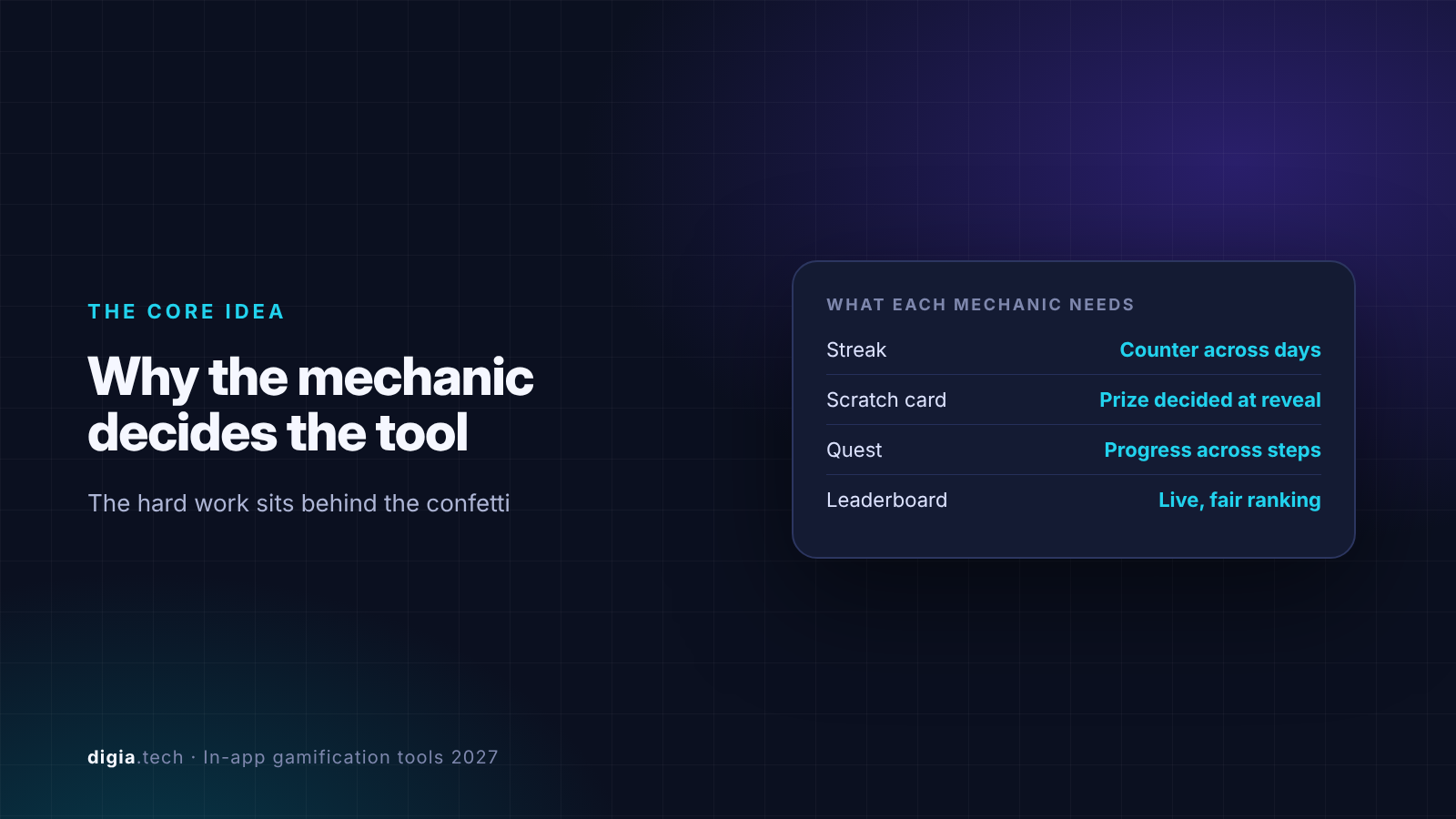
Every gamification demo shows the same thing: a confetti animation on a phone. The work that decides whether the feature survives in production sits behind the animation.
| Mechanic | What it needs underneath | Hard part |
|---|---|---|
| Streak | A counter per user that survives across days and time zones | Defining a "day", freezes and repairs |
| Scratch card | A prize decision at the moment of reveal | Server-side prize decision and fraud caps |
| Quest or challenge | Progress across several steps, often within a time window | Tracking partial progress across sessions and devices |
| Leaderboard | A ranking that updates as users act | Fairness and cheating |
A scratch card can be built on any tool that renders UI and fires an event. A streak or a quest needs somebody to store state per user. If the tool does not, your backend team does, and the "no-code" label stops being true.
Streaks: state over days
A streak counts consecutive periods in which a user did the core action, and it works because losing it feels worse than never having it.
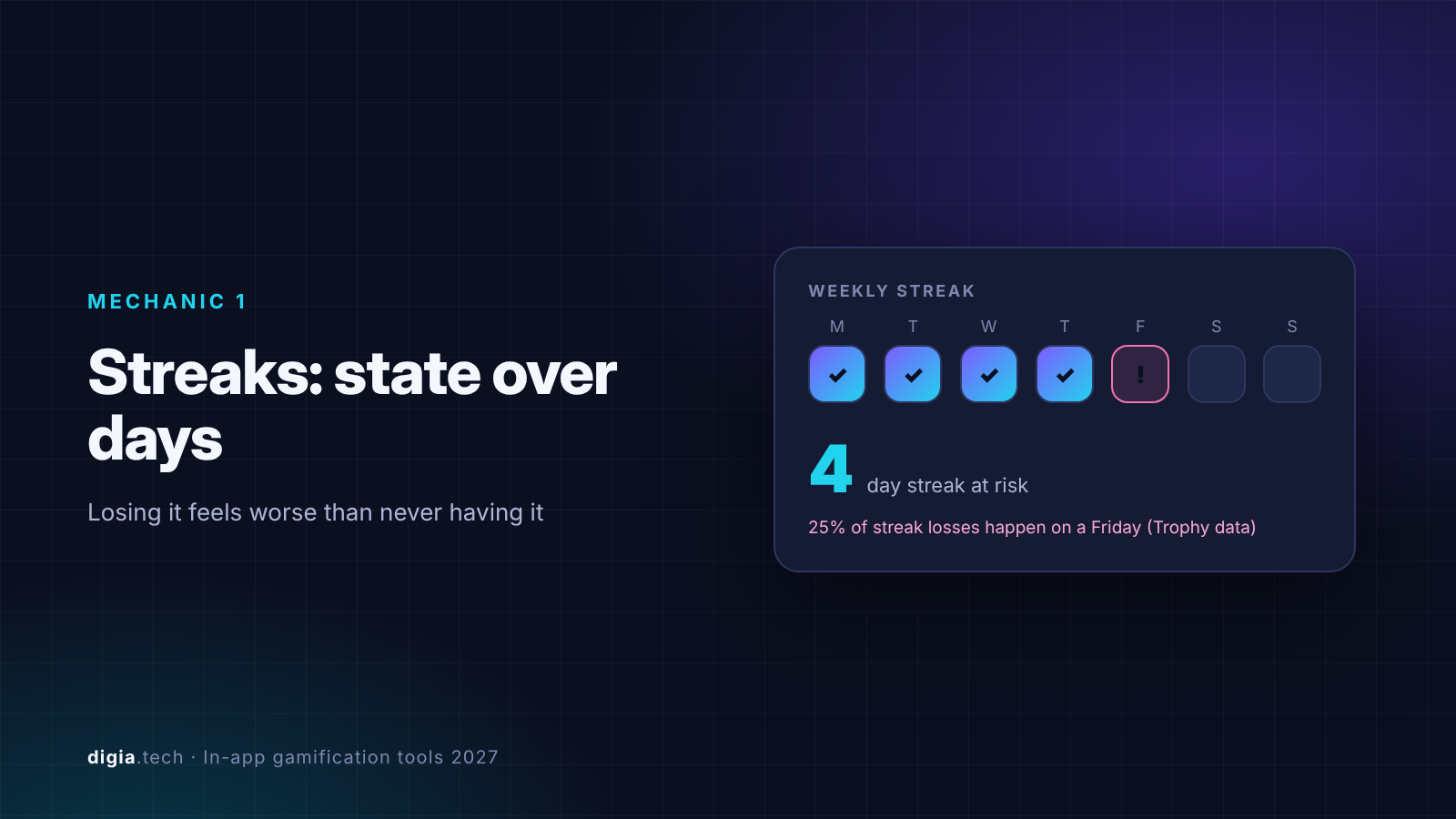
The evidence that streaks drive habit is strong at the top end. More than 10 million Duolingo users hold a 365-day streak, according to figures shared at Pocket Gamer Connects London in January 2026. Duolingo's Q2 2026 shareholder letter reported its next-day retention metric for current users at a record 84%.
Streak data also shows where they break. Trophy, a gamification API, reports from the 24 million streaks it powers that 25% of all streak losses happen on a Friday, followed by Saturday at 19% and Wednesday at 18%. That is a vendor's own dataset, and it still gives a growth team a concrete test: put streak-protection prompts on Friday.
What to check in a streak tool
- The definition of a day. Calendar day in the user's time zone, or a rolling 24 hours. Users travelling or working night shifts break naive streaks.
- Freezes and repairs. Can a user protect or restore a streak, and can you limit how often?
- Cadence. Daily suits learning and fitness. Weekly suits savings and investing, where daily use is unnatural.
- Where the counter lives. On the vendor's server, on yours, or on the device. A device-only counter resets when the user changes phones.
Pick the cadence that matches healthy behaviour. A daily streak in a trading app rewards overtrading. The UK FCA found that points and prize draws in trading apps raised trading by 12% and the share of risky trades by 6%.
Scratch cards: one-shot rewards
A scratch card reveals a prize after a completed action, and its whole value depends on the prize being decided somewhere the user cannot tamper with.
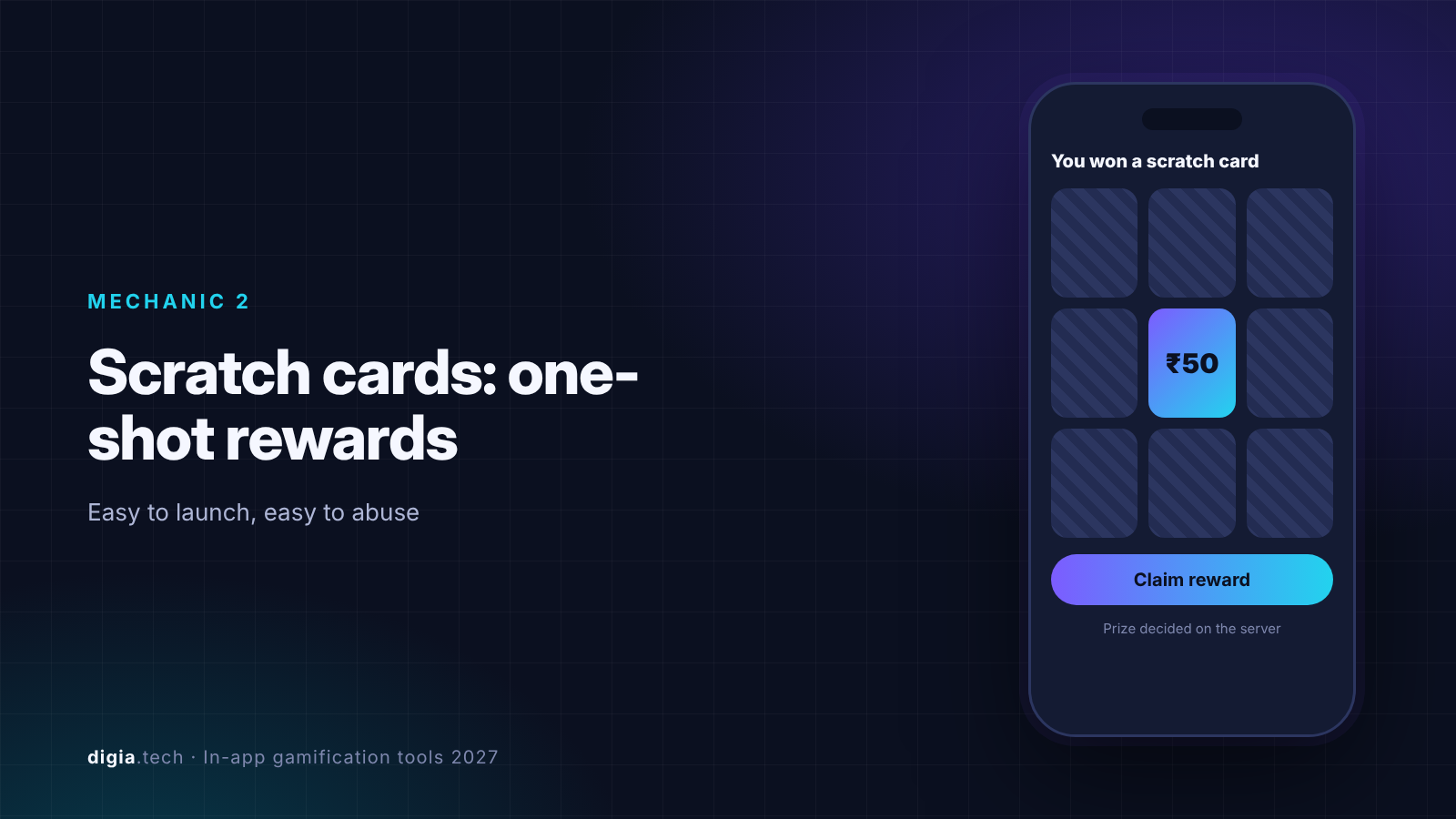
Scratch cards are the easiest mechanic to launch, which is why every tool in this comparison offers one. They are also the easiest to abuse. If the client decides the prize, a modified app can claim the best one every time.
The research on rewards in financial apps shows how much they move behaviour. When a Latin American bank switched off its reward module of prize wheels, raffles, scratch cards and in-app currency, logins fell 20% and on-time loan repayments fell 31%.
What to check in a scratch card tool
- Server-side outcome. The prize is decided on a server and the card only displays it.
- Caps. Per user, per day, per campaign and per payout channel, with an alert before the budget runs out.
- Repeat prevention. Some CEP templates need a manual segment exclusion to stop the same user scratching twice.
- Fulfilment. Coupon code, points, voucher or cash, and who actually delivers it.
For design and timing data, see Digia's piece on scratch cards in mobile apps and the psychology behind Paytm's scratch card.
Quests: progress across steps
A quest, also called a challenge or mission, asks a user to complete several actions, often within a time window, for a reward at the end.
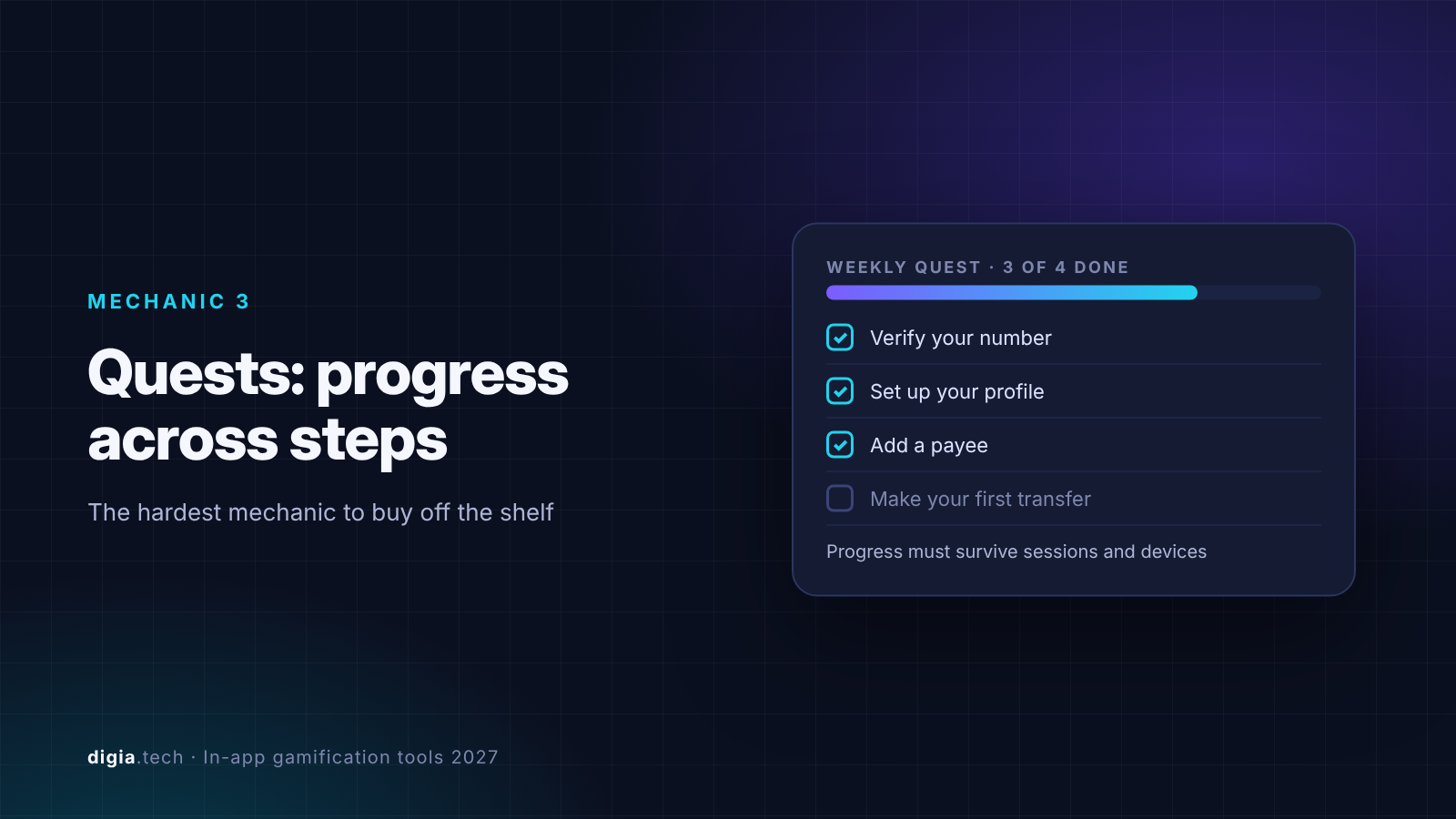
Quests suit activation and cross-sell: "verify your number, set up your profile, add a payee and make your first transfer this week". They are also the hardest mechanic to buy off the shelf, because the tool has to remember that a user finished step two on Monday and step three on Thursday, possibly on a different device.
What to check in a quest tool
- Partial progress. Is progress stored per user on a server, and shown when the user returns?
- Step logic. Ordered or unordered steps, and whether a step can depend on event properties such as amount.
- Time windows. Fixed dates, or a rolling window from when each user starts.
- Analytics. Drop-off by step, so you know which step to simplify.
How we evaluated the tools
In November 2026 we scored each tool on five criteria:
- Mechanic coverage. Streaks, scratch cards, quests or challenges, and leaderboards.
- State. Whether the tool stores streak and quest progress per user, or leaves it to you.
- Reward logic. Server-side prize decisions, caps, fulfilment and fraud screening.
- Rendering. Native UI, HTML templates, or no UI at all (you build it).
- Pricing access. Whether gamification is in the base plan, an add-on, or enterprise-only.
Comparison table
"Not stated" means we found nothing in the vendor's public pages or docs as of November 2026.
| Tool | Type | Streaks | Scratch cards | Quests or challenges | Stores progress | Rendering | Gamification pricing |
|---|---|---|---|---|---|---|---|
| Plotline | No-code experience layer | Yes, with milestones | Yes | Not stated | Not stated | Native | Enterprise tier only |
| Nudge | No-code experience layer | Yes | Yes | Yes, challenges | Not stated | Native SDKs incl. Flutter | Not published |
| Digia Engage | No-code experience layer on your CEP | Yes, with milestone rewards | Yes | Milestone rewards | Not stated, rewards decided by your backend | Native, no WebView | Included in every plan, from $499/month |
| Flyy | Reward engine with game UI | Yes | Yes | Not stated | Server-side events and eligibility | Not stated | Not published |
| Trophy | Developer API | Daily to monthly | No | Multi-step achievements | Yes | No UI, you build it | Free to 100 MAU, from $99/month |
| StriveCloud | Developer API and engine | Yes | Raffles | Yes, quests | Yes | Mostly API | Not published |
| CleverTap | CEP templates plus Promos | Not stated | Yes, HTML template in private beta | Not stated | Promos points ledger | HTML | Promos is an add-on |
| MoEngage | CEP templates | Not stated | Yes, HTML template | Not stated | No, redemptions not tracked | HTML | Included for existing customers |
The 8 tools reviewed
1. Plotline: the widest format library
Best for funded consumer apps that want many game formats and can afford enterprise pricing.
Plotline offers scratch cards, spin wheels, quizzes, streaks, slot machines, treasure chests and mystery boxes, triggered by events or user actions. It ran a live showcase in 2026 for its newly launched streak and milestone features. Rendering is native across iOS, Android, React Native and Flutter, and campaign controls include probability weights and per-user limits.
Where it falls short. Gamification sits on the Enterprise tier with custom pricing, so Plotline's published Starter and Growth prices do not include it. Server-side prize validation and quest-style multi-step challenges are not described publicly. Payouts are limited to coupon codes and winner export.
2. Nudge: challenges and streaks with a points system
Best for consumer apps that want challenges, streaks, points and quizzes in one no-code module.
Nudge describes its gamification module as covering a points system, challenges, streaks, quizzes, a game zone and gamified referrals, with scratch cards and coupons as rewards. The Nudge team confirmed a Flutter SDK in its 2.0 launch thread, and says one SDK integration covers every feature.
Where it falls short. Nudge publishes little detail on how streak and challenge state is stored, how prizes are validated, or what caps exist. Pricing is not public. Ask for the data model and fraud controls in writing.
3. Digia Engage: native gamification on the CEP you already run
Best for teams on CleverTap, MoEngage or WebEngage that want native game UI without an enterprise contract.
Digia Engage renders scratch cards, spin wheels, quizzes, streaks and milestone rewards as native components and takes triggers and audiences from the CEP you already run. Gamification is included in every plan, from $499 a month. Campaign controls include probability weights and per-user limits.
Where it falls short. Digia Engage does not publicly document reward payouts or server-side prize validation. Its scratch card fires an event when scratched, and your backend decides and delivers the reward. Teams that need cash payouts or a full points ledger should pair it with a reward engine. Digia's own comparison, Digia vs Flyy, covers how the two fit together.
4. Flyy: the reward engine with built-in games
Best for payments and lending apps that need cash or voucher rewards with budget control.
Flyy's feature list covers scratch cards, spin wheels, leaderboards, streaks, raffles, quizzes and referral programmes. Its event model is server-side: your backend sends events to Flyy through an API, and Flyy checks eligibility. It is the only vendor here that publicly documents cash payouts to UPI or bank accounts, through a RazorpayX payout gateway, and its webhooks include events for campaign budget and daily and total reward limits.
Where it falls short. Flyy does not publish pricing or its rendering approach. It is strongest in India, and teams elsewhere should check payout rails for their market.
5. Trophy: streak and achievement infrastructure for developers
Best for product teams with engineers who want streaks and achievements tracked correctly, and will build their own UI.
Trophy is an API platform for achievements, streaks, points and leaderboards. It supports one-off and multi-step achievements and streaks from daily to monthly, with a no-code dashboard for configuring the logic and type-safe SDKs for tracking events. It also sends gamified email and push notifications. Trophy launched version 1.0 in January 2026 and says it now powers more than 24 million streaks.
Where it falls short. Trophy renders nothing in your app. Your engineers build every streak counter and badge screen, so changing how a streak looks still needs a release. It has no scratch cards or prize logic. Pricing is free up to 100 monthly active users, with Starter from $99 a month for 1,000 users, which rises with scale.
6. StriveCloud: quests and tiers as an engine
Best for larger B2C apps that want a managed engine for quests and tiers.
StriveCloud describes its product as one API that wires streaks, quests, tiers and rewards to an app's existing events, with webhooks and role-based access control. Its onboarding process starts with picking one loop, such as streaks, challenges, leaderboards or raffles, and going live to a first cohort within the first two weeks.
Where it falls short. It is API-first, so UI work sits with your team or its services. Pricing is not public, and it positions itself as enterprise-grade.
7. CleverTap: game templates and a points ledger
Best for existing CleverTap customers who want to test a game format without adding a vendor.
CleverTap offers Spin the Wheel and Scratch the Card templates in its in-app editor. They are custom HTML templates in private beta, enabled through an account manager. Its Promos product adds loyalty points, cashback, coupons, per-user and per-coupon redemption limits and campaign budgets.
Where it falls short. The game templates are HTML and still in beta, and we found no public streak or quest mechanic. Custom rewards go through a webhook to your own wallet service, so fulfilment stays with your team. Promos is an add-on.
8. MoEngage: the cheapest place to test a scratch card
Best for existing MoEngage customers testing whether a game format moves a metric.
MoEngage offers no-code gamification templates for Spin the Wheel, with up to 10 sectors, and Scratch Card. They work with the existing SDK, so there is no new integration.
Where it falls short. The templates are HTML-based. Repeat prevention for scratch cards is not built in, so teams set a user attribute and exclude that segment, and MoEngage does not track redemptions. We found no streak or quest mechanic.
Which tool fits which team
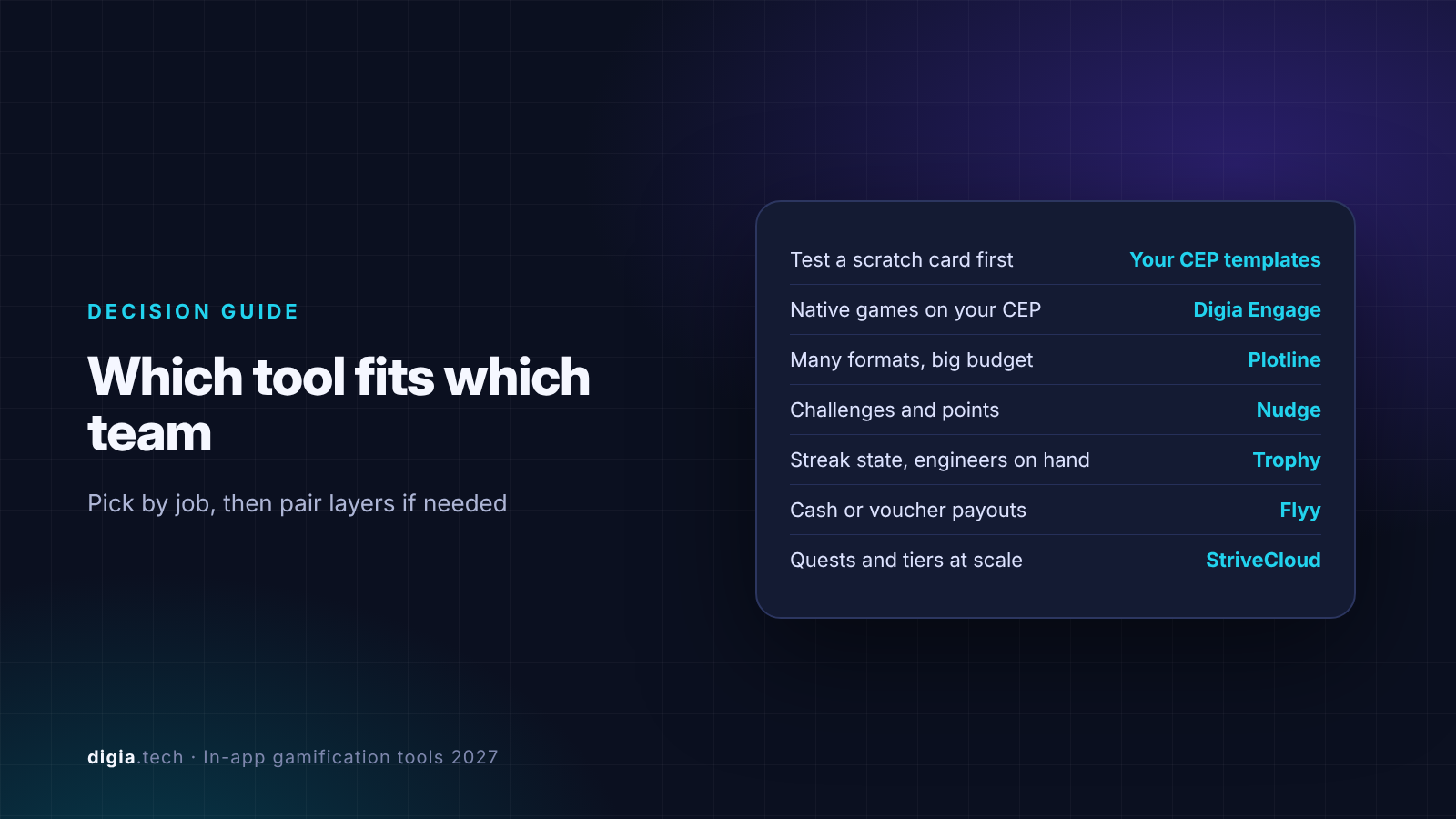
| Your situation | Strongest fit | Why |
|---|---|---|
| Testing whether a scratch card moves a metric at all | Your CEP's templates | No new integration, results in a week |
| Native streaks and scratch cards on an existing CEP, mid-market budget | Digia Engage | Gamification in every plan, uses CEP triggers |
| Many formats, enterprise budget | Plotline | Widest library, native rendering |
| Challenges, streaks, points and quizzes in one module | Nudge | Points system plus challenges and streaks |
| Correct streak and achievement state, engineers on hand | Trophy | API built for streak logic, free to start |
| Cash or voucher payouts with budget limits | Flyy | Server-side eligibility and documented payouts |
| Managed quest and tier engine at scale | StriveCloud | Quests and tiers behind one API |
A common setup pairs two layers: an experience layer that renders the game and a state or reward layer that remembers progress and decides prizes. For fintech-specific rules on rewards in India, see Digia's guide to gamification tools for Indian fintech apps. For measuring whether any of this worked, the in-app engagement metrics scorecard covers holdouts and retention benchmarks.
Buyer checklist
Ask every vendor these questions and get the answers in writing:
- Which mechanics do you support natively: streaks, scratch cards, quests, leaderboards?
- Where is streak and quest progress stored, and does it survive a phone change?
- How do you define a "day" for streaks, and can users freeze or repair a streak?
- Is the scratch card prize decided on a server, or can the client influence it?
- Which caps can we set per user, per day and per campaign?
- Who delivers the reward: coupon, points, voucher or cash?
- Does the game render natively, in HTML, or do we build the UI?
- Is gamification in the plan we are pricing, or an enterprise add-on?
Key Takeaways
- Scratch cards are one-shot moments. Streaks and quests are state that must be stored per user across days, so check who stores it before you buy.
- Most no-code tools render games well and say little about state or prize validation. Developer APIs such as Trophy track state well and render nothing.
- Rewards change behaviour in both directions. Switching rewards off cut on-time loan repayments by 31% at one bank, and gamified trading apps raised risky trades, so reward the habit that helps the user.
- Pricing access varies widely. Gamification is enterprise-only on some tools, an add-on on others, and included in every plan on Digia Engage.
Further Reading
From Digia
- Gamification in Mobile Apps: Streaks, Rewards and Retention
- Scratch Cards in Mobile Apps: Design, Timing, and Conversion Data
- Digia vs Flyy: Which Layer of Fintech Gamification Are You Actually Buying?
- The Best Fintech Gamification Tool Is Usually Two Tools (2026)
External
- More than 10 million Duolingo users have a 365-day streak
- Game over: how customers respond when mobile banking app rewards go dark
External Sources: All Claims Attributed
Linked sources:
- More than 10 million Duolingo users have a 365-day streak, PocketGamer.biz, 16 February 2026
- Game over: mobile banking app rewards study, UC Davis, 25 October 2024
- FCA keeps trading apps under review over gaming concerns, FCA, 20 June 2024
- Digia Engage gamification and Pricing, Digia, accessed November 2026
Vendor and company materials (available on each publisher's own site):
- Duolingo, Q2 2026 shareholder letter
- Trophy, Trophy 1.0 launch page and comments on Product Hunt, 2026, and pricing as listed on G2
- StriveCloud, Gamification API product page, accessed November 2026
- Plotline, Gamification product page, pricing page and 2026 gamification showcase event page
- Nudge, Gamification and Rewards feature page and Nudge 2.0 launch thread
- Flyy, features, rewards and webhook documentation
- CleverTap, in-app editor documentation and Promos product page
- MoEngage, no-code gamification templates documentation
Sources: vendor documentation, product pages, pricing pages, company disclosures and published research, as listed above, as of November 2026.
Want native streaks, scratch cards and milestone rewards on the CleverTap, MoEngage or WebEngage setup you already run? See how Digia Engage gamification works, or book a demo.