


TL;DR:
- The share card is the real product. Spotify, Duolingo and Swiggy all design backwards from the card people post.
- Spotify counts listening from 1 January to mid-November. Wrapped launched on 4 December 2024 and 3 December 2025.
- Wrapped 2024 swapped fan-favourite stats for an AI podcast and drew a backlash. The 2025 edition brought Top Genres back and ended with 300M+ engaged users and 630M+ social shares.
- Duolingo found its top 10% of learners drove more than half of all shares, so it added "learner styles" to give everyone something to post.
- Swiggy's "How India Swiggy'd" is mostly a national PR report. Its 2025 in-app quiz, with city and India fallbacks for new users, is the part worth copying.
- Strava put its 2025 recap behind a paywall and was criticised for limiting reach. Keep the personal recap free.
- To ship this December, the story renderer must already be in your app. Copy, card order and targeting should all be remote.
What is a year-in-review in-app campaign?
Every December, a product team somewhere gets the same request from leadership: "Can we do a Wrapped?" The request usually arrives as a dashboard spec. Total orders, total spend, favourite category, done.
That spec misses why Wrapped works. We reviewed every public source on the three flagship campaigns on 26 November 2026, and the pattern that repeats is that users are not consuming a report. They are collecting an object to post.
Three things are often called a year-in-review and are not the same product.
The personal in-app recap
A sequence of full-screen cards inside the app, built from one user's data, ending on something shareable. Spotify Wrapped, Duolingo Year in Review, YouTube Music Recap and Apple Music Replay all sit here.
The brand-level trends report
A press story about the whole user base. "India ordered X biryanis." Swiggy's "How India Swiggy'd" is mostly this. It drives earned media and social chatter, but nobody sees their own data in it.
The stats dashboard
A settings-style screen with totals. Accurate, useful, and almost never shared. If your plan stops here, you have built an analytics page, which is fine, but it will not produce the December distribution spike people associate with Wrapped.
The rest of this breakdown is about the first type, with the second used as context where a brand runs both.
Spotify Wrapped, Apple Music Replay, YouTube Music Recap and more, compared
All facts below are from linked sources in the brand sections. "Not confirmed" means we found no primary source as of 26 November 2026.
| Campaign | Type | 2024 / 2025 launch | 2026 status (26 Nov 2026) | In-app entry | Format | Share mechanic | Main caveat |
|---|---|---|---|---|---|---|---|
| Spotify Wrapped | Personal in-app story | 4 Dec 2024, 3 Dec 2025 | "Get ready" post only (5 Nov 2026), no launch date | Wrapped feed at top of Home, or search | Tap-through story plus hub. 2025 added speed control, quiz, Wrapped Party | Share cards to social and Spotify Messages, TikTok integration (2024) | 2024 AI backlash. Data cutoff mid-November |
| Duolingo Year in Review | Personal in-app story | 2 Dec 2024, ~3 Dec 2025 | Not confirmed live. Landing page asks users to update | In-app (2022: profile page) | Story ending on a share card | Share card, widget art (2024) or gems (2025) as a share reward | Desktop lessons reportedly missing in 2025. Recap disappeared early for some |
| Swiggy "How India Swiggy'd" report | Brand-level trends report | ~24 Dec 2024 (9th ed.), ~23 Dec 2025 (10th ed., secondary) | Not announced | Press and Swiggy Diaries | Article and PR | Social pickup of national stats | Not a personal recap |
| Swiggy 2025 in-app quiz | Personal, optional in-app quiz | Circulating by ~20 Dec 2025 | Not announced | In-app, non-blocking | 3 levels, 5 questions each, trophies | Shareable score and trophy | Metrics come from a designer's case study, not Swiggy |
| Zomato Lookback | Personal in-app plus national wrap | Late Dec 2024 into New Year | 2025 and 2026 editions not confirmed | In-app Lookback | Story recap with Roast or Sweet mode, Personality Cards | Shareable cards | Some roast lines left users "taken aback" |
| YouTube Music Recap | Personal in-app | 24 Nov 2025 | Not confirmed | Profile avatar, then Your Recap | Story, section carousel, AI "Ask about your year" | Shareable graphics, including AI answers | Count window skips December |
| Apple Music Replay | Personal in-app and web | 2 Dec 2025 | Year-end 2026 film not out | App and replay.music.apple.com | Native recap and highlight reel | Highlight reel to social | Monthly Replay is a different product |
| Strava Year in Sport | Personal recap plus separate trend report | 2025 personal recap subscribers-only | Not announced | Mobile app | Animated graphics | Shareable video and graphics | 2025 paywall backlash |
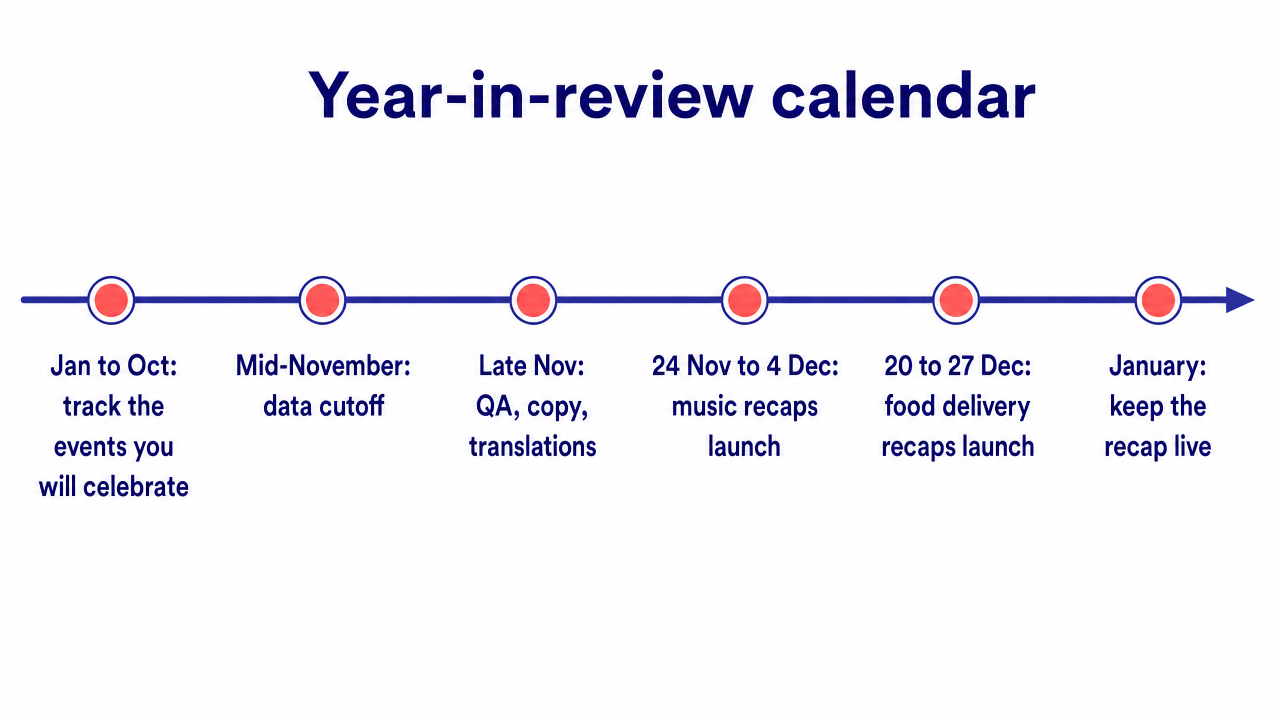
Two patterns jump out. Music recaps cluster between late November and the first week of December. Indian food-delivery recaps land in the last week of December, closer to New Year. Neither timing is wrong, but they imply very different data cutoffs and build calendars, which we cover in the playbook below.
Spotify Wrapped: a ritual users will defend
Spotify started the format in 2015 as "Year in Music," renamed it Wrapped in 2016 and built it directly into the app in 2019, according to its own 10-year Wrapped retrospective. The 2015 edition reached "more than 5 million unique users." By 2023, Spotify said Wrapped "engaged a record 227 million monthly active users."
The most recent official number is larger. In its Q4 2025 earnings release (10 February 2026), Spotify gave its biggest number yet. At the end of the campaign, 2025 Wrapped "had more than 300 million engaged users and more than 630 million shares on social media globally in 56 languages." We could not find a comparable official figure for 2024.
Where it lives in the product
Spotify tells users to update the app before every edition, including in the 2024 and 2025 user-experience posts and the 5 November 2026 "Get Ready" post. The entry point in 2025 was a Wrapped feed at the top of Home, with search as a backup. That feed doubles as a hub for revisiting stories, "Best of" playlists and artist clips.
The 2024 edition also seeded Wrapped data into the everyday share sheet. Sharing a track could reveal whether it was in your top 100 songs. That is a small idea with a big effect, because it extends the campaign into normal behaviour after the story ends.
Eligibility is explicit. In 2025 a user needed at least 30 songs streamed for more than 30 seconds each, from at least five different artists. Below that, no Wrapped. That threshold is a product decision worth copying: a thin recap is worse than no recap.
The methodology is part of the product
Spotify published a methodology post on 5 December 2025 that every team planning a recap should read. The key rules:
- A song listen counts after more than 30 seconds.
- Top Artists use a weighted count, with the primary artist weighted above featured artists.
- An album listen requires streaming the majority of its tracks.
- The counting window runs from 1 January "until mid November" so the team has time "to check the data and get everything ready for launch day."
Offline listening is included. Private Mode sessions and tracks excluded from the Taste Profile are left out of taste-based stories. Spotify also admits that shared devices and smart speakers can mix household listening into one profile.
Why publish this at all? Because users compare. On launch day in 2024, one of the most-shared complaints came from @shivlestat. They asked why "my last fm stats and spotify wrapped stats" were so different, and repeated a rumour of an "early october cutoff." The real cutoff is mid-November. An unexplained window erodes trust even when the data is correct.
2024: the teaching case
TechCrunch reported on 4 December 2024 that users were calling the year's Wrapped "boring" or a "flop." The 2024 feature list had leaned into generative AI, including a Wrapped AI Podcast built with Google NotebookLM and "Your Music Evolution," which grouped listening into up to three musical phases.
What users noticed was what had gone. TechCrunch flagged a viral post from @shivlestat on 4 December 2024. It read: "spotify wrapped flopped this year so bad like where are the music cities, the playlists, the top genres or the listening auras… all that wait for WHAT." As fetched on 26 November 2026, that post showed more than 145,000 likes and about 5.8 million impressions.
A second widely shared post, from @_johnsonator, named the design problem precisely: "Less unconventional data viz moments like in previous years (like the city matches, zodiac signs, etc). It was all very obvious." The same post blamed layoffs. That is a user theory, not a confirmed cause.
Spotify declined to explain its feature choices to TechCrunch.
2025: the course-correction
The 2025 Wrapped reads like a response to every 2024 complaint. Top Genres came back, described by Spotify as "this fan favorite is back." Top Albums appeared for the first time. Stream counts were shown for the top 100 songs. New share objects included Listening Age, Top Song Quiz, Clubs (one of six listening-style communities) and a live comparison mode called Wrapped Party.
AI did not disappear. It moved to a narrower slot, "Listening Archive," available in English in select markets. Spotify also added controls to change the speed of the story and jump to a specific moment without restarting.
SoundGuys' 4 December 2025 review treated it as a course-correction while still calling some features gimmicky. The share object people actually posted shows up in posts like @TheAveryCristy's: "my LISTENING AGE IS 68."
What other teams should take from Spotify
Users treat a year-in-review as a ritual with expected stats. Removing a beloved story to make room for something technically impressive is remembered as a downgrade. Add new cards on top of the classics, and publish your counting rules before someone else guesses them for you.
Duolingo Year in Review: optimizing the share object
Duolingo's own engineering and design write-up, How we built a personalized Year-in-Review for millions of learners (8 December 2022), is the most useful public document on the format from any brand. It is worth reading in full.
From email to in-app
In 2019, the recap was a personalized end-of-year email with active days, time spent, words learned and lessons completed. In 2020 it moved into the app and invited users to share on social. Chief product officer Cem Kansu later said on LinkedIn that the in-app version "started in 2020," which matches the blog.
The insight that shaped every edition after 2020
The blog is unusually candid about what drove sharing. "One of the things we saw in initial versions of Year-in-Review was that learners loved sharing comparison stats, aka their XP percentile ranking. In 2021, we highlighted that stat in the share card, which increased overall share rates (especially for our top learners!)."
Then the catch. In the 2020 data, learners in the top 10% of XP earners "contributed to more than half of the total shares." A percentile card is great if you are in the top decile and a reason to stay quiet if you are not.
Duolingo's fix was a second share object, "learner styles," habit-based personalities designed "to make the experience more enjoyable for everyone, regardless of performance." The blog says this "significantly boosted share rates." Spotify's Clubs and Listening Age follow the same logic.
The 2022 edition ran in 25 UI languages, and the blog calls it the localization team's largest annual project. It also reports, without numbers, a lift in lessons completed and time spent after users go through Year in Review, and a "significant spike in new users in 2021" after launch. Treat those as directional, not as a benchmark.
2024 and 2025 in the product
Luis von Ahn announced the 2024 edition on LinkedIn on 2 December 2024. The next day, Cem Kansu posted screenshots of four years of recaps and listed the stable core: minutes, new words and rank among learners. Extras have rotated, including longest streak, learner style and, in 2024, Math and Music stats. Kansu described the goal as making it "shareable, informative, celebratory, and fun," adding that "maybe if people see their friend's accomplishments, they'll head back to Duolingo in the new year."
NationalWorld's 3 December 2024 coverage noted the gag ending about whether you had learned enough to stay "safe" from Duo, and that sharing earned new widget art. Users found they could share to themselves to get it privately.
In 2025, Android Authority reported on 3 December 2025 that the recap was rolling out quietly and users might need to update the app. The author received 100 gems for sharing the card.
Timing as a distribution choice
Duolingo launched on 2 December 2024 and around 3 December 2025. Wrapped landed on 4 December 2024 and 3 December 2025. Going just ahead of the biggest recap of the year means your card is in feeds before the Wrapped wave, and gets carried along by it.
Where Duolingo users pushed back
Reddit thread titles (we could not retrieve comment bodies) show two failure modes worth designing against: desktop lessons missing from the 2025 recap and the 2025 recap disappearing quickly. A December 2024 post on X also questioned a streak mismatch between the recap and the live app. Unify your data sources across mobile, web and desktop, and keep the recap findable well after launch day.
What other teams should take from Duolingo
Design the share card before you design the story. Decide which stat makes a power user brag, then give everyone else a non-competitive object so the top decile does not carry all of your distribution.
Swiggy: one name, two very different products
"How India Swiggy'd" is often cited as India's answer to Wrapped. That is only half right, and the half that matters to a product manager is the less famous one.
A note on sourcing: Swiggy's official 2024 and 2025 press-release pages returned server errors when we tried them on 26 November 2026. Claims below come from Swiggy's own blog, reputable press republications, or a Swiggy designer's public case study, and we say which.
The brand-level report
The flagship "How India Swiggy'd" is a national trends story about biryani counts, city quirks and delivery distances. Swiggy Diaries called the 2023 edition the eighth consecutive year and published it on 14 December 2023, using data from 1 January to 23 November 2023. Mediabrief covered the 2024 edition on 24 December 2024 as the ninth, with a window of 1 January to 22 November 2024. ReviewStreet's republication of the 2025 report on 23 December 2025 called it the tenth edition. A separate Instamart edition for 2024 used data through 1 December 2024 across 54 cities.
None of these is a personal recap. The 2023 Swiggy Diaries post did say, "Of course, you will see your personalised 'How India Swiggy'd' recap on the Swiggy app," so a personal version existed alongside the report that year. For 2024, a user post saying "my Swiggy wrapped hurt me" suggests one existed, but we found no official description of its format.
The 2025 in-app quiz: the part worth copying
The most useful public record of Swiggy's 2025 personal experience is a case study by Aroop Dutta, who lists himself as a Lead Designer at Swiggy. It is a personal portfolio page, not a Swiggy announcement, so treat its numbers as the designer's claims.
Dutta describes a platform-wide experience spanning Food, Instamart and Dineout, built as an interactive quiz instead of a static summary. There are three levels, each with five dynamically chosen questions, one point per correct answer, and Bronze, Silver or Gold trophy states.
The architecture that makes it reusable is the fallback logic:
| User type | Quiz path |
|---|---|
| Active user with order data | Personal quiz, then City or point-of-interest quiz, then India quiz |
| User in a point-of-interest location | Personal, then point-of-interest, then City |
| New or inactive user | City quiz, then India quiz |
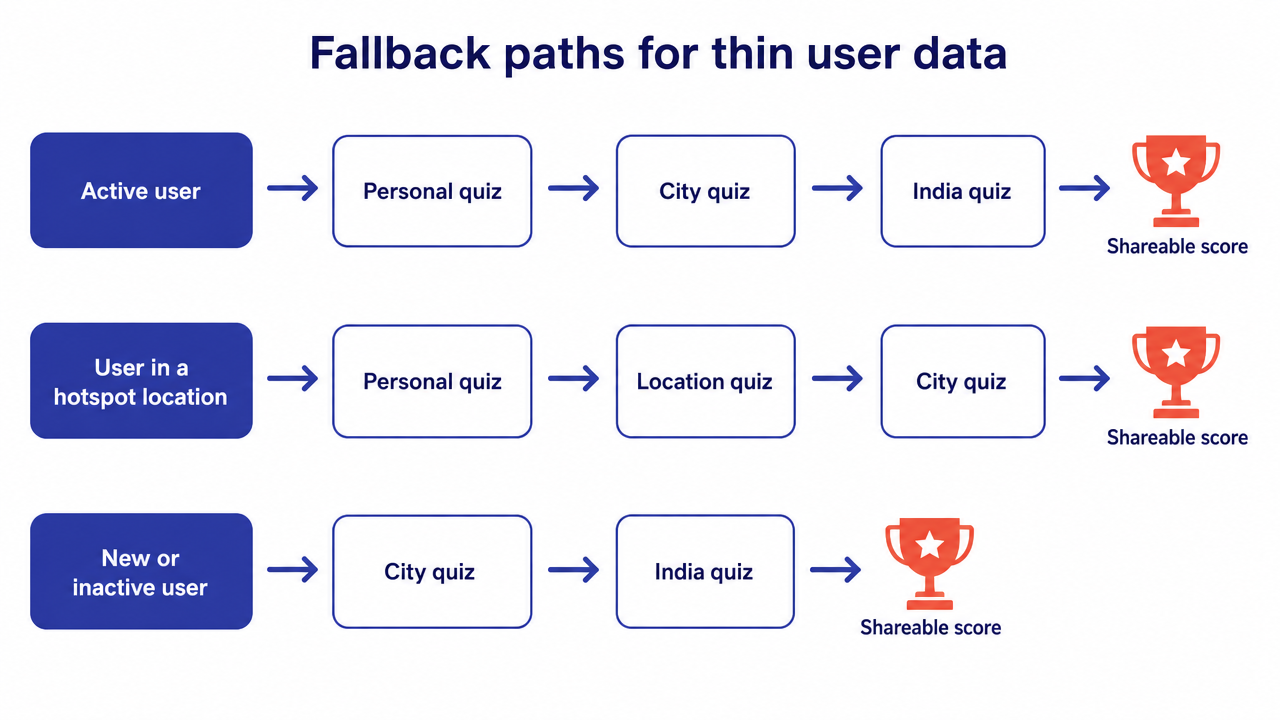
A brand-new user still gets a playable experience. Nobody hits an empty "you did nothing this year" screen. The stated design constraint was to stay "lightweight, optional, and non-blocking."
After each answer, the user sees whether they were right, a Bollywood-meme visual with Lottie motion, and then a trivia screen with a platform-level insight. Scores and trophies were designed as shareable artifacts.
The case study reports these figures, which we reproduce as published there and have not verified with Swiggy:
| Metric (per Dutta's case study) | Point-of-interest locations | Overall |
|---|---|---|
| Users engaged | 49.4K | 880K |
| Quizzes played | 156K | 2.64 million |
| Repeat plays per user | 3.15 | 3.01 |
| Completed a quiz | 95% | 92% |
| Completed all 3 levels | 78% | 61% |
| Unique users who shared | 18.4% | 20.2% |
Reddit threads about the quiz and an iPhone contest attached to it were circulating around 20 December 2025, for example on r/swiggy. The national report followed around 23 December.
What other teams should take from Swiggy
If your users have uneven data, a story built only from personal stats leaves your newest users with nothing. A quiz that blends personal, local and national facts gives every segment a complete, shareable run. That matters more in commerce and fintech than in music, where nearly every active user has a year of listening.
Zomato Lookback, YouTube Music Recap, Apple Music Replay and Strava Year in Sport
Zomato Lookback: tone as a toggle
CNBC-TV18 reported on 27 December 2024 that Zomato's Lookback 2024 came with Personality Cards and two tones: Roast Mode and Sweet Mode. afaqs covered the roast copy on 3 January 2025 and noted some lines left users "taken aback." Some users loved it. One post simply read "zomato lookback>>> spotify wrapped". We could not confirm a 2025 Lookback.
YouTube Music Recap: early and opt-in AI
9to5Google reported that the 2025 Recap began rolling out on 24 November 2025, with a counting window that skips December. The new feature was "Ask about your year," an AI chat where each answer becomes a shareable graphic. The AI is something the user chooses to talk to, not a show that replaces the stats.
Apple Music Replay: the highlight reel
The Verge covered Replay 2025 on 2 December 2025, native in the app and on the web, with new Discovery, Loyalty and Comebacks stats and a shareable highlight reel. Apple also runs monthly recaps all year, which is a different product from the December film.
Strava Year in Sport: the paywall lesson
Ars Technica reported on 19 December 2025 that, for the first time since 2016, Strava's personal Year in Sport was subscribers-only at $80 a year. Ars quoted Sana Ajani saying year-in-review content is "great content and distribution… so I'm surprised that Strava is limiting its reach." Users were blunter. Pranav Anand wrote: "It is the one thing I was looking forward to all year after a pretty active year but all I see is a damn subscription popup."
The free share object is your distribution. Gating it turns your most-posted card into an upsell screen.
How to build a Spotify Wrapped-style recap for your app in 2027
This playbook is for two readers: a team hoping to get something live before 31 December 2026, and a team planning a full 2027 edition. The steps are the same. The scope is not.
Step 1: Instrument all year, not in November
Spotify says its data scientists "spend the entire year experimenting with methodologies" (methodology post). TechCrunch reported Spotify had already started the next Wrapped by December 2024. If the events you want to celebrate (completions, minutes, orders, streaks) are not tracked cleanly across every platform, no December sprint will fix it. Duolingo's 2025 desktop gap is the cautionary example.
Step 2: Cut the data in mid-November, and say so on screen
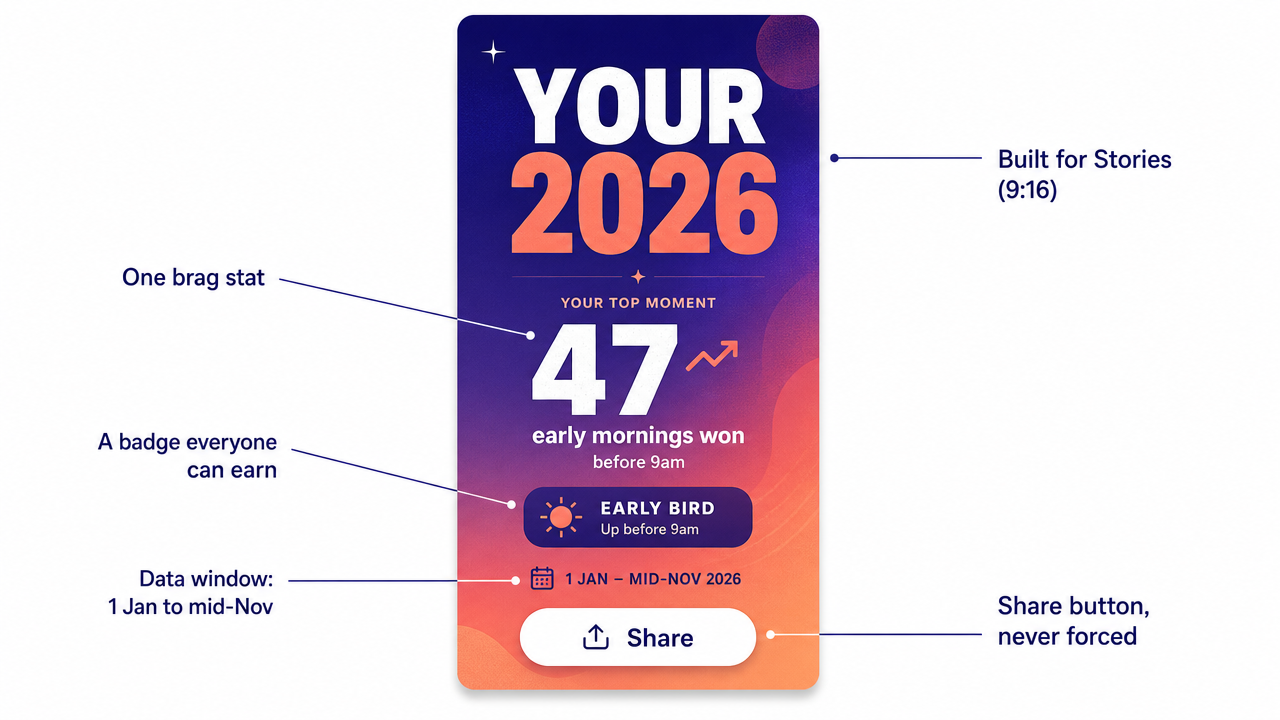
Spotify counts 1 January to mid-November. Swiggy's public reports used 23 November (2023) and 22 November (2024). That gap exists for data checks, QA and localization. Put the window on the first or last card ("Your year, 1 January to 15 November") so nobody needs to guess.
Step 3: Pick your launch window on purpose
Music recaps cluster from 24 November to 4 December. Duolingo goes a day or two before Wrapped. Indian food delivery lands around 20 to 27 December. Early December rides the Wrapped wave. Late December owns New Year and the holiday break but competes with fewer peers. Either works if your cutoff and QA calendar match it.
Step 4: Design the share card first
Make the final card a vertical 9:16 image built for Stories, Reels and TikTok, with a square fallback for chat. (Vertical is industry practice. None of the brands' official pages we read specified dimensions.) Put the single most bragworthy stat on it, as Duolingo did with the XP percentile in 2021. Then add one non-competitive card for everyone else: a style, a club, an age, a trophy.
Step 5: Keep the story short, or make it skippable
Digia's own in-app storytelling breakdown argues that three to five segments work best for product engagement, with completion falling after seven or eight. Wrapped runs longer, but Spotify added speed control and jump-to-moment in 2025. If you go long, let people scrub.
Step 6: Plan for thin and empty profiles
Choose one of two published models. Spotify excludes users below a threshold (30 songs, five artists). Swiggy's 2025 quiz falls back to city and national questions. For commerce, fintech and edtech, where many users had only a few sessions, the Swiggy model is usually the better fit.
Step 7: Ship content remotely, not the renderer
Spotify, Duolingo and YouTube Music all ask users to update their app before the recap appears. That tells you the story renderer, fonts or native hooks ship in a binary ahead of time, while the data and copy arrive remotely.
That split is the whole game for a December deadline. Say the native story component, entry banner and share hook are already in your app. Then copy, card order, targeting, fallback paths and entry points can all change from a dashboard mid-campaign. If they are not, you need a store release first, and Apple and Google still set limits on what remote UI may change. Digia's posts on changing in-app UI without an app release (2027) and what Apple and Google let you change without an update cover where that line sits.
If you already run Digia Engage, four pieces map to a recap: In-App Stories for the tap-through recap, Widgets or Nudges for the Home entry point, and Personalization for segment and attribute targeting, which includes a "Personalized Milestones" use case. Your data pipeline and your methodology still belong to your team, and the SDK has to be in the binary before any of this works. Digia does not remove that first release.
"Every November a growth team asks me whether it is too late to do a Wrapped. My answer depends on one thing: is a story renderer already sitting in your live app? If it is, you can still ship a lean recap this December. Five cards, one share card, a fallback for people with thin data. If it isn't, don't push a rushed native build through review in December. Use this year to lay the pipes, and make 2027 the year you do it properly."
Anupam Singh, CEO, Digia
Step 8: Test the card before the story
Test in rough order of impact. Start with which stat sits on the final share card. Then try celebratory versus roast tone, the entry point (Home banner, bottom sheet or profile), story length and any share reward. Hold out a group if you want to measure return visits in January. Duolingo reported a lift in lessons after its recap, but did not publish a number, and you should not assume one.
Step 9: Give users control before launch day
Spotify's November 2026 "Get Ready" post is almost entirely about controls: excluding tracks from the Taste Profile and, new this year, toggling off "kids and family music." Tell users ahead of time how to keep private sessions, children's activity and shared devices out of their recap.
Step 10: Keep it up and make it findable
A recap that disappears in mid-December wastes the second wave of sharing, when people who saw a friend's card come looking for their own. Leave a persistent entry, such as Spotify's Wrapped feed or YouTube Music's profile route, live into January.
Ship checklist
- Events instrumented on every platform (mobile, web, desktop, offline)
- Data cutoff chosen and printed on a card
- Eligibility threshold or fallback path for thin profiles
- Final 9:16 share card with one brag stat
- One non-competitive share object for everyone else
- Skip, scrub or speed controls if the story runs past five cards
- Renderer and share hook already in the live binary
- Entry point that stays live into January
- Privacy controls announced before launch
- Roast copy opt-in only, with sensitive categories excluded
- Personal recap free, even if members get extra depth
What changes in 2027
These trends are already visible in the 2024 to 2026 record. We are not predicting numbers.
AI is an optional layer, not the headline
Spotify's 2024 NotebookLM podcast and vague Music Evolution labels drew the backlash. In 2025 Spotify kept AI in a narrower slot, and YouTube Music made its AI an opt-in chat. For 2027, plan AI as something users can choose on top of hard, inspectable stats.
"My rule is simple. AI can narrate, but it can't replace the number. If a user can't point at a stat and say 'that's mine, and I can check it,' they won't trust the card and they won't share it. Put the hard stats first and let AI be the optional layer on top."
Anupam Singh, CEO, Digia
Controls move into the product
Spotify's 2026 pre-launch messaging is about exclusions and kids' music. Recaps that surprise people with a partner's or child's activity will age badly. Expect controls to sit inside the recap flow, not in a help article.
The calendar keeps moving earlier
YouTube Music launched on 24 November 2025. Wrapped still cuts data mid-November and launches in early December. A plan that starts in December is a late plan.
Interaction joins the film
Spotify added a Top Song Quiz, Clubs and Wrapped Party in 2025. Swiggy built its whole 2025 recap as a quiz. Linear stories still work, as Duolingo shows, but interactive layers give users more reasons to come back during the campaign.
Free stays free
Strava's 2025 paywall is now the public reference case for limiting a recap's reach. Teams that want social distribution will keep the personal card free and reserve extra depth for paying users.
Platform rules still apply
A remotely updated recap should render in components that already shipped and should not download new native code. Digia's 2027 Apple and Google rules post covers the boundary.
System assistants become another surface
Digia has written about OS assistants and on-device agents reaching into app content. It is reasonable to expect recap data to become something users ask an assistant about. There is no public usage data on that yet, so we have not put a number on it.
Where the Wrapped pattern has limits
Low-frequency products have less to celebrate
Music and language apps generate daily data. An insurance or travel app might see a user four times a year. A forced recap ("You opened the app 4 times!") reads as a reminder of disengagement. A city or community-level fallback, like Swiggy's, may be the whole product for those users.
Roast copy can backfire on a personal card
Zomato offered Sweet Mode for a reason. A joke about late-night orders lands differently on a brand-level PR report than on a card with someone's name on it, posted to their followers. Keep sensitive categories off personal share cards entirely.
Accurate data still looks wrong without a stated window
Spotify's numbers were correct in 2024, and people still compared them with last.fm and assumed an October cutoff. Methodology has to be visible.
Copying Wrapped's features is not copying its ritual
Spotify has run this for over a decade and users anticipate it. A first-year recap will not get Wrapped-scale sharing, and it is a mistake to model the business case on Spotify's 630 million shares.
"Roast copy works for a meme page. It is risky on a card with someone's name on it. In India especially, food, money and late-night habits are personal. I'd default to celebration, make roast opt-in, and keep spending, health and anything a family member could misread off the shareable card entirely."
Anupam Singh, CEO, Digia
Key Takeaways
- The share card is the product. Design it first, with one brag stat and one non-competitive object for everyone else.
- Cut data around mid-November and print the window on screen. Spotify, Swiggy and others all leave about two to five weeks between cutoff and launch.
- Never remove a fan-favourite stat to make room for something new. Spotify's 2024 to 2025 reversal on Top Genres is the public evidence.
- Duolingo's 2020 data showed the top 10% of learners drove more than half of shares. Learner styles fixed that skew.
- Swiggy's "How India Swiggy'd" is mostly a brand PR report. Its 2025 quiz, with fallbacks for new users, is the reusable design.
- Keep the personal recap free. Strava's 2025 paywall is the counterexample.
- For a December deadline, the native renderer must already be in your app. Everything else (copy, order, targeting, entry points) should be remotely editable.
Further Reading
From Digia
- In-App Storytelling: How to Use Stories Format to Drive Engagement
- Change In-App UI Without an App Release (2027)
- What Apple and Google Let You Change Without an App Update (2027)
- Launch an In-App Campaign in Under 24 Hours: Checklist
- A/B Test In-App Campaigns Without Engineering
- Duolingo's Habit-Forming In-App Reminders
- Swiggy's Bottom Sheets for Repeat Orders
- Spotify Upgrade Nudge Timing
- Products: Personalization, In-App Stories, Widgets, Nudges, Gamification
External
- Duolingo: How we built a personalized Year-in-Review for millions of learners
- Spotify: How Wrapped data is calculated
- Aroop Dutta: How India Swiggy'd 2025 case study
External Sources: All Claims Attributed
Spotify
- Spotify Newsroom: 10 years of Spotify Wrapped (4 December 2024)
- Spotify Newsroom: 2024 Wrapped user experience (4 December 2024)
- Spotify Newsroom: 2025 Wrapped user experience (3 December 2025)
- Spotify Newsroom: Wrapped methodology explained (5 December 2025)
- Spotify Newsroom: Q4 2025 earnings (10 February 2026)
- Spotify Newsroom: Get ready for your Spotify Wrapped (5 November 2026)
- TechCrunch: Spotify users are disappointed by an underwhelming Wrapped (4 December 2024)
- SoundGuys: Spotify Wrapped 2025 review (4 December 2025)
- X posts: @shivlestat (4 Dec 2024), @shivlestat follow-up, @_johnsonator (4 Dec 2024), @TheAveryCristy (4 Dec 2025)
Duolingo
- Duolingo Blog: How we built a personalized Year-in-Review (8 December 2022)
- Luis von Ahn on LinkedIn (2 December 2024)
- Cem Kansu on LinkedIn (3 December 2024)
- NationalWorld: Duolingo launches 2024 yearly review (3 December 2024)
- Android Authority: Duolingo Year in Review 2025 (3 December 2025)
- Duolingo Year in Review landing page (checked 26 November 2026)
- Reddit: desktop lessons missing (2025), recap already gone (2025). X: @vvrrww streak mismatch (4 Dec 2024)
Swiggy
- Swiggy Diaries: How India Swiggy'd 2023 (14 December 2023)
- Mediabrief: How India Swiggy'd its way through 2024 (24 December 2024)
- Moneycontrol: Swiggy year-end trends 2024
- Investment Guru India: How India Swiggy'd 2024, Instamart edition (26 December 2024)
- ReviewStreet: How India Swiggy'd 2025 (23 December 2025, secondary republication)
- Aroop Dutta: How India Swiggy'd 2025 case study (designer portfolio)
- r/swiggy: quiz and iPhone contest thread (December 2025). X: @rdow_02 (5 Jan 2025)
Others
- CNBC-TV18: Zomato and Blinkit year-end wraps (27 December 2024)
- afaqs: Zomato's New Year wrapped roasts consumers (3 January 2025)
- 9to5Google: YouTube Music 2025 Recap (24 November 2025)
- The Verge: Apple Music Replay 2025 (2 December 2025)
- Ars Technica: Strava puts Year in Sport behind an $80 paywall (19 December 2025)
- X: @sambatra033 (2 Jan 2025), @pranavanand46 (10 Dec 2025)
Planning a year-in-review for 2027 on the app you already run? See how Digia Engage In-App Stories works, or book a demo.