


TL;DR
- Fintech app engagement is the repeated completion of high-value money actions (a payment, a SIP, a repayment, a claim) with low friction and trust intact.
- Screen time and notification clicks are weak proxies, and in finance a rising session length often means a user is anxious or stuck.
- Finance apps kept only 12.5% of users on day one in H1 2025, so the work that moves retention sits in onboarding and failure recovery, long before any campaign.
- Measure each core action on four layers together (outcome, friction, trust, and messaging health), and ship only changes that improve completion without raising complaints, opt-outs, or disputes.
- From 1 January 2027, RBI's amended directions on how financial products are marketed and sold apply to banks and NBFCs, and the draft behind them targeted dark patterns directly, which makes trust-first engagement a compliance requirement in India as well as a growth strategy.
Editorial note: We rebuilt this guide in October 2026, merging four earlier Digia posts into one and re-checking every regulation and benchmark it cites against its source. Digia Engage is an in-app experience layer that integrates with customer engagement platforms such as CleverTap and MoEngage. Dezerv and Wink, cited below, are Digia customers.
What is fintech app engagement?
Fintech app engagement is the repeated, successful completion of high-value financial actions, with low friction and high trust. The action differs by product. In a payments app it is a completed transfer. In a wealth app it is a SIP that runs on schedule. In a lending app it is an on-time repayment. In an insurance app it is a claim settled without a chase. The definition holds across all of them because the user came for an outcome involving money, and engagement is how often they get that outcome without fear or friction.
This definition is deliberately narrow. Most engagement playbooks are written for social and gaming apps, where more sessions and more minutes usually mean more value. Finance does not work that way. Nobody wants to spend extra time inside a banking app. A user who opens the app four times in an hour after a failed payment is highly "engaged" on a dashboard and close to churning in reality.
What fintech engagement is not
Four common metrics look like engagement and frequently are not:
- Time in app. Long sessions in finance often signal anxiety or a stuck state, such as waiting on a pending transfer.
- Notification volume or click-through. Clicks without completed actions are noise, and in finance they can teach users to tap links in messages, which is exactly the habit scammers exploit.
- DAU/MAU as a standalone goal. A user who pays a credit card bill once a month on time is a healthy user even with a low DAU/MAU ratio.
- Habit loops built on pressure. Streaks and artificial urgency can raise activity while pushing users toward decisions they later regret. Regulators in India, the UK, and the EU now treat several of these as dark patterns.
What counts as a fintech app?
For this guide, a fintech app is any mobile product where the core action moves, stores, borrows, invests, or protects money. That covers UPI and wallet apps, neobanks and bank apps, lending and BNPL apps, stockbroking and mutual fund apps, insurance apps, and B2B payment apps for merchants. The framework below adapts to each, mainly by changing which action counts as "core" and how often it should repeat.
Why is fintech engagement different from other apps?
Four forces make finance the hardest category to engage well.
Trust is the product
A user hands a fintech app their identity documents and their money. Every screen either adds to or draws down that trust. US research for Plaid found that 87% of consumers were comfortable opening an account with a large bank versus 79% with a fintech, even though nearly nine in ten used at least one fintech app. That eight-point gap is the trust tax fintech apps start with.
Money creates anxiety, and anxiety looks like engagement
When money is in flight, users refresh. They reopen the app, refresh the status, call support, and sometimes post a complaint publicly. On a standard engagement dashboard this looks like a great week. In practice it is a reliability or communication failure, and the fix usually starts with clearer state messaging.
Fraud changes what "good engagement" means
India recorded over 24 lakh financial cyber-fraud complaints in 2025, with reported losses of ₹22,495 crore, according to figures the Home Ministry gave Parliament. Every engagement message that trains users to act fast on a link makes the scam version of that message more convincing. In fintech, a well-designed engagement program actively makes users harder to defraud.
Regulation limits experimentation
A retail app can test aggressive urgency copy on Friday and roll it back on Monday. A lender cannot. Rules on dark patterns, lending disclosures, consent, and investment advice constrain what copy and flows a fintech team can ship. The regulation section below covers the specifics.
Fintech engagement benchmarks for 2026
Public benchmarks for finance apps are thinner than most vendor blogs suggest. As of October 2026, no major attribution vendor publishes free day-7 or day-30 retention figures for finance apps, so any article quoting precise day-30 numbers without a source should be treated with suspicion. Here is what is verifiable.
| Metric | Figure | Source |
|---|---|---|
| Global finance app installs, YoY | +11% in Q3 2025, after +27% in 2024 | Adjust, Oct 2025 |
| Global finance app day-1 retention | 12.5% in H1 2025, down from 13.8% in 2023 | Adjust, Oct 2025 |
| Banking app day-1 retention | 20.6%, highest of any finance subvertical | Adjust, Oct 2025 |
| Average finance session length, India | 14.4 minutes, the longest globally | Adjust, Oct 2025 |
| Finance app day-1 uninstall rate | 27% higher than the average of other verticals | AppsFlyer, 2023 |
| Fintech installers who sign up in week one | 21% | CleverTap Fintech Benchmark, 2023 |
| Financial onboarding abandonment (Europe) | 68% of consumers abandoned at least one in 2022, up from 40% in 2016 | Signicat, 2022 |
| Conversion lift, broadcast to behaviour-based messaging (financial services) | 16.5x | MoEngage benchmarks |
Sources: Adjust finance report (Oct 2025), Adjust finance app insights, AppsFlyer uninstall report, CleverTap Fintech Benchmark, Signicat Battle to Onboard, MoEngage benchmarks.
Two of these numbers deserve a second look.
India's 14.4-minute session length is not automatically good news. It reflects how central finance apps have become to daily life in India, and it also includes time spent waiting, re-checking, and recovering from failures. Use it as context for your own data.
Day-30 retention is falling across APAC. AppsFlyer's 2026 APAC report found that organic Android finance installs in India grew 55% while day-30 retention declined across every finance vertical in the region. Acquisition is getting cheaper, which pushes the hard work downstream into keeping users.
The scale behind Indian fintech engagement
The volumes explain why small percentage gains matter. UPI processed 24,161.69 crore transactions worth ₹314.23 lakh crore in FY26, with 55.49 crore onboarded users as of June 2026, according to a written reply in the Lok Sabha. In August 2026, UPI hit an all-time monthly high of 24.51 billion transactions. On the investing side, AMFI data showed over 10 crore contributing SIP accounts and ₹32,297 crore in monthly SIP flows in August 2026, and India passed roughly 234 million demat accounts by July 2026. At that scale, a one-point gain in KYC completion or SIP continuation is worth more than most campaigns.
For Indian in-app format benchmarks by vertical and trigger type, see Digia's India In-App Engagement Benchmarks 2026.
The core actions and trust signals framework
Every useful fintech engagement program rests on two anchors.
Core actions are the smallest repeatable outcomes with a clear success state. "Opened the investments tab" is not a core action. "SIP instalment debited successfully" is. If you cannot define the success state precisely enough to log it from your backend, it is not a core action yet.
Trust signals are the indicators that tell you whether users feel safe completing those actions: failure and reversal rates, disputes, support contacts, opt-outs, and security events. They act as guardrails. An engagement change that raises core actions while degrading trust signals is borrowing against future retention.
Core actions by fintech category
| Category | Core action | First value moment | Healthy cadence |
|---|---|---|---|
| Payments and wallets | Successful payment or transfer | First payment that completes without a retry | Daily to weekly |
| Neobanks | Salary credit, card spend, bill pay | First funded transaction after KYC | Weekly to monthly |
| Lending and credit | On-time repayment, first drawdown | Funds received with terms clearly understood | Monthly, with episodic spikes |
| Investing and wealth | SIP instalment, top-up, rebalance | First order executed and visible in portfolio | Weekly to monthly |
| Insurance | Policy purchase, renewal, claim filed | Policy document issued and easy to find | Annual, with episodic claims |
The cadence column matters more than it looks. A lending app that pushes users to open it daily is optimizing against its own healthy cadence. Benchmark each core action against its own natural frequency.
Pick two core actions, not ten
A practical rule from teams that do this well: pick one or two core actions per product line, find the top three failure states for each, and fix those failure states before adding any new messaging. For most fintech apps that report an engagement problem, fixing broken moments returns more than adding messages.
The fintech engagement lifecycle, stage by stage
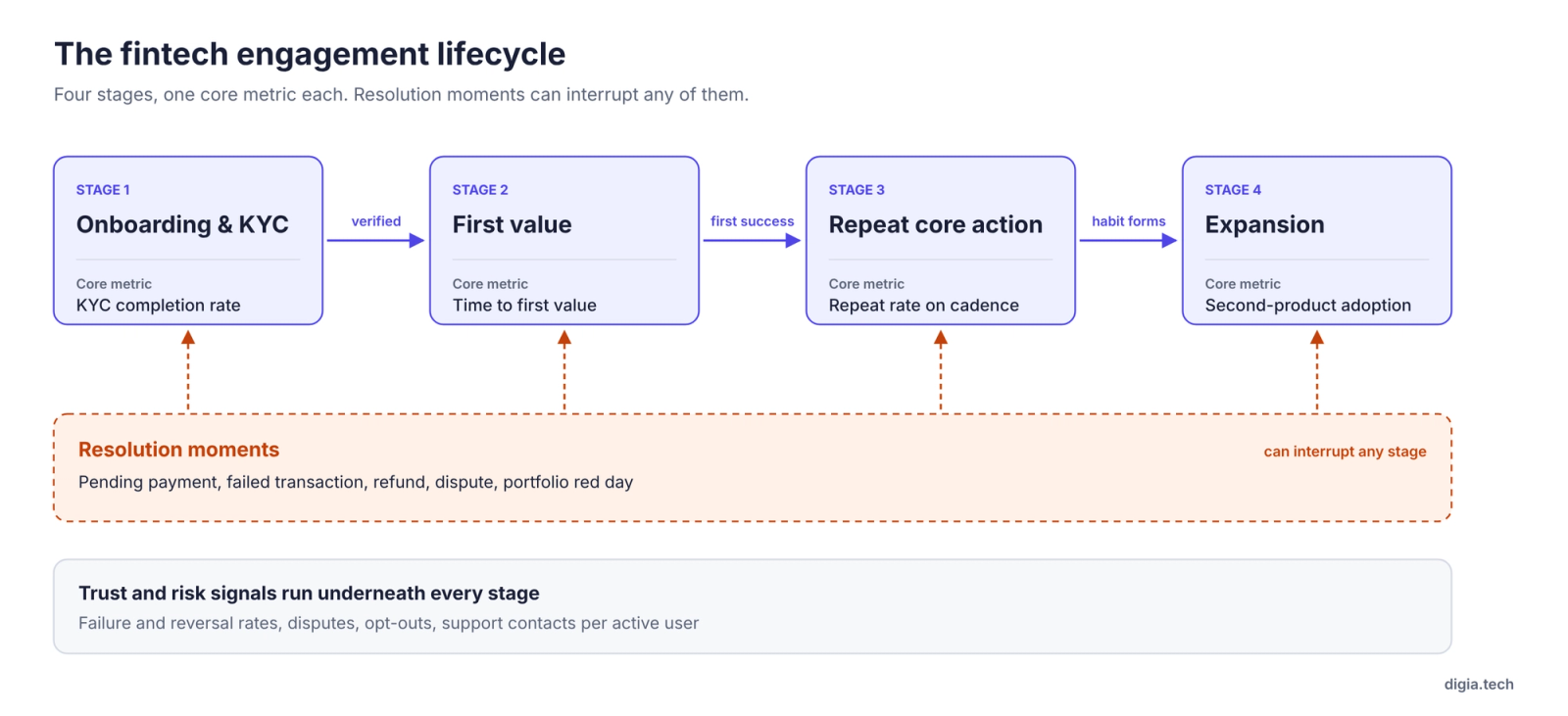
Fintech engagement runs across four stages, with trust and risk management running underneath all of them: onboarding and verification, first value, repeat core action, and expansion. A fifth set of moments, resolution, can interrupt any stage and often decides whether the user stays.
Stage 1: Onboarding and KYC
Onboarding is where fintech apps lose the most users, and the losses are expensive because acquisition has already been paid for. Signicat's long-running study found that 68% of European consumers abandoned a financial onboarding in 2022. In India, Digia's earlier analysis of activation patterns, drawing on Product Growth Intelligence data, puts drop-off before KYC completion for trading apps at around 35%.
What works:
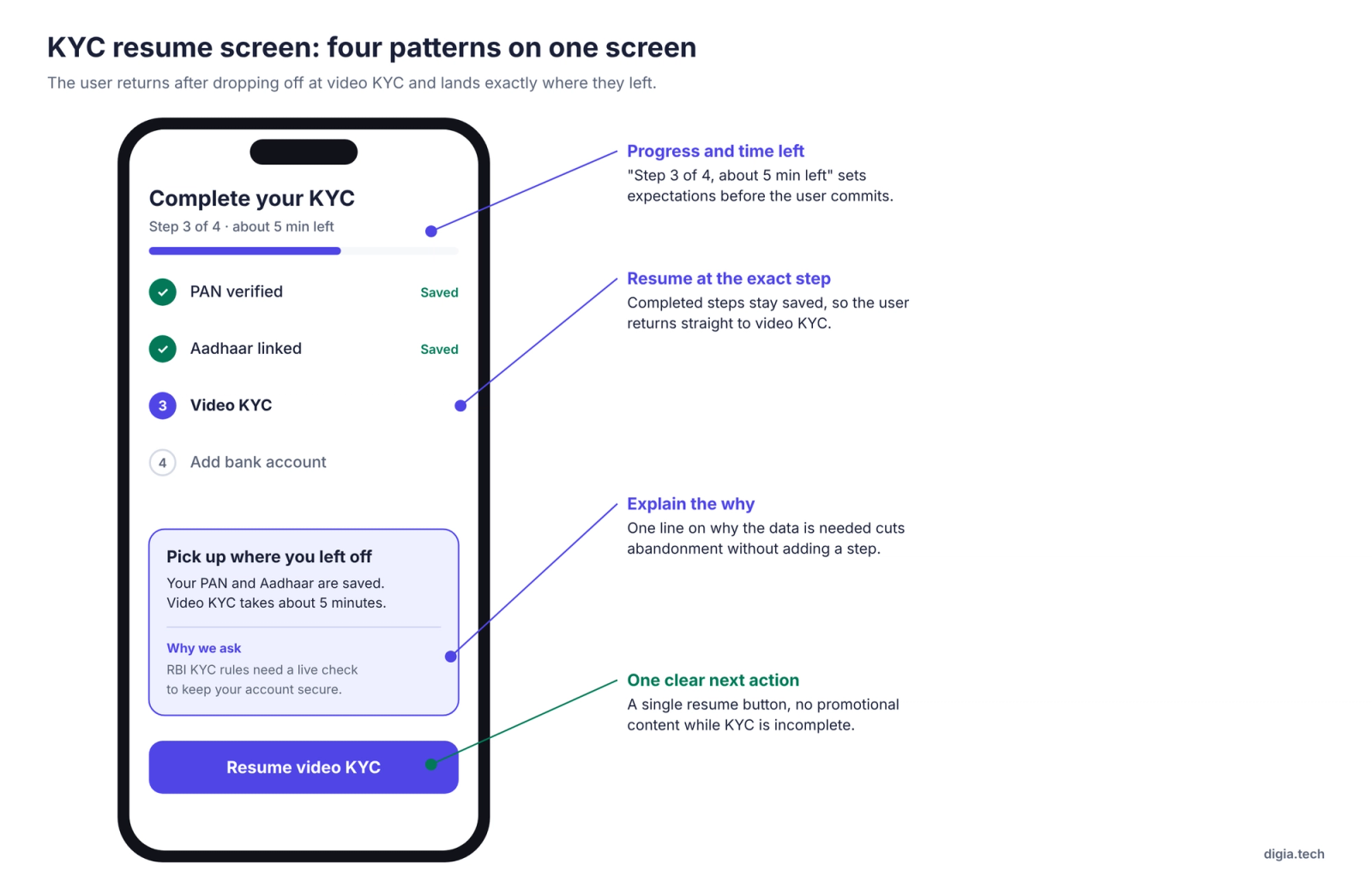
- Explain the why before every data request. Users abandon when they do not understand why an app needs a PAN, a selfie, a video call, or bank statement access. One line of context at the moment of the request ("We need this to comply with RBI KYC rules and keep your account secure") reduces abandonment without adding a step.
- Resume where the user left off. A user who drops at document upload should return to document upload, not to the start. Show progress and the time remaining.
- Use progressive disclosure. Nielsen Norman Group's guidance on progressive disclosure is to show the essentials first and reveal advanced options only when needed. Baymard's research on checkout makes the same point with numbers: the average US checkout shows 14.88 form fields against an ideal of 7 to 8.
- Design for video KYC failure. RBI permits video-based customer identification (V-CIP) as a consent-based alternative, with liveness checks and geotagging inside India. Calls drop, lighting fails, and agents run out of slots. Users stuck in "KYC under review" need a status, an expected time, and a way to come back, delivered inside the app where they are already looking.
For a full build guide, see How to Build an In-App Onboarding Flow That Gets Users to Their First Win.
Stage 2: First value
KYC completion is not activation. Digia's analysis of how Indian fintech apps drive activation found that neobanks lose around 60% of users between completing KYC and making a first transaction, with a roughly 72-hour window in which activation is most likely. Treating "verified" as "activated" is one of the most common measurement mistakes in fintech.
The first value moment should be specific and fast: a first payment that completes without a retry, a first SIP that shows up in the portfolio, a loan disbursal with terms the user can actually explain back. Engagement work in this stage is mostly about removing the next obstacle, such as adding a bank account or setting a UPI PIN, with a single in-context prompt on the screen where the user is stuck.
Stage 3: Repeat core action
Once a user has completed the core action once, the job is to make the second and tenth time effortless.
- One-tap repeat. "Pay again," "Repeat last order," and "Top up the same amount" remove decision friction for routine actions. Pair them with a clear confirmation so speed never feels uncontrolled.
- Autopay as engagement. Mandates and auto-debits are the most reliable repeat engine in finance because they complete the core action without requiring an open. The engagement work shifts to making the mandate trustworthy: clear upcoming-debit notices, a visible debit history, easy pause, and easy cancellation. A hard-to-cancel autopay is a trust violation and, under India's dark-pattern rules, a likely subscription trap.
Dezerv's team shows how much value sits in this stage. A bottom-sheet nudge on the SIP screen offering one-tap auto top-up to users who had set up a SIP without it generated over $250K in new digital collections, replacing manual relationship-manager outreach.
Stage 4: Expansion and cross-sell
Expansion means a user adopting a second product: a credit card for a savings customer or insurance for an investor. Cross-sell is where fintech engagement most often tips into pressure, so two rules apply.
First, base the offer on what the user did in your product, and say so. "Because you pay rent through us every month" is explainable. "You've been selected" is not. Second, never cross-sell into a stress state. A user with a failed payment, an open dispute, a pending KYC review, or a fraud flag should see no promotional content until that state resolves.
For lending specifically, RBI's Digital Lending Directions 2025 require loan service providers working with multiple lenders to show all matching offers, and they rule out dark or deceptive patterns in that display. A "best offer for you" carousel that hides alternatives is a compliance problem as well as a UX one.
Wink, a payments platform for merchants, used this stage-aware approach in B2B: a four-step onboarding progress widget and a biometric-checkout discovery prompt shown only after merchants crossed a volume threshold, so the cross-sell arrived when it was relevant.
Resolution moments: where users decide to stay or leave
Resolution moments can interrupt any stage: a pending payment, a failure, a refund, a dispute, a portfolio's red day. They are low in volume and enormous in impact.
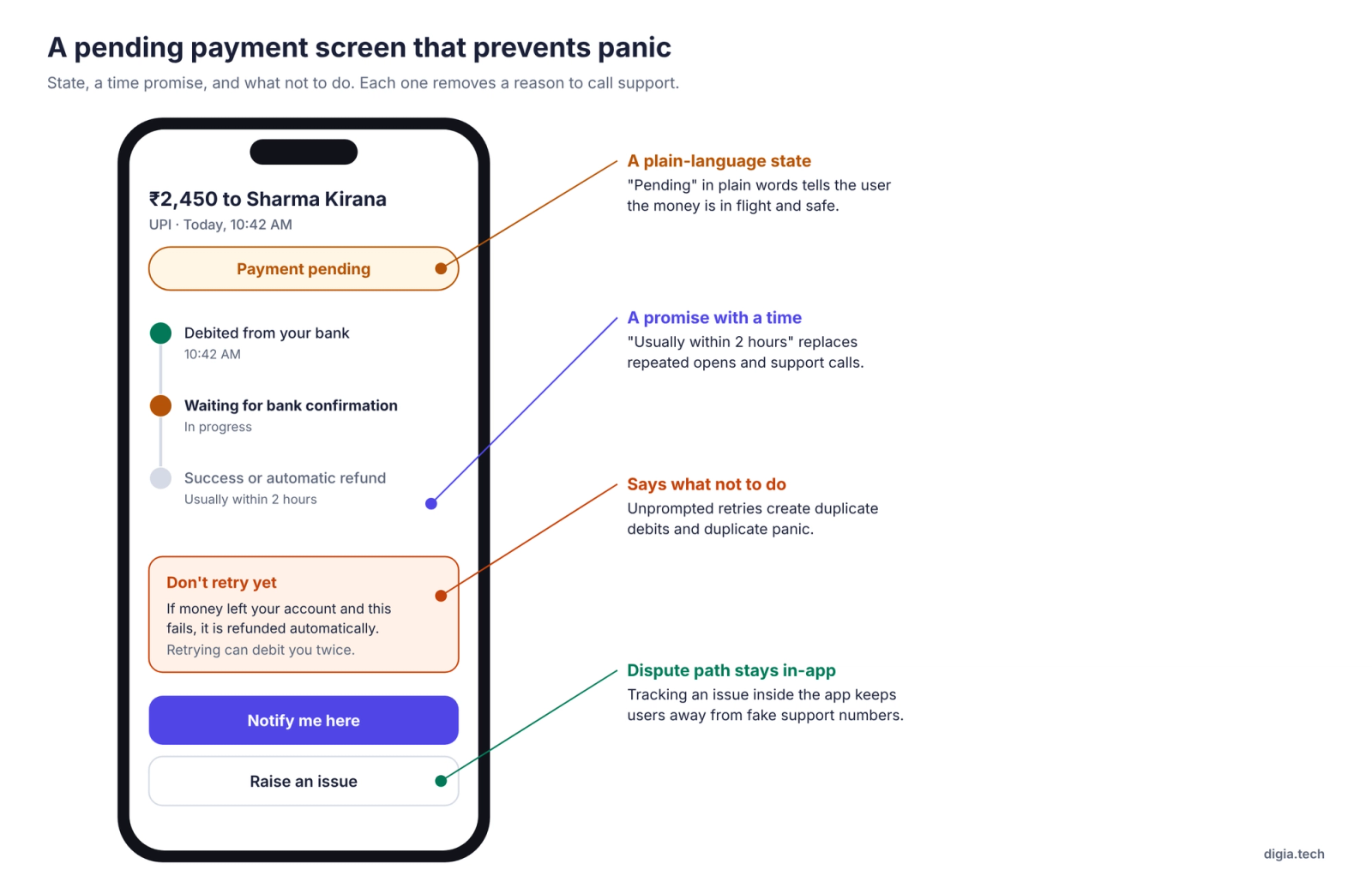
- Pending states need a timeline and a promise. "Processing" with no time estimate generates support tickets. "Your bank usually confirms within 2 hours. We'll update you here" does not.
- Failure recovery should say what not to do. After a failed UPI payment, the most useful message is often "Don't retry yet. If money left your account, it will be reversed automatically within the standard timeline." Unprompted retries create duplicate debits and duplicate panic.
- Disputes should be trackable inside the app. Users who can see dispute status contact support less and trust the resolution more.
UPI has become far more reliable. NPCI's CEO said technical decline rates had fallen to around 0.7 to 0.8%, from 8 to 10% in 2016. At 24 billion transactions a month, that still means well over a hundred million declines every month. For any individual user, the failure they experience is the one that matters.
12 fintech engagement patterns that work
The table below condenses the patterns that hold up across payments, lending, investing, and insurance. Each one moves a user from one money state to the next.
| # | Pattern | When it triggers | What to measure | Risk if misused |
|---|---|---|---|---|
| 1 | Single-source-of-truth receipt | Every completed transaction | Support contacts per transaction | Low |
| 2 | Pending timeline with a "next update" promise | Any in-flight money state | Repeat opens during pending, tickets | Low |
| 3 | Failure recovery that says what not to do | Failed or reversed transaction | Retry loops, duplicate debits, tickets | Low |
| 4 | Resume onboarding where the user left off | Return after KYC drop-off | KYC completion rate, time to complete | Low |
| 5 | "Explain the why" for data requests | Each sensitive permission or document | Step drop-off at the request | Low |
| 6 | Progressive disclosure at decision moments | Complex choices (loan terms, fund selection) | Completion, post-decision regret signals | Low |
| 7 | One-tap repeat | Routine core actions | Repeat rate on correct cadence | Medium |
| 8 | Autopay and mandate setup | After the first successful manual action | Mandate success, pause and cancel rates | Medium |
| 9 | State-based next best action | User completes a state (KYC, first SIP) | Next-stage conversion | Low |
| 10 | Transparent dispute tracking | Dispute or complaint raised | Resolution time, repeat contacts | Medium |
| 11 | Action-linked education | Just before a risky or unfamiliar action | Errors, reversals, complaint rate | Low |
| 12 | Risk friction that feels fair | Unusual device or payee | Fraud caught vs legitimate abandonment | High |
Two patterns deserve a note.
Pattern 11, action-linked education, beats standalone content. A tooltip explaining exit loads on the redemption screen is read and remembered. A blog post on exit loads in the "Learn" tab is mostly ignored. Digia's BFSI analysis cites RBI financial literacy data indicating that 64% of semi-urban users trust fintechs that teach before they sell.
Pattern 12, risk friction, is the only high-risk pattern because both failure modes are expensive. Too little friction lets fraud through, while too much blocks a legitimate user at the moment that matters most to them. The answer is to explain the friction ("We're confirming this because it's a new payee and a large amount") and to measure both sides.
For more examples with screens, see In-App Nudges: What They Are, When to Use Them, and 12 Examples and the breakdown of CRED's in-app nudges.
Which fintech engagement metrics should you track?
The short answer: track each core action on four layers at once and never let one layer improve at the expense of another.
The four-layer fintech engagement dashboard
| Layer | What it answers | Example metrics |
|---|---|---|
| Outcome | Are users completing the core action? | Success rate, time to first value, repeat rate on cadence, core-action retention |
| Friction | How hard was it? | Step drop-off, completion time, retries, error loops |
| Trust and risk | Do users still feel safe? | Failure and reversal rates, disputes, fraud flags, support contacts per active user |
| Messaging health | Is communication helping or hurting? | Opt-outs, mutes, uninstalls after a campaign, complaint rate |
How to calculate the outcome metrics
- Success rate = completed ÷ initiated, where "completed" requires a confirmed success state from the backend or provider, not a client-side screen view.
- Time to first value = time from signup to the first successful core action. KYC approval is too early a finish line.
- Repeat rate on cadence = the share of users who complete the core action again within its natural window (seven days for payments, one month for SIPs, the billing cycle for credit).
- Core-action retention = retention defined by completing the core action in period N.
For refunds and reversals, track the slow tail alongside the average. A median refund time of four hours hides the 2% of users who waited nine days, and those users write the reviews.
Instrument states, not screens
Fintech flows span your app and a chain of third parties such as banks and KYC vendors. Screen-view analytics cannot see most of what happens. Two practices fix that:
- Standardize state events for every core action: initiated, submitted, pending, completed, failed, reversed.
- Stitch IDs across systems with a shared flow ID plus the provider's reference ID, so a single user journey can be reconstructed end to end.
Then segment every metric by verification state, payment rail, OS and app version, and provider. A spike in failures that only hits one bank on one Android version is invisible in an aggregate.
The metric gate
Before any engagement change goes to everyone, it should pass a simple gate: completion goes up, friction goes down or stays flat, trust signals stay stable or improve, and opt-outs do not rise. This mirrors what Microsoft's experimentation team calls guardrail metrics, the aspects of a product you do not want to degrade while chasing a primary metric. Kohavi and co-authors' Trustworthy Online Controlled Experiments treats them as a core part of any experiment design.
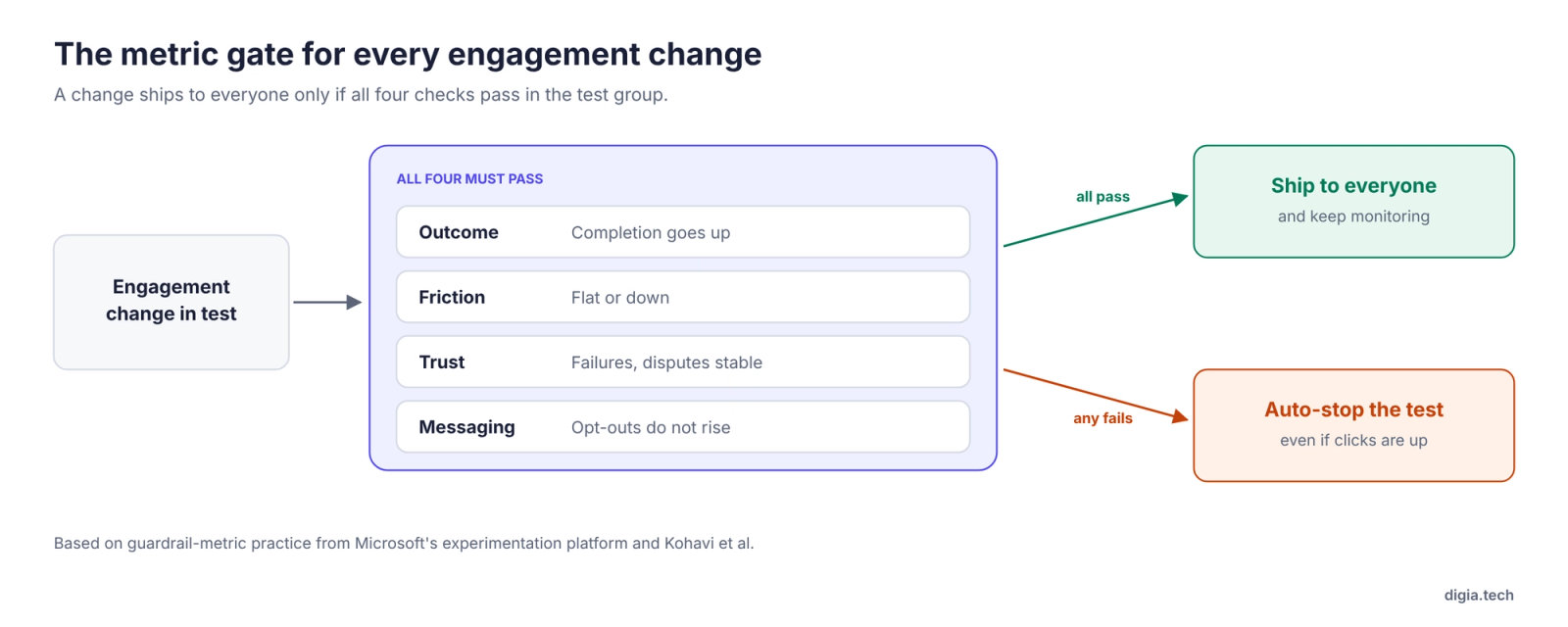
Set auto-stop rules for tests: if opt-outs, complaints, disputes, or support contacts in the treatment group worsen beyond a threshold, the test stops even if clicks are up. For a practical setup, see How to A/B Test In-App Campaigns Without Engineering.
Reading reminder-driven engagement
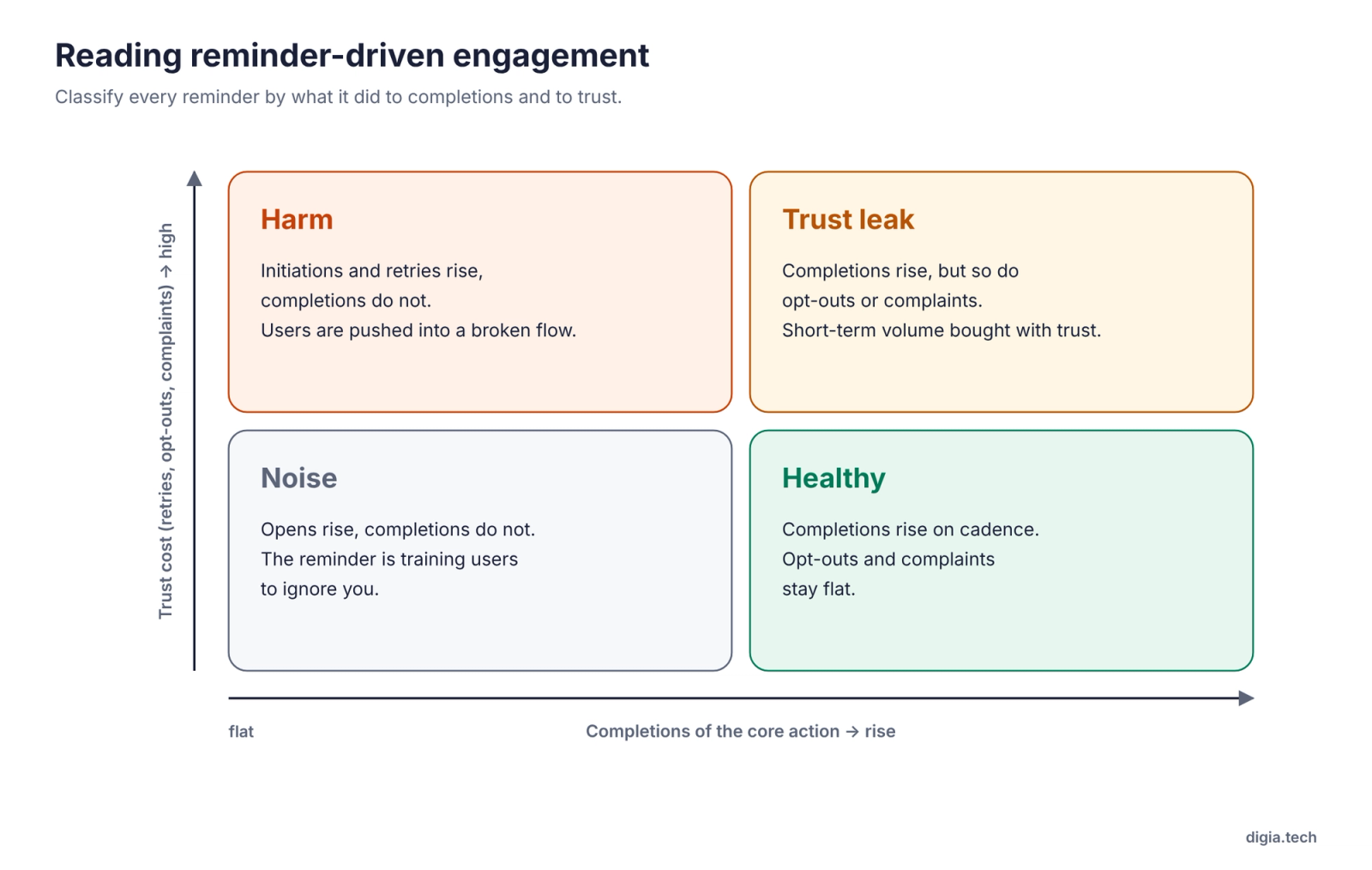
Reminders are the most common fintech engagement lever and the easiest to misread. Classify outcomes into four buckets:
- Noise: opens rise, completions do not. The reminder is training users to ignore you.
- Harm: initiations and retries rise, completions do not. The reminder is pushing users into a broken flow.
- Trust leak: completions rise, but so do opt-outs or complaints. You are spending trust to buy short-term volume.
- Healthy: completions rise on cadence, and opt-outs and complaints stay flat.
Four measurement mistakes to avoid
- Treating app opens as engagement.
- Treating KYC verification as activation.
- Ignoring trust signals because they live in support and risk tools, not the analytics tool.
- Instrumenting screens instead of states, which hides provider failures.
For the broader metrics view across verticals, see App Engagement Metrics That Matter (And the Ones That Don't).
When does fintech engagement become risky?
Fintech engagement changes behaviour around money, so it carries risks other categories do not. Regulators have measured some of them.
The UK's Financial Conduct Authority ran an experiment with over 9,000 people on trading-app features. It found that push notifications increased trading by 11% and points or prize draws by 12%, while the share of risky trades rose by 8% and 6%. The Ontario Securities Commission found in a 2,430-person trial that points with no economic value raised the number of trades by 39%. Engagement features work. In investing, that is exactly the problem.
Indian data shows why this matters. SEBI's August 2026 study found that 90.9% of individual equity F&O traders lost money in FY25 and 87.7% in FY26, with 43% of FY26 traders under 30. An engagement program that increases trading frequency in that population is increasing losses.
Six ways fintech engagement goes wrong
- Noisy or manipulative messaging. Urgency copy ("Only 2 hours left!") on financial decisions pushes users to act before they understand.
- Lock-screen exposure. Balances or due amounts in push notifications are visible to anyone holding the phone.
- Dark patterns. Pre-ticked add-ons, fake countdowns, hard-to-find cancellation, and confirm-shaming ("No, I don't want to save money") are now named and restricted in Indian rules.
- Regret loops. Features that raise activity in volatile products (leveraged trading, crypto, BNPL, short-tenure loans) produce users who churn angry and complain publicly.
- Scam training. Link-heavy, urgent messages teach users the exact behaviour fraudsters exploit.
- Support collapse. A campaign that drives volume into a degraded system, such as a bank with a high decline rate that week, creates a ticket spike that costs more than the campaign earned.
The trust-first operating rules
- Classify every message into one of five types: security, transactional, service, educational, or promotional. Security and transactional messages should look different from promotional ones, so users learn to trust them.
- Suppress during stress states. No promotional content while a user has a failed payment, an open dispute, a KYC under review, an account in recovery, or a fraud flag. For the logic, see When NOT to Show a Nudge: Building a Suppression Logic.
- Keep sensitive actions in-app. Messages should bring users into the app to act, never ask them to act via a link or a phone call.
- Respect the preference centre in practice. A preference centre that is not enforced across every channel is worse than none, because it breaks a promise the user can verify.
Frequency matters too. A Localytics survey found that at two to five pushes a week, 37% of users would disable notifications and 22% would stop using the app. The data is old, and the direction has not changed. For placement and capping, see Designing Non-Annoying Nudges: Frequency, Placement, and Context.
Regulation that shapes fintech engagement in 2026
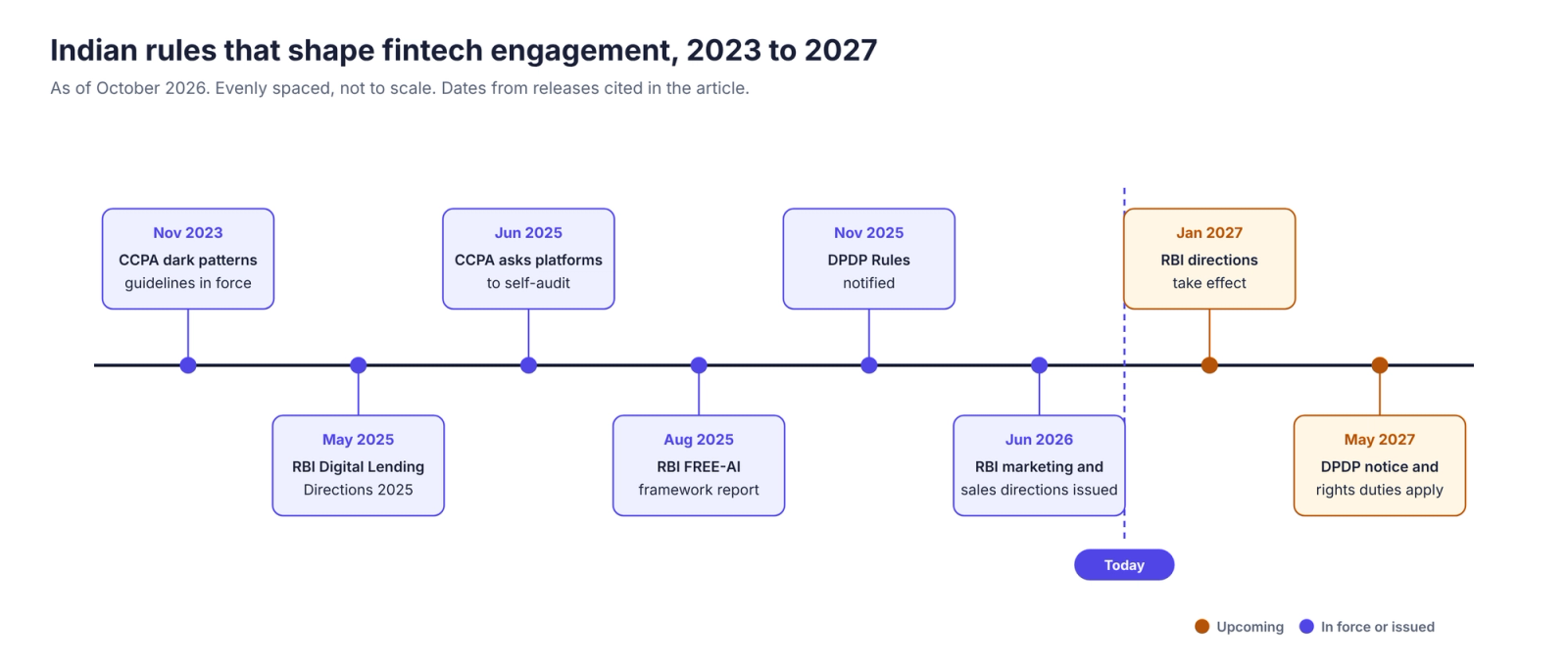
As of October 2026, fintech growth teams in India work under more engagement-relevant rules than at any point before. This is a growth team's reading of what the rules change for engagement design. Run any specific campaign past your compliance team.
India
| Rule | Status | What it means for engagement |
|---|---|---|
| RBI Responsible Business Conduct amendment directions | Issued 15 June 2026, effective 1 January 2027 for banks and non-bank lenders, including NBFCs and HFCs | Governs how financial products are marketed and sold. RBI's release confirms the draft covered dark patterns and mis-selling, and the February 2026 draft named patterns such as false urgency, basket sneaking, subscription traps, and confirm shaming. Audit in-app flows before January. |
| RBI Digital Lending Directions 2025 | In force since May 2025 | Cooling-off period of at least one day without penalty, Key Fact Statement before signing, all matching offers shown by multi-lender platforms, no access to contacts or call logs. |
| CCPA Guidelines on Dark Patterns, 2023 | Effective 30 November 2023 | Names 13 dark patterns, including nagging, false urgency, drip pricing, and subscription traps. A June 2025 advisory asked platforms to self-audit within three months. |
| DPDP Rules 2025 | Notified November 2025, phased over 18 months | Requires clear, separate consent notices. Notice and data-principal-rights duties apply by May 2027, and withdrawing consent must be as easy as giving it. Personalization built on data users did not knowingly share is a liability. |
| SEBI on unregistered advice and market data | Rules tightened through 2024 | Regulated entities must end ties with unregistered advisers and finfluencers. Brokers cannot share live market data with virtual trading or fantasy platforms. Influencer-style content inside broking apps needs care. |
| Google Play financial services policy | Live | Personal loan apps in India must be on RBI's list of lending apps, and loans repayable in 60 days or less are banned. |
Sources: RBI press release, 15 Jun 2026, MediaNama on the Feb 2026 draft, RBI Digital Lending Directions 2025, CCPA dark patterns guidelines, the 13 specified patterns, CCPA self-audit advisory, DPDP Rules 2025, JSA on the DPDP timeline, SEBI on unregistered advisers, SEBI on market data and gaming apps, Google Play financial services policy.
Global
- United States: the SEC's 2021 request for comment on digital engagement practices put behavioural prompts and gamified features at brokers under scrutiny.
- United Kingdom: the FCA's Consumer Duty requires firms to deliver good outcomes on consumer understanding and support, and to avoid barriers to switching or cancelling.
- European Union: Article 25 of the Digital Services Act bans interfaces that deceive or manipulate users, and ESMA has consulted on gamification and nudging in digital retail investing.
- App stores: Apple's App Store Review Guidelines cap loan APR at 36% and bar crypto apps from offering currency for completing tasks.
The pattern across jurisdictions is consistent. Regulators now examine how an interface steers decisions as closely as what a financial product says, which puts engagement design squarely in scope.
Gamification and rewards in fintech apps
Gamification works in finance. The FCA and OSC experiments above prove it. The question every fintech team has to answer is which behaviour the reward reinforces.
Reward the behaviour you want more of
Rewards that reinforce good financial habits are low-risk and defensible: completing KYC, setting up autopay, paying a bill on time, continuing a SIP through a market dip, building a savings streak. Rewards that reinforce frequency in risky products, such as trades, leveraged positions, crypto, or short-tenure loans, are the ones regulators are studying. The OSC found that a stock appearing on one platform's "Top Movers" list was traded at 36 times its average volume. Leaderboards and "trending" lists in investing apps are not neutral design choices.
Operating rules for fintech rewards
- Validate rewards server-side. Client-side reward logic invites fraud, especially with cashback.
- Cap reward spend per user and per day, and watch for clusters of new accounts that only redeem.
- Disclose terms right where the reward appears. Hidden conditions are drip pricing under India's dark-pattern guidelines.
- Never attach rewards to regulated advice or product recommendations. "Get ₹100 for buying this fund" is a recommendation with an incentive, and it will not read well in a complaint.
Scratch cards remain the most common reward format in Indian payments. Digia's breakdown of Paytm's scratch card psychology explains why they work and where they cross into slot-machine territory, and Scratch Cards in Mobile Apps: Design, Timing, and Conversion Data covers the mechanics. For streaks and milestones, see Gamification in Mobile Apps: Streaks, Rewards and Retention.
Personalization and AI in fintech engagement
McKinsey's research found that personalization most often lifts revenue by 10 to 15%, and that 71% of consumers expect it. In financial services, the gap between relevant and creepy is narrow.
Explainable personalization
The safest rule: personalize around what the user did in your product, and be able to say so in one sentence. "You've paid your electricity bill on the 5th for three months. Want to set up autopay?" is explainable and useful. An offer based on inferred income from SMS data the user does not remember sharing is a DPDP risk and a trust risk at once.
Behaviour-triggered messaging is where personalization pays off most reliably. MoEngage's benchmarks show a 16.5x conversion lift in financial services when moving from broadcast to behaviour-based messaging. For the trigger design, see Behaviour-Triggered In-App Campaigns: The Complete Guide.
AI governance for regulated entities
RBI's FREE-AI committee report, released in August 2025, set out seven guiding principles and 26 recommendations for responsible AI in the financial sector. For growth teams using AI to choose offers or timing, two practical implications follow. Keep a human-reviewable record of why a user saw a given offer. Keep AI-generated copy out of security and transactional messages, where consistency is itself a trust signal.
Festive season and seasonal spikes
Indian fintech engagement is highly seasonal. On the eve of Diwali 2025, UPI recorded an all-time single-day high of 740 million transactions, and October 2025 set a then-record of 20.7 billion monthly transactions. Festive weeks also bring gold purchases and bonus-driven SIP top-ups.
Four things change during festive peaks:
- Decline rates rise with load, so failure recovery messaging matters more, not less.
- Scam volume rises with fake offers and fake customer care numbers, so security messaging should be visually distinct and frequent enough to be recognized.
- Frequency caps should tighten, because every brand is messaging at once and users opt out faster.
- Support queues lengthen, so in-app status and self-serve answers carry more load.
Ship festive campaigns as in-app experiences that can be paused instantly if a payment rail degrades. A campaign hard-coded into a release cannot be pulled back in the middle of Dhanteras.
Why release cycles break fintech engagement
Most of the patterns in this guide depend on changing copy or layout on state-critical screens: the pending screen, the failure screen, the KYC step, the SIP screen. In most fintech apps, those screens are hard-coded into the app binary, so every change waits for an engineering sprint and an app store review. When a bank's decline rate spikes on a Tuesday, the failure-recovery message the team wants to change ships the following week, after the damage is done.
That gap is the reason many fintech teams over-rely on push and email. Those channels can change in an hour, so they become the default lever even when the right fix belongs inside the app.
A server-driven approach closes the gap. Digia Engage, for example, renders native in-app components such as bottom sheets, tooltips, inline banners, and surveys from a dashboard, and updates them server-side without an app release, sitting alongside the customer engagement platform a team already uses. Dezerv's growth team used this to test four onboarding copy variants in one week and roll back underperformers the same afternoon. For the architecture, see What is Server-Driven UI for Engagement and Why App Engagement Fails When It's Tied to Release Cycles.
Whatever tool you use, the guardrail is the same: changes to state-critical screens need version control, approval, instant rollback, and the same metric gate as any experiment.
Fintech engagement use cases by job
Each use case below pairs a common fintech job with the trigger event that starts it and the metric that decides whether it worked.
| Job | Trigger event | Typical in-app format | Primary metric |
|---|---|---|---|
| KYC completion | Drop-off at a KYC step | Resume prompt, progress widget | KYC completion rate |
| UPI payment recovery | Failed or pending payment | Inline status card, bottom sheet | Retry loops, tickets per failure |
| SIP nudges | SIP created without top-up, or missed instalment | Bottom sheet with one-tap action | SIP continuation, top-up adoption |
| Credit card activation | Card issued, no first spend | Inline banner, checklist | Time to first spend |
| Loan cross-sell | Eligibility met, no stress state | Spotlight with all offers shown | Approved applications, complaint rate |
| Referral rewards | First successful core action | Post-success prompt | Referred users reaching first value |
| Scratch card rewards | Habit-building action completed | Scratch card | Repeat core action, reward cost |
| Savings streaks | Recurring deposit or saving goal | Streak tracker | Streak continuation, deposits |
Pre-ship checklist for fintech growth teams
Before any fintech engagement change goes live, the team should be able to answer every question below.
- Which core action does this change improve, and how is its success state logged?
- What is the healthy cadence for that action, and does this change respect it?
- Which trust signals will we watch, and what threshold stops the test?
- Which stress states suppress this experience?
- Does any part of the copy or offer resemble a named dark pattern (false urgency, confirm shaming, hidden terms, hard cancellation)?
- Is every data point used for targeting covered by consent the user knowingly gave?
- Can a security or transactional message be confused with this one?
- Can we pause or roll back the change within minutes if a payment rail or provider degrades?
If the team cannot answer these, the change is not ready to ship.
Key Takeaways
- Fintech app engagement means repeated, successful completion of high-value money actions with trust intact. Opens and minutes are weak proxies, and rising session time often signals anxiety.
- The biggest losses happen early. Finance apps keep about one in eight users after day one, and most activation is lost between KYC completion and the first transaction, so fix onboarding and failure recovery before adding campaigns.
- Measure every core action on four layers together (outcome, friction, trust and risk, messaging health) and ship only changes that pass the metric gate.
- Regulators in India, the UK, the US, and the EU now scrutinize how interfaces steer financial decisions. RBI's amended marketing and sales directions for banks and NBFCs, drafted with dark patterns in scope, apply from 1 January 2027, so trust-first engagement is now part of compliance.
Further Reading
From Digia
- India In-App Engagement Benchmarks 2026
- How Indian Fintech Apps Drive User Activation: 8 In-App Patterns
- In-App Experiences for Fintech and BFSI Apps in India
- How Groww Uses In-App Surveys to Build Risk Profiles Without Feeling Risky
- Mobile App Retention Rate: What It Is and What's Pulling It Down
- Best Mobile App Engagement Platforms in 2026: An Honest Comparison
External
- FCA: trading apps and gaming concerns
- Ontario Securities Commission: gamification in online investing
- Nielsen Norman Group: progressive disclosure
- BJ Fogg Behavior Model
External Sources: All Claims Attributed
- Adjust finance app report, via Business Wire release - Adjust, 29 Oct 2025
- Adjust: Finance app insights 2025 - Adjust, 29 Oct 2025
- AppsFlyer State of Marketing in APAC 2026 coverage - MediaNews4U citing AppsFlyer, 27 Aug 2026
- AppsFlyer uninstall report 2023 - AppsFlyer, Feb 2023
- CleverTap Fintech Benchmark Report - CleverTap via ACN Newswire, 27 Feb 2023
- Signicat: Battle to Onboard six-year retrospective - Signicat, 21 Apr 2022
- MoEngage customer engagement benchmarks - MoEngage
- UPI FY26 figures, Lok Sabha reply - DD News, 20 Jul 2026
- UPI August 2026 volume - Outlook Business citing NPCI, 1 Sep 2026
- AMFI August 2026 SIP data - Fintech BizNews citing AMFI, 10 Sep 2026
- Demat accounts July 2026 - Asianet Newsable via ANI, 14 Aug 2026
- Plaid: consumer insights reshaping finance - Plaid and Harris Poll, 16 Nov 2023
- Cyber fraud losses in 2025, MHA reply - Dynamite News, 11 Feb 2026
- Product Growth Intelligence: trading app onboarding - Product Growth Intelligence
- NN/g: Progressive Disclosure - Nielsen Norman Group, 3 Dec 2006
- Baymard: Cart abandonment rate statistics - Baymard Institute, updated 22 Sep 2025
- RBI: Video-based Customer Identification Process (V-CIP) - RBI, 9 Jan 2020
- RBI Digital Lending Directions 2025 - RBI, 8 May 2025
- RBI Responsible Business Conduct amendment directions - RBI, 15 Jun 2026
- RBI dark patterns draft, 2026 - MediaNama, Feb 2026
- Dezerv case study - Digia
- Wink case study - Digia
- UPI technical decline rates - Inc42 citing NPCI CEO via PTI, 20 Nov 2024
- Microsoft ExP: patterns of trustworthy experimentation - Microsoft Research, 25 Jan 2021
- Trustworthy Online Controlled Experiments (index) - Kohavi, Tang, Xu, Cambridge University Press, 2020
- FCA keeps trading apps under review over gaming concerns - FCA, 20 Jun 2024
- OSC Staff Notice 11-796: gamification - Ontario Securities Commission, 17 Nov 2022
- SEBI F&O study FY25 and FY26 - SEBI, 20 Aug 2026
- Localytics push frequency survey - MarketingProfs, 2018
- CCPA Dark Patterns Guidelines 2023 - SCC Online, 4 Dec 2023
- Dark patterns in India: the 13 specified patterns - Bar & Bench, 10 Sep 2025
- CCPA self-audit advisory - ETV Bharat, 7 Jun 2025
- DPDP Rules 2025 notified - PIB, 17 Nov 2025
- JSA: DPDP Rules phased timeline - JSA, Nov 2025
- SEBI on unregistered advisers - Outlook Business via PTI, 23 Oct 2024
- SEBI on market data sharing with gaming apps - India Blooms, 3 Jul 2024
- Google Play: financial services policy - Google
- SEC: request for comment on digital engagement practices - SEC, 27 Aug 2021
- FCA Consumer Duty - FCA, updated 24 Feb 2026
- DSA Article 25 - Regulation (EU) 2022/2065
- ESMA discussion paper on digital retail investing - ESMA, 14 Dec 2023
- Apple App Store Review Guidelines - Apple
- McKinsey: the value of getting personalization right - McKinsey, 12 Nov 2021
- RBI FREE-AI committee report - RBI, 13 Aug 2025
- UPI Diwali 2025 daily record - DD News via IANS, 22 Oct 2025
- UPI October 2025 record - CA Club India citing NPCI, 4 Nov 2025
Want to fix KYC drop-off and failed-payment recovery inside your app, without an app release? Digia Engage plugs into the customer engagement platform you already run, such as CleverTap or MoEngage, and renders native bottom sheets, tooltips, and inline widgets from a dashboard in under 100ms, so your growth team can test and roll back state-critical messages the same day. Book a demo to see how it works.