


Table of Content
- Introduction: Why fintech teams feel pressure to “increase app engagement”
- Fintech engagement changes decisions around money
- Where fintech engagement becomes risky
- Trust erosion from noisy or manipulative messaging
- Privacy and sensitive data exposure
- Dark patterns and aggressive conversion tactics
- Financial harm and user regret loops
- Fraud amplification and social engineering risk
- Operational overload and support collapse
- Fintech engagement risks at a glance
- Safe engagement vs unsafe engagement
- The trust-first playbook for growth without breaking trust
- Redefine engagement as repeat successful outcomes
- Make state clarity the primary engagement surface
- Build a messaging taxonomy and enforce it
- Implement preference controls and suppression rules
- Add trust guardrails to experimentation
- Use explainable personalization (not creepy inference)
- Design scam-resistant communications
- Engagement principles at a glance
- The operating system: metrics that keep you honest
- A practical checklist for safe fintech engagement
- Conclusion: engagement is easy to grow; trust is hard to rebuild
- FAQs
Fintech teams are under constant pressure to “increase app engagement.” more opens, more activity, more repeat usage, and more conversions. The problem is that in fintech, engagement is not a neutral objective. It can change user behavior around money, credit, and risk. It can expose sensitive information. It can unintentionally incentivize harmful actions. And if you push too hard, you don’t just lose users, you lose trust, invite complaints, and create regulatory and reputational exposure.
That is why fintech mobile app engagement is risky. Not because engagement is bad, but because the same tactics that work in low-stakes apps can create real harm in financial products.
This article explains where the risk actually comes from, what “unsafe engagement” looks like, and how strong fintech teams drive growth while preserving trust. If you’re building payments, banking, lending, investing, or insurance experiences, you should treat this as a playbook for growth that doesn’t blow up later.
This article is part of a broader pillar on mobile app engagement, where we explore how engagement is shaped by product systems, metrics, and domain-specific constraints. While the pillar establishes that engagement is not just about activity but about meaningful, context-driven outcomes, this piece focuses on one of its most critical dimensions in fintech: the risk layer of engagement.
In this article, we examine why fintech teams often feel pressure to increase engagement in ways that can backfire, where engagement becomes risky or unsafe, and how it can lead to trust erosion, privacy exposure, financial harm, and fraud amplification. We also introduce a trust-first engagement playbook, covering safe vs unsafe patterns, messaging governance, experimentation guardrails, and the mobile app engagement metrics that keep teams accountable helping you grow engagement without compromising user trust or long-term product integrity.
Fintech engagement changes behavior around money
In most categories, engagement is about attention. In fintech, engagement is about decisions. A nudge can change when someone repays, how much they spend, whether they borrow, whether they invest, whether they panic-sell, or whether they reveal private information to a scammer. You are not just optimizing clicks. You are influencing financial outcomes.
That is why a fintech engagement program must be held to a higher standard than “opens” and “CTR.” You need to prove that your nudges improve outcomes without increasing anxiety, confusion, or harm.
Where fintech engagement becomes risky
Trust erosion from noisy or manipulative messaging
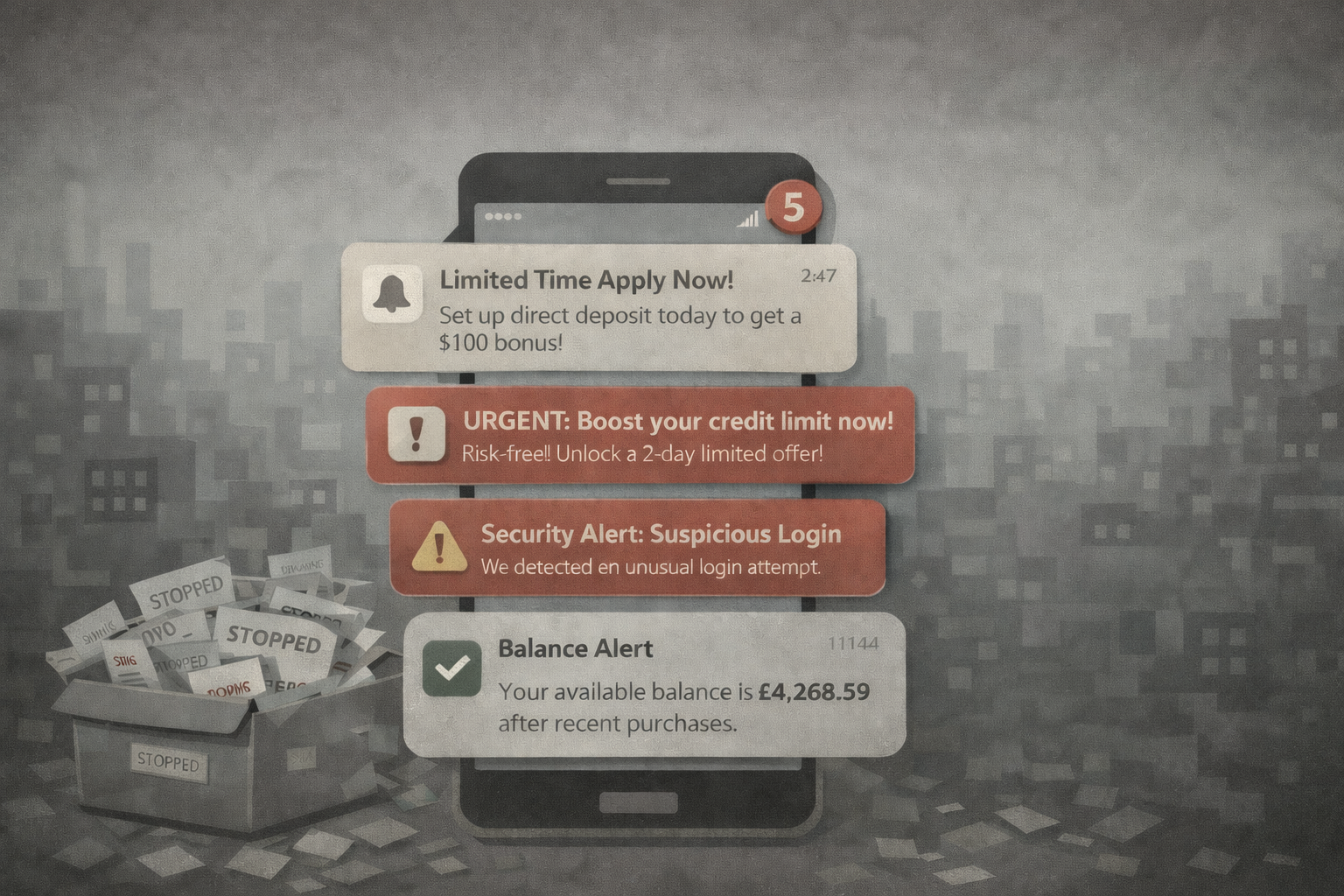
Fintech apps are unusually sensitive to messaging fatigue because the content is inherently personal. If users feel watched, pressured, or gamified around money, they lose confidence. The most common failure mode is when growth teams treat push notifications like a universal lever: send more, send faster, send “smart” personalization.
The result is predictable. Users disable notifications, unsubscribe, or uninstall. Worse, they start ignoring messages that actually matter, such as security alerts and transaction confirmations. Engagement tactics that reduce the credibility of critical messages are not growth. They are long-term damage.
Privacy and sensitive data exposure
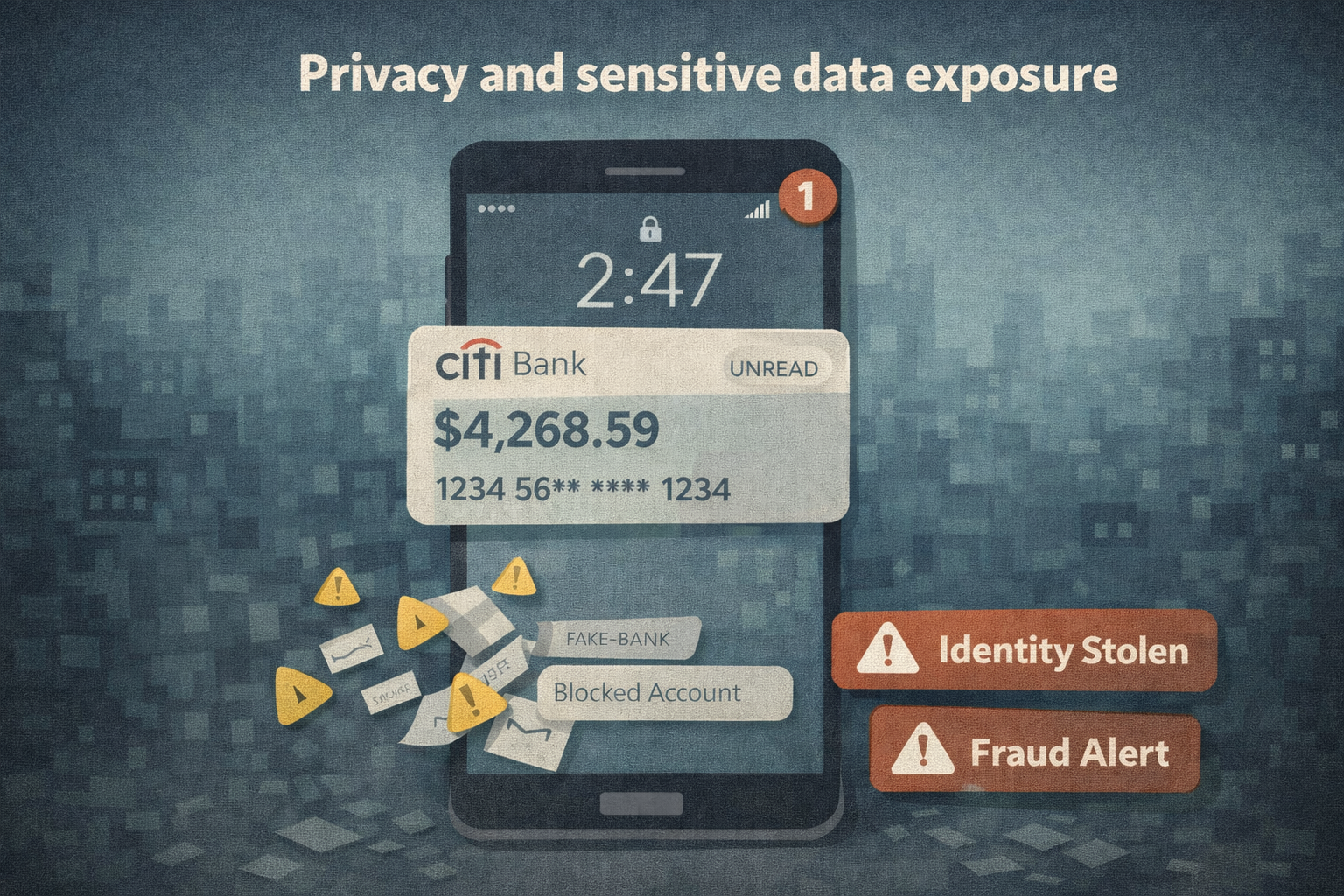
Some fintech engagement messages are dangerously easy to get wrong. Even a well-intended notification can reveal account balances, repayment status, or personal financial events on a lock screen. If you operate in multiple markets, the compliance expectations around consent, marketing communications, and data processing can vary widely, but user expectations are consistently high: they do not want their finances broadcast through casual messaging defaults.
Risk also shows up internally. Over-collection of data to “personalize engagement” can create a privacy liability. If your mobile app engagement strategy requires deep inference about a user’s finances beyond what you need to deliver the product, you are accumulating risk without guaranteed benefit.
Dark patterns and aggressive conversion tactics
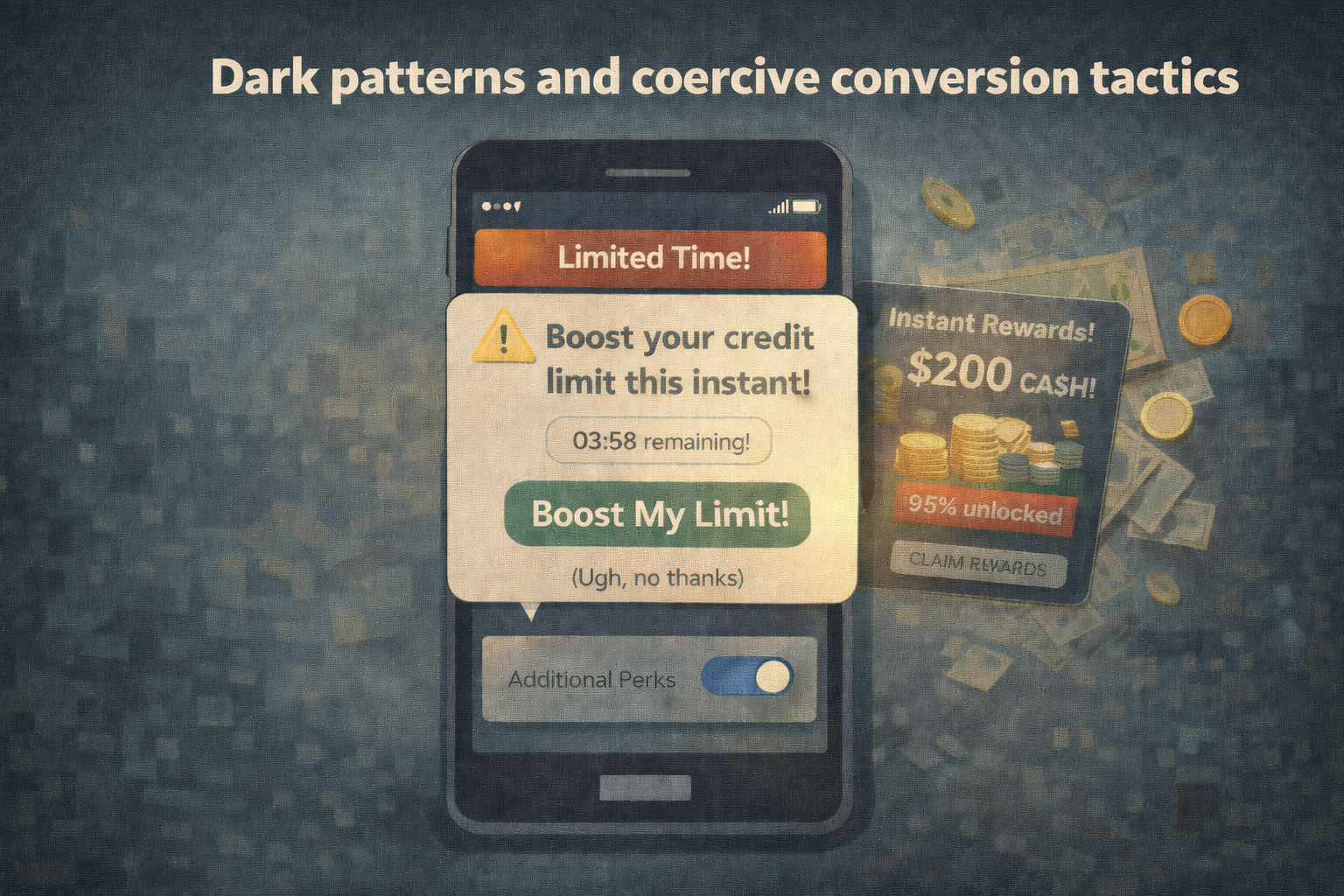
This is where fintech mobile app engagement crosses the line from “growth” into “pressure.” Examples include preselected higher credit limits, confusing fee disclosures, urgency language that pushes borrowing, or obstacles that make cancellation hard. In low-stakes apps, these tactics are already questionable. In fintech, they can cause direct financial harm.
Even if the tactics increase short-term conversion, they increase long-term churn and complaints. They also increase dispute rates and support load because users feel tricked. If your “engagement improvements” correlate with higher complaint volume or higher dispute initiation, you are not improving the product. You are exploiting attention.
Financial harm and user regret loops

Fintech products can create regret quickly. A user who invests impulsively based on a “market is moving” push, a user who borrows because a nudge framed it as a reward, a user who pays late because reminders were poorly timed, or a user who over-trades because the product rewards activity, these are engagement-driven harm engagement performance patterns.
You do not need to be a “trading app” to create this risk. Any product that influences spending, borrowing, or investing has to consider whether engagement mechanics are encouraging unhealthy behavior.
Fraud amplification and social engineering
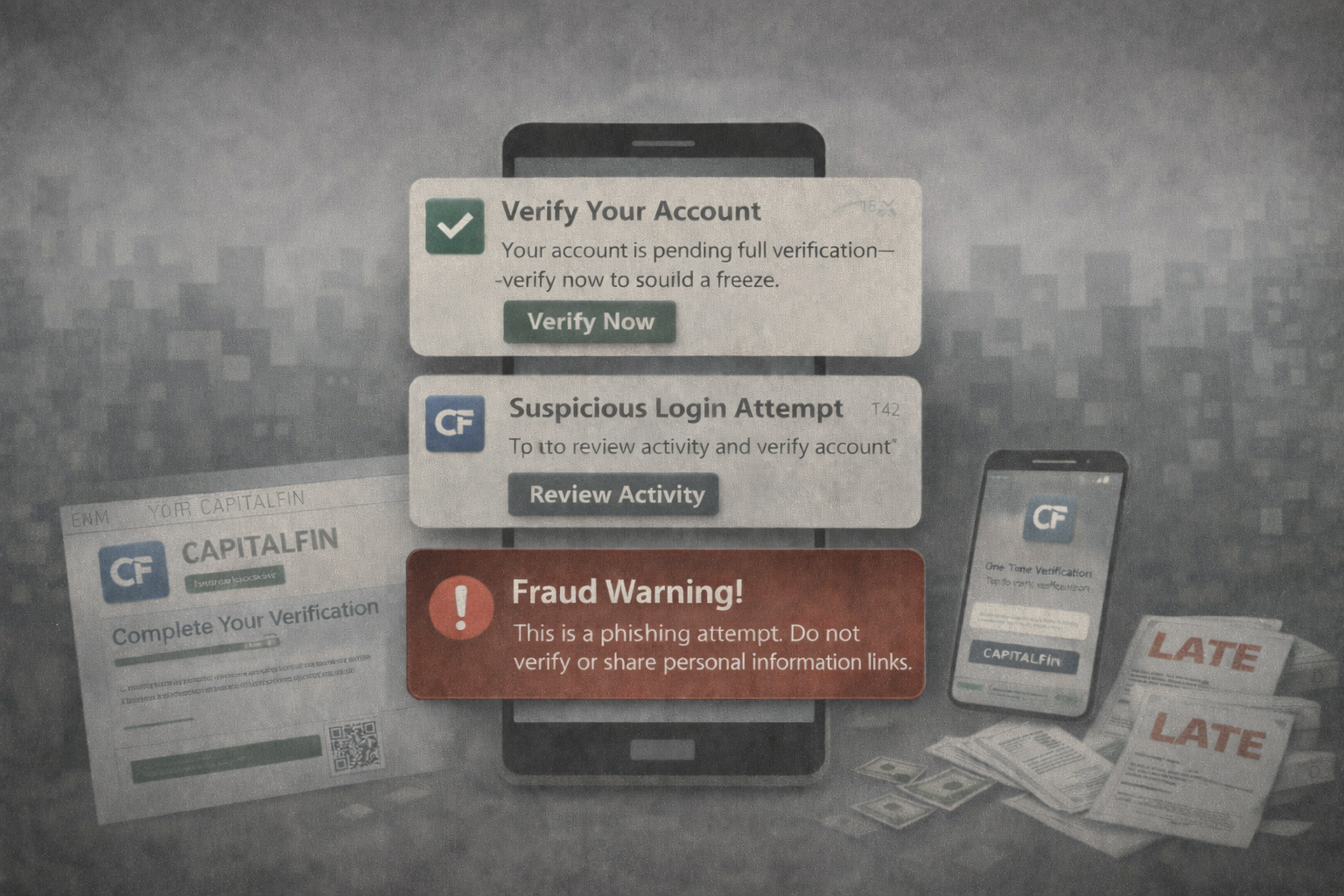
Fintech engagement surfaces are also attack surfaces. Fraudsters take advantage of how users interpret messages and states. Poorly designed notifications, ambiguous receipts, weak in-app confirmations, and confusing verification steps make it easier for scammers to impersonate your brand and manipulate users.
If your engagement strategy relies heavily on sending links, asking users to “verify now,” or creating fear-based urgency, you may unintentionally train users into scam-friendly behavior. That is a security risk disguised as marketing.
Operational load and support collapse
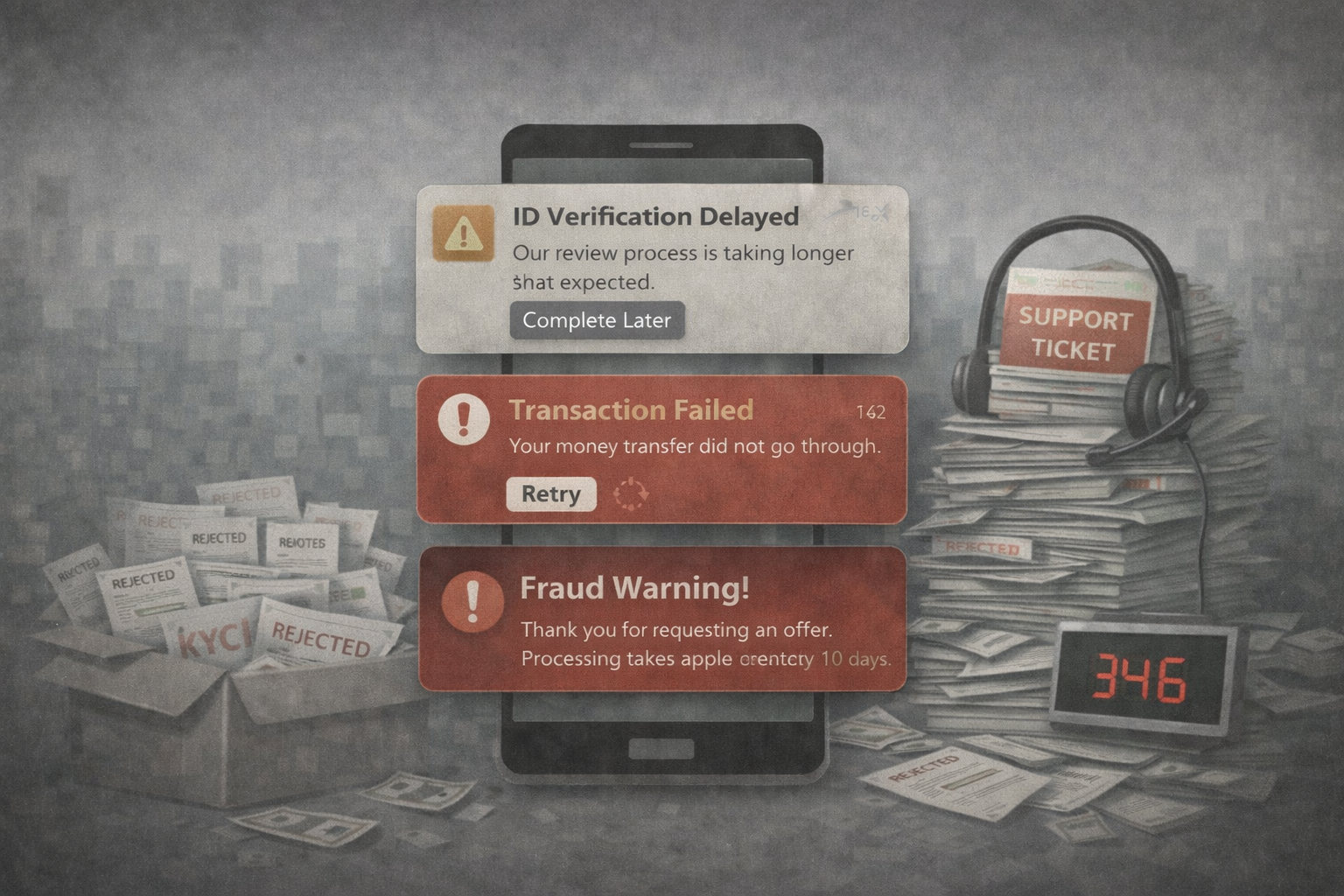
Engagement tactics that increase activity without increasing clarity create support incidents. A common pattern is pushing users into flows that are not ready - KYC systems that create limbo, payment flows with fragile dependencies, or offer flows that generate confusion. When the product cannot resolve issues through clear states and recovery paths, users flood support.
Support contact rate per active user is one of the best “trust risk” metrics you can track. If engagement “improves” while support rate rises, the engagement is hollow.
Fintech Engagement Risks at a glance
| Risk | What it looks like | Why it’s dangerous |
|---|---|---|
| Noisy or manipulative messaging | Promotional pushes overwhelm transactional/security messages; constant “come back” nudges | Users mute everything, stop trusting alerts, churn increases |
| Privacy and sensitive-data exposure | Lock-screen notifications reveal balances/repayments; excessive tracking for “personalization” | Data leakage, user discomfort, complaints, compliance exposure |
| Dark patterns and coercive conversion | Hidden fees until late, urgency to borrow/spend, preselected options, hard-to-cancel flows | Financial harm, disputes, reputational damage |
| Regret loops and harmful behavior | Nudges that encourage panic-selling, over-trading, impulse borrowing | Users make worse financial decisions and blame the product |
| Fraud amplification and social engineering | “Verify now” links, inconsistent brand voice, training users to click | Scammers exploit habits; account takeover and losses increase |
| Operational overload and support collapse | Campaigns drive users into fragile flows; ticket spikes on money-status issues | Support costs explode; trust drops; teams firefight |
| Reliability problems misread as engagement | Users repeatedly check “pending/failed” states; retry loops inflate sessions | Metrics lie; teams optimize friction, not value |
| Experiments without trust guardrails | Tests optimize CTR only; ignore opt-outs, complaints, disputes | Short-term lifts create hidden long-term damage |
The difference between safe engagement and unsafe engagement
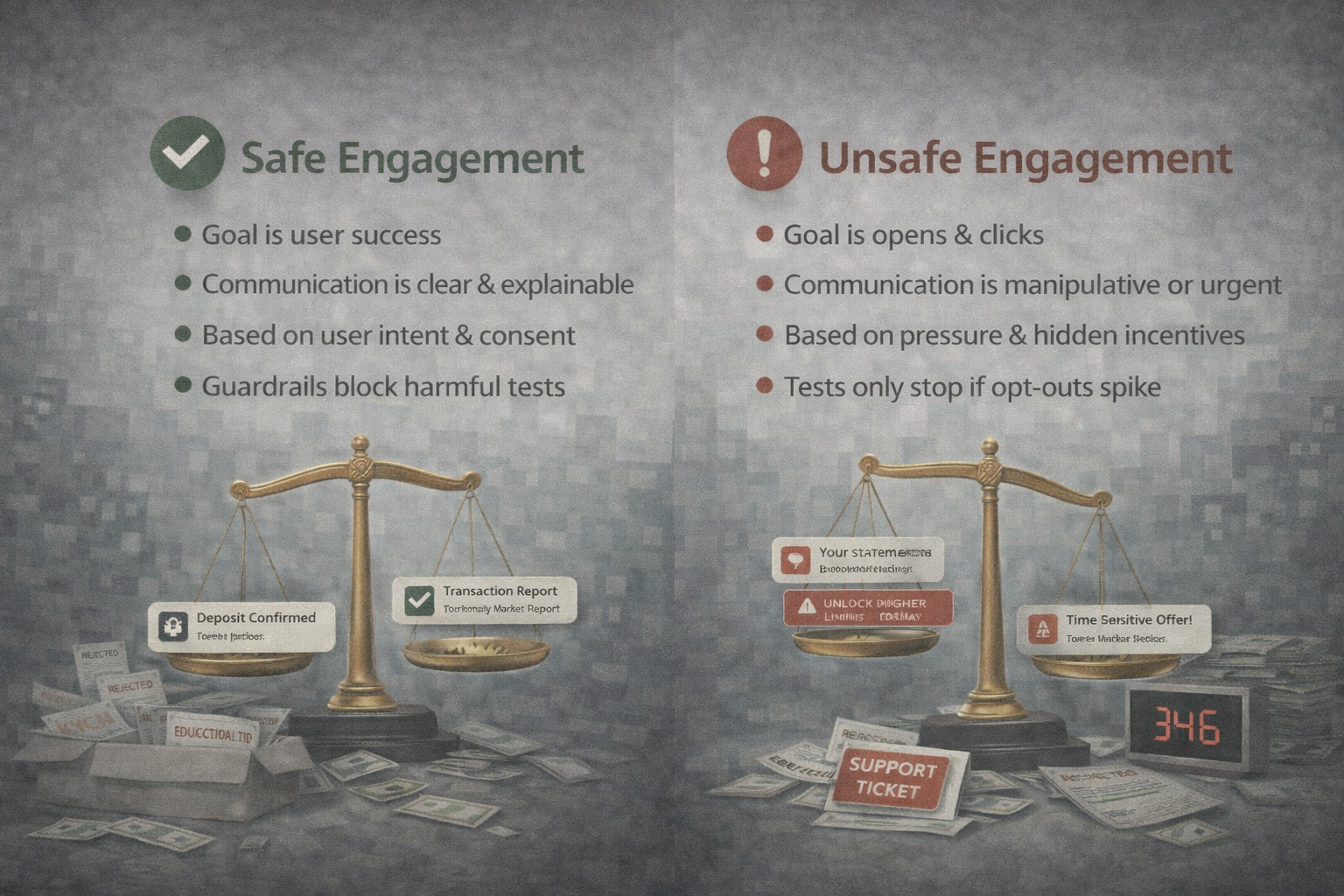
Safe fintech engagement is state-aware, user-controlled, and outcome-based. Unsafe fintech engagement is attention-based, pressure-based, or opaque.
A safe engagement program has three characteristics:
First, it is anchored to core actions and user intent. It helps users complete money outcomes they already want, rather than manufacturing desire through pressure.
Second, it is governed by preferences and consent. Users can control what they receive and when, and sensitive details are handled carefully.
Third, it has guardrails. Engagement experiments are blocked or rolled back when trust signals degrade.
An unsafe program optimizes for opens and short-term conversions, uses urgency and gamification to push decisions, hides key information until late, and treats opt-outs as a problem to “fix” rather than a signal to respect.
The trust-first playbook: how teams drive growth without breaking trust
Redefine engagement as “repeat successful outcomes”
Before you change any tactic, change your definition. Engagement should be measured as repeat completion of core actions on the intended cadence. If you align your KPIs to outcomes, you immediately reduce the incentive to spam users into opening the app.
Teams that do this stop celebrating “activity lifts” that come from anxiety. They start investing in reliability and clarity, because those are the levers that actually increase repeat usage.
Treat state clarity as your primary engagement surface
The most effective engagement in fintech happens inside the product experience, not in the notification layer. Receipts, pending states, failure recovery, dispute timelines, and verification progress screens are engagement systems because they reduce uncertainty and enable repeat usage.
If your app makes “what happened” and “what’s next” obvious, users come back because the product works, not because you begged them to.
Build a messaging taxonomy and enforce it
Not all messages are equal. Safe fintech teams separate messages into types: security, transactional, service, educational, and promotional. They apply different rules to each type.
Security and transactional messages should be high-credibility and minimal.
Promotional messages should be optional and preference-controlled. Educational messages should be tied to user state and action, not broadcast.
This taxonomy prevents a common disaster: users muting everything because they can’t distinguish important messages from noise.
Implement preference controls and suppression rules
A preference center is not a “nice-to-have.” It’s a trust requirement. Users need control over what they receive. Teams need suppression rules to prevent messages during high-sensitivity moments: disputes in progress, failures unresolved, verification under review, account recovery, suspected fraud, or repeated errors.
A simple governance rule is: if the user is in a “stress state,” do not market to them. Resolve first. Then engage.
Add guardrails to experimentation
Fintech teams should not run engagement experiments with only conversion metrics. Every test should have outcome metrics and trust guardrails. If opt-outs rise, complaints rise, disputes rise, or support contacts rise, the test should stop, even if clicks improved.
Guardrails are not bureaucracy. They are how you grow without generating hidden costs that show up a quarter later.
Use “explainable personalization,” not creepy personalization
Personalization is high-risk in fintech because it can feel invasive. If you personalize, make it explainable. Tie it to a user action or a state, not to inferred financial behavior that the user never explicitly shared.
A safe rule is: personalize around what the user did in your product, not around what you assume about their life.
Design for scam resistance
If your engagement system trains users to click links, act urgently, or “verify now” without context, you are increasing fraud risk. Safer patterns include encouraging users to open the app directly rather than tapping external links for sensitive actions, using consistent language, and keeping critical confirmations in-app.
Also make security messages visually and linguistically distinct from promotional messages, so users don’t learn to ignore them.
Engagement principles at a glance
| Principle | What it means in practice |
|---|---|
| Redefine engagement as repeat successful outcomes | Measure completed core actions and repeat rate, not opens and time-in-app |
| Make state clarity the primary engagement surface | Receipts, pending timelines, failure recovery, dispute tracking are product features, not “support content” |
| Build and enforce a messaging taxonomy | Separate security, transactional, service, educational, and promotional messages with different rules |
| Implement preference controls and suppression rules | Give users control; suppress marketing during stress states (failures, disputes, recovery) |
| Add trust guardrails to experimentation | Auto-stop tests when opt-outs, complaints, disputes, or support contacts worsen |
| Use explainable personalization | Personalize based on user intent/state, not creepy inference; make “why you’re seeing this” obvious |
| Design scam-resistant communications | Keep sensitive actions in-app; avoid link-heavy urgency; consistent security language and UX |
| Treat reliability as a growth lever | Track failure/recovery and provider performance; don’t run campaigns into degraded systems |
The operating system: the metrics that keep you honest
If you want to drive engagement without breaking trust, you need an operating system of metrics that pairs outcomes with trust signals. At minimum, track:
Outcome engagement: core action completion, repeat rate, and time to first value.
Friction: drop-offs, retries, error loops, time-to-complete. Trust signals: failure rates and recovery time, disputes/chargebacks where applicable, fraud flags and step-up auth rates, support contacts per active user, notification opt-outs and uninstall correlation.
This is how you prevent “growth” from becoming hidden damage.
A practical checklist for safe fintech engagement
Before shipping any engagement change, ask: Does this help users complete a core financial job they already want to do? Will this reveal sensitive data on a lock screen or shared device? Do users have control over receiving this type of message? Does this create urgency that could lead to regret? Could this be weaponized by scammers? What happens if the underlying system is down or delayed? What are the guardrails, and who watches them?
If you can’t answer these, you are not ready to ship.
Conclusion: engagement is easy to grow; trust is hard to rebuild
In fintech, it is easy to drive short-term engagement: send more messages, add more prompts, push more offers. It is much harder to build long-term engagement rooted in confidence, transparency, and reliability.
The best fintech teams treat engagement as a trust-bearing system. They grow by reducing uncertainty, making core actions repeatable, giving users control, and enforcing guardrails. That’s slower than “growth hacks,” but it compounds instead of backfiring.
If you want, I can add a five-question FAQ section and an “engagement safety policy” template you can publish internally, so your product, growth, risk, and compliance teams stop debating every campaign from scratch.