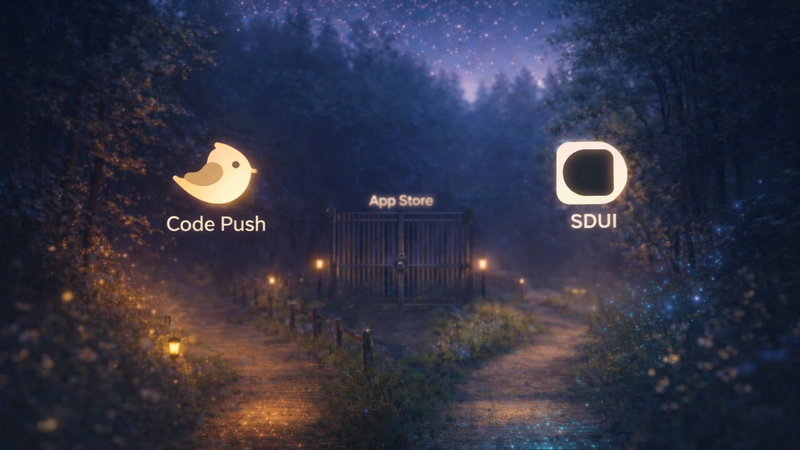


For more than a decade, the mobile industry has poured billions of dollars and countless engineering hours into one obsession: building faster. Every year introduced a new framework that promised shorter development cycles, a CI/CD platform that shaved minutes off pipelines, or a cloud service that eliminated entire categories of backend work. Then AI arrived and detonated creation time altogether, screens, flows, logic, and tests now materialize from a prompt.
And yet, something strange happened.
Even as creation accelerated 10×, apps themselves didn’t evolve any faster.
Users weren’t seeing updates sooner. Product intuition wasn’t reaching the audience quicker. Growth teams weren’t learning in tight loops. In fact, the lived experience inside mobile teams remained the same: ideas turned into features in hours, but features reached users in weeks.
The uncomfortable truth is that building was never the real bottleneck. Delivery was. And beneath delivery, adoption was. No matter how fast a team creates, the moment a change depends on an App Store release and the moment adoption depends on users updating, the entire system snaps back to 2010 speed.
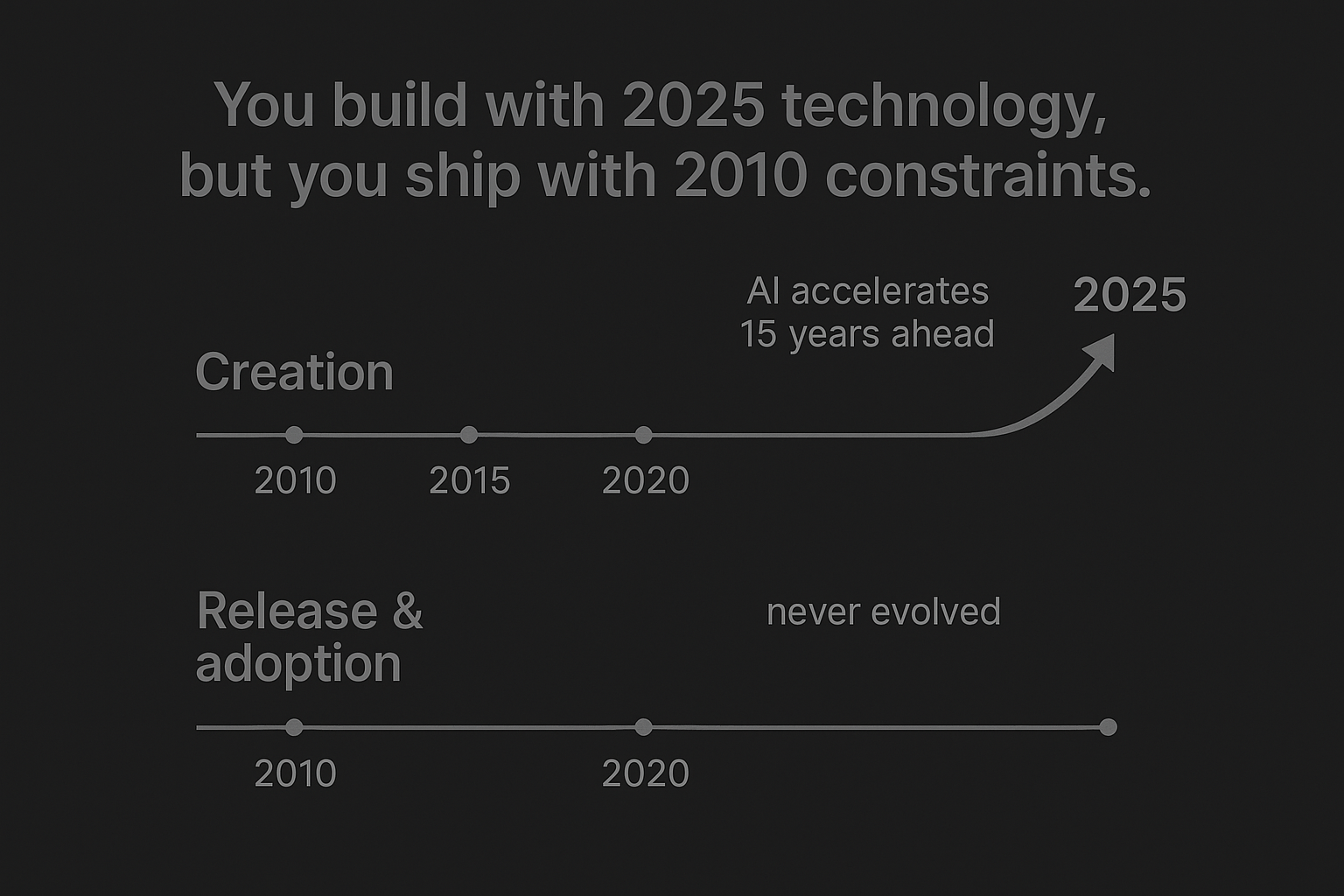
Every team eventually feels this tension. You build with 2025 technology, but you ship with 2010 constraints. The more AI accelerates creation, the more painful this mismatch becomes.
At some point, the industry had to confront a question it has avoided for years:
If the world is building faster than ever, why aren’t apps evolving faster?
And all roads lead to the same conclusion:
If releases are the bottleneck, stop depending on releases. If adoption is the bottleneck, stop depending on adoption.
This isn’t a tooling trick. It’s not a productivity hack. It’s not another DevOps upgrade. It is the emergence of the first truly new model of mobile development in a decade:
The Zero-Release Model.
But What Exactly Is this Zero-Release Model?
To understand Zero-Release, you have to unlearn a foundational assumption of mobile development: that the product experience lives inside the binary.
If you wanted to change onboarding, adjust pricing, test a layout, or update a paywall, you opened Xcode or Android Studio, made the change, built a new version, submitted it, waited for review, and hoped users updated. The binary was the container for everything - UI, logic, flows, content, experiments.
Zero-Release breaks this assumption at the root.
Under the Zero-Release Model, the binary stops being the product. It becomes the engine that runs the product. The actual experience - the screens, the navigation, the logic, the text, the offers, the states all lives on the server, evolves on the server, and reaches the user the moment it changes.
The user doesn’t update the app to get a new experience but the experience updates itself.
In this model:
- A new onboarding flow isn’t shipped in a version. It is streamed.
- A new layout isn’t packaged. It’s defined on the server and rendered instantly.
- Experiments aren’t tied to releases. They are live variations controlled centrally.
- Product evolution isn’t gated by App Store approvals or user adoption. It becomes continuous.
The binary is still essential, it handles OS-level interactions, performance, network, sensors, authentication but the evolution of the product no longer depends on the binary.
This is the philosophical break. This is what unlocks everything else.
Zero-Release isn’t about skipping releases; it’s about untethering product velocity from them. It transforms the mobile app from a static artifact into a dynamic system, one that adapts as fast as your thinking.
The Mental Shift Behind Zero-Release
The architecture is only half the story; the mindset shift is the real unlock. For decades, mobile teams were trained to think in versions: version 3.4.2, version 6.1.0, version whatever. Product evolution happened in discrete packets, each one scheduled, prepared, tested, approved, and gradually adopted.
Zero-Release collapses that mental model.
The product isn’t delivered in versions anymore, it is delivered continuously.
| Old Thinking | New Thinking |
|---|---|
| We ship versions. | We ship experiences. |
| Users adopt when they update. | Users adopt instantly, nothing to update. |
| Learning begins after rollout. | Learning begins the moment a change is made. |
| Releases are stressful milestones. | Releases fade into the background. |
This mindset shift has profound consequences. AI has already crushed the “how fast can we build?” barrier. But without Zero-Release, that acceleration doesn’t matter because feedback remains slow.
Once the product becomes dynamic, AI-accelerated creation finally connects to AI-accelerated learning. Ideas move into production instantly, signals return instantly, and iteration loops tighten from months into hours.
This is the first time in mobile history where building fast and learning fast become equally possible.
How Zero-Release Actually Works
The mechanism behind Zero-Release isn’t magic; it’s Server-Driven UI (SDUI).
The native app becomes a renderer capable of interpreting instructions.
The server becomes the source of truth for the actual UI, navigation, and logic.
When the user opens the app:
- The app requests a UI schema.
- The server returns the components, layout rules, content, and conditions.
- The app renders everything natively.
- If product changes something on the server, the next app launch reflects it instantly.
This architecture shifts responsibilities:
| Native (The Engine) | Server (The Experience) |
|---|---|
| Performance, OS APIs, Networking | Interface layout, Navigation Flow |
| Sensors, Authentication, Payments | Business Logic, Dynamic Content |
| Core Capabilities and Components | Experimentation (A/B Tests), Personalization Rules |
Teams stoped shipping screens. They ship capabilities. Screens assemble themselves dynamically at runtime.
Want to know more about Server Driven UI (SDUI)? Read in full -> Server Driven UI (SDUI): The Necessary Evil for Scalable Mobile Apps
This transforms the role of native engineering. Instead of rebuilding the same interface over and over, native teams focus on expanding the engine - improving performance, adding integrations, strengthening security, and exposing new capabilities the experience layer can use.
The product team becomes the driver of evolution, editing the experience in real time.
What Makes Zero-Release Systems Possible
To support continuous evolution, several layers must work in harmony. A mature Zero-Release system typically includes:
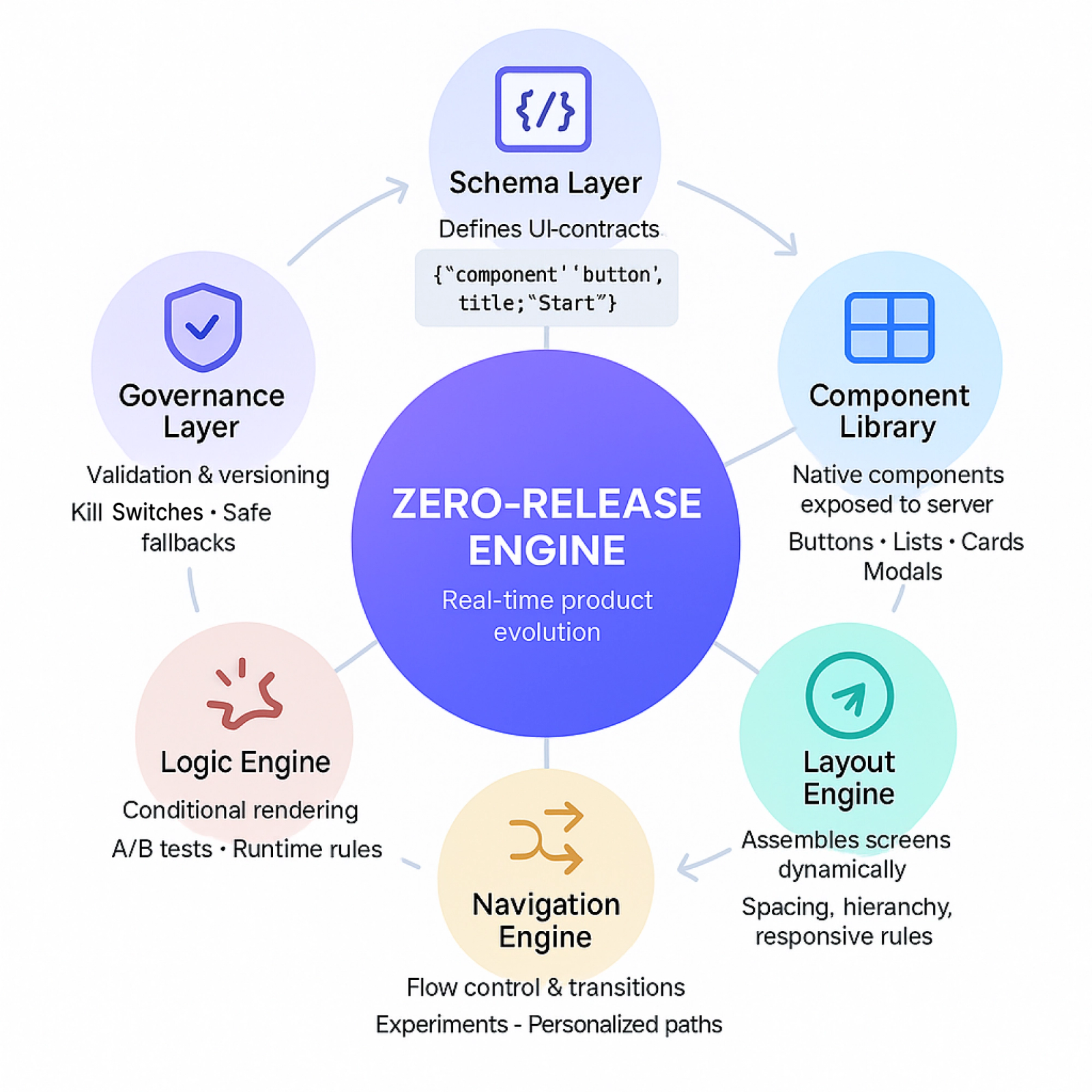
Schema Layer
A shared contract defining how the client and server communicate, ensuring predictable rendering and safe updates.
Component Library
A curated set of native UI elements that the server can compose dynamically. Stability and performance here determine how expressive the experience can be.
Layout Engine
Rules that describe how components assemble into screens. This allows high-level changes (like rearranging onboarding) without touching code.
Navigation Engine
Dynamic routing logic that defines how users transition across flows, experiments, or personalized paths.
Logic Engine
Conditional rendering, A/B tests, personalization rules, and runtime branching. This is the heart of adaptive UX.
Governance Layer
Validation, versioning, kill switches, fallbacks, audit trails, and safety nets that ensure mistakes don’t propagate instantly.
The power here is not any one layer, it’s how they interlock to make real-time evolution safe, predictable, and reversible.
Trade offs of Zero Release Model
Zero-Release is not a free lunch; it represents a major engineering and operational trade-off. Teams eliminate the cost of repeated UI feature work (low-leverage, high-frequency) but introduce the substantial, complex cost of building and maintaining a sophisticated Mobile Platform (high-leverage, high-stability).
The primary trade-offs are detailed below:
1. The Centralization of Complexity
| Feature Velocity vs. Platform Stability | Individual feature developers gain extreme velocity, but the centralized Schema and Component Library become single points of failure. The platform team must now be obsessed with backwards compatibility and robustness, as a mistake in the engine affects every dynamic screen, not just one feature. |
|---|---|
| Shift to Declarative Contract | Native teams lose the flexibility of imperative, hand-tuned UI code. They must adhere to the limitations of the Schema Layer and the Component Library. If a product team needs a unique new design, the platform team must first build the underlying component or schema rule, which is a new dependency. |
| Platform Investment Over Feature Work | The biggest cost. The initial engineering lift to build a functional Layout Engine, Navigation Engine, and Governance Layer is immense. This requires a dedicated, well-funded platform team for 12–18 months before the product team sees significant velocity gains. |
2. Operational & Debugging Overhead
| Decoupled Debugging | A crash is no longer just a client bug or a server bug; it's a contract violation. Debugging requires correlating client logs, server logs, and the specific dynamic Configuration (Schema) that was streamed at that moment. The complexity of tracing logic flow increases significantly. |
|---|---|
| Increased Governance Responsibility | The Governance Layer must be flawless. Deploying UI is now as risky as deploying backend API logic. The company must adopt robust CI/CD for configurations, including audit trails, permission layers, and rapid rollback tooling for non-code assets. |
| Offline and Caching Complexity | Maintaining a coherent, performant experience when the network is poor or offline becomes difficult. The platform must intelligently manage local schema caching and pre-fetching while gracefully handling version mismatches between the cached schema and the current server schema, which is a significant technical challenge. |
3. Cultural & Skill Shift
| Native Engineer Job Shift | Native engineers must transition from feature implementers to platform providers. This requires a mindset change toward building robust, reusable systems and focusing on performance/reliability, which can lead to friction or attrition if not managed with strong leadership. |
|---|---|
| Product Team Responsibility | Product Managers and Designers gain immense power to change the experience instantly, but they also inherit the responsibility for safety. They must be trained on the platform's Governance rules, understand the limitations of the Component Library, and be hyper-aware of the impact of continuous releases. |
Zero-Release demands a higher discipline in engineering practices and platform governance, but in return, it unlocks product velocity that is fundamentally impossible under the traditional version-based mobile model.
Zero-Release Doesn’t Replace Native. It Amplifies It.
A common misconception is that SDUI reduces the importance of native engineering. The opposite is true. SDUI frees native teams from repetitive UI maintenance and lets them focus entirely on the high-leverage work that mobile apps depend on: core performance, deep system integrations, secure storage, low-latency networking, and OS-level interactions.
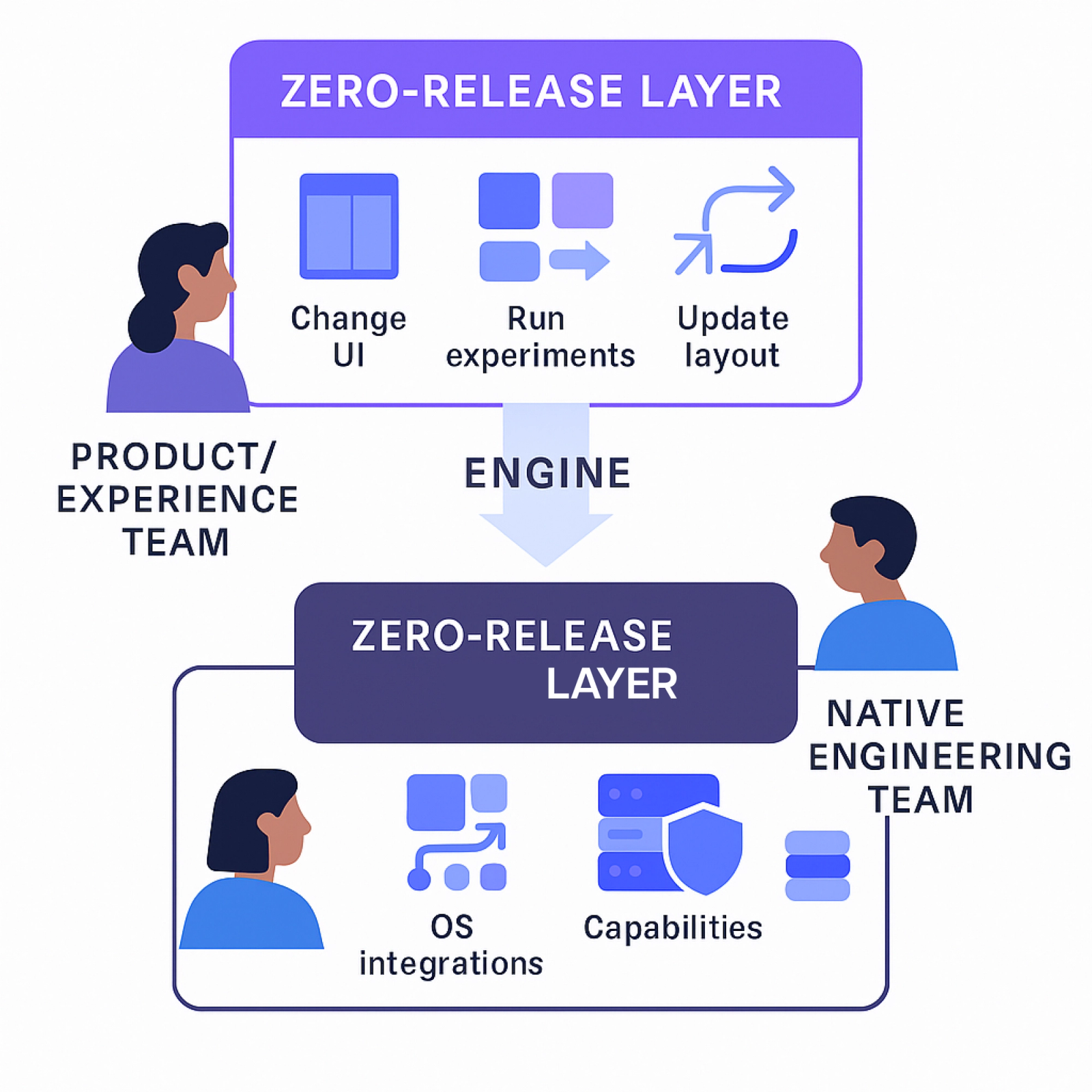
In Zero-Release systems, native engineering becomes the platform team.
Product engineering becomes the experience team.
The distinction finally becomes clear.
Native code doesn’t disappear. It becomes the foundation on which evolution accelerates.
Why the Industry Has Already Shifted
The most iteration-driven companies like LinkedIn, Netflix, Airbnb, Flipkart, Zomato, Urban Company, adopted SDUI long before the rest of the industry paid attention. They didn’t adopt it because it was fashionable. They adopted it because their business models could not survive release cycles.
| Company | Why They Adopted SDUI | Outcome |
|---|---|---|
| Daily feed + onboarding experiments | Faster growth through rapid iteration | |
| Netflix | Constant optimization of promotions & thumbnails | Hyper-personalized UX |
| Airbnb | Dynamic screens across platforms | Faster rollout cycles |
| Flipkart | Seasonal UX demands | Real-time control |
| Zomato | Instant onboarding & paywall tests | Growth loop acceleration |
| Urban Company | Diversified service flows | Parameterized, flexible workflow |
These companies ran into the limits of app-store-paced evolution earlier than anyone else. They rebuilt their architectures not out of curiosity, but out of necessity.
Now, AI has accelerated creation to the point where traditional delivery pipelines are fundamentally incompatible with modern product speed. The industry is being forced into the next phase.
Conclusion: Evolution is the New Battlefield
For the last decade, the entire industry poured its energy into building faster. New tools, new frameworks, new automation that everyone was chasing speed. And now, with AI compressing creation time to practically zero, that part of the game is solved. We can generate screens, flows, and entire features in minutes.
So the real question becomes: what matters next? The next decade won’t be defined by creation. It will be defined by evolution by how quickly an app can change, adapt, learn, and improve while it’s already in people’s hands.
And this is where Zero-Release fundamentally changes the conversation. It’s not a framework you plug in, it’s not a shiny feature you enable, and it’s definitely not a clever workaround. Zero-Release is a structural shift in how mobile software behaves and how product teams operate. It turns the app from a static object into a living system. That shift is so profound that, very soon, teams won’t be wondering whether they should adopt it, they’ll be wondering how long they can survive without it.
Because the truth is, the world already builds fast. That advantage is gone. The teams that win now are the ones that learn faster, and you simply can’t learn fast if you can’t deliver fast. Zero-Release removes the friction between idea, iteration, and adoption. It breaks the bottleneck that has held mobile back for years and finally aligns product velocity with market reality.
In a world where creation takes minutes, evolution becomes the battlefield and Zero-Release is the engine that makes rapid evolution possible.
Digia: The Engine That Makes Zero-Release Practical
Zero-Release sounds inevitable on paper, but any team that has tried to implement SDUI or dynamic runtime systems knows the truth: the idea is simple; the execution is brutal.
You don’t just need JSON-driven screens, you need a stable schema contract, a native rendering engine, a component library, a layout engine, a navigation engine, a logic layer, and governance that prevents bad configurations from detonating in production. Building even a basic version of this takes 12–18 months of platform engineering, not counting maintenance, compatibility, and evolving product needs.
This is the gap Digia fills.
Digia Studio gives teams a production-ready Zero-Release engine on day one - the infrastructure required to make continuous product evolution safe, fast, and scalable. Instead of sinking a year into platform work, teams can install Digia and start shipping dynamic experiences in the same week.
But the real advantage is this: Digia doesn’t require a rewrite.
The biggest fear teams have with Zero-Release is that it demands rebuilding the entire app around a new architecture. Digia makes that concern irrelevant. It integrates directly into existing iOS and Android apps, no matter how old the codebase or how complex the modules. This is how Zero-Release adoption is supposed to work: surface by surface, capability by capability, fully compatible with your existing app from day one.
Under the hood, Digia handles everything that is expensive, risky, and operationally complex about Zero-Release:
- A stable, versioned schema layer that prevents client–server mismatches
- A native component library that renders UI with true performance
- A declarative layout and navigation engine that turns definitions into full experiences
- A logic layer for conditions, experiments, and personalization
- A governance layer with validation, preview modes, audit logs, kill switches, and instant rollback
And unlike generic SDUI attempts, Digia is designed for the AI era. Digia completes the loop: AI accelerates creation, Digia accelerates delivery, and together they eliminate the bottleneck between idea → iteration → adoption.
For the first time, mobile teams can build as fast as they think and ship as fast as they build.
This is the core promise:
Digia transforms your native app into a system that evolves continuously, without rewrites, without waiting for releases, and without depending on user updates.
Teams keep their native strengths: performance, security, sensors, payments, deep OS integrations. Digia simply becomes the runtime that powers everything above it - the surfaces, flows, screens, and logics that change weekly, daily, or hourly.
In other words: Your app stays native. Your evolution becomes instant.
That’s what Zero-Release demands. And Digia is the practical, production-ready way to reach it.