


In most mobile apps, onboarding helps users understand the product quickly. The goal is simple: show the value, reduce friction, and guide users to their first meaningful action.
In fintech, healthcare, payments, and other trust-sensitive products, onboarding carries a different responsibility.
Users are not only evaluating the usefulness of the product. They are evaluating the safety of the product. Before they connect a bank account, upload identity documents, or share health information, they must believe that the app is legitimate, responsible, and secure.
This changes the role of onboarding entirely.
The first minutes of the product experience become a moment of risk evaluation. Users start asking quiet but important questions:
- Can this company be trusted with my data?
- Will my money be safe here?
- What happens if something goes wrong?
A customer onboarding checklist for these environments cannot focus only on product education. It must also guide users through a gradual process of confidence building.
Why Standard Onboarding Checklists Fail in High-Trust Products
Most mobile onboarding checklists were originally designed for SaaS products where the perceived risk of engagement is relatively low.
When someone signs up for a project management tool or a note taking app, the worst possible outcome is usually inconvenience. The user may waste time or dislike the interface. Very little personal risk is involved.
Trust-sensitive apps operate in a very different environment.
A financial app may ask users to connect their bank accounts. A healthcare app may require personal medical data. A payment platform may request identity verification documents. Each of these requests introduces a moment of hesitation.
Users are not simply learning how the product works. They are deciding whether it is safe to continue.
Standard onboarding patterns often fail here because they treat trust as an assumption rather than a goal. Product tours, feature walkthroughs, and linear checklists attempt to move users forward without acknowledging the underlying risk evaluation that is happening in the user's mind.
When that risk evaluation is ignored, friction increases. Users hesitate, abandon onboarding, or delay sensitive actions even when they initially intended to continue.
What Makes Customer Onboarding Different in Fintech, Health, and Payments
Trust-sensitive industries operate within constraints that do not exist in most consumer apps.
Regulatory requirements introduce mandatory steps such as identity verification and compliance checks. These steps cannot simply be removed or simplified. They must be handled carefully so they do not appear suspicious or intrusive.
Data sensitivity also changes the user experience. When users share health records or financial data, the emotional weight of that decision is significantly higher than when they create a standard app account.
Mistakes also carry higher consequences. If a user misunderstands a step in a productivity app, the result may be confusion. If a user misunderstands a step in a financial app, the result may feel like a financial risk.
Because of these conditions, onboarding must balance two goals at the same time. It must guide users toward activation while also reinforcing legitimacy, transparency, and security.
During the first session, trust becomes the real product experience.
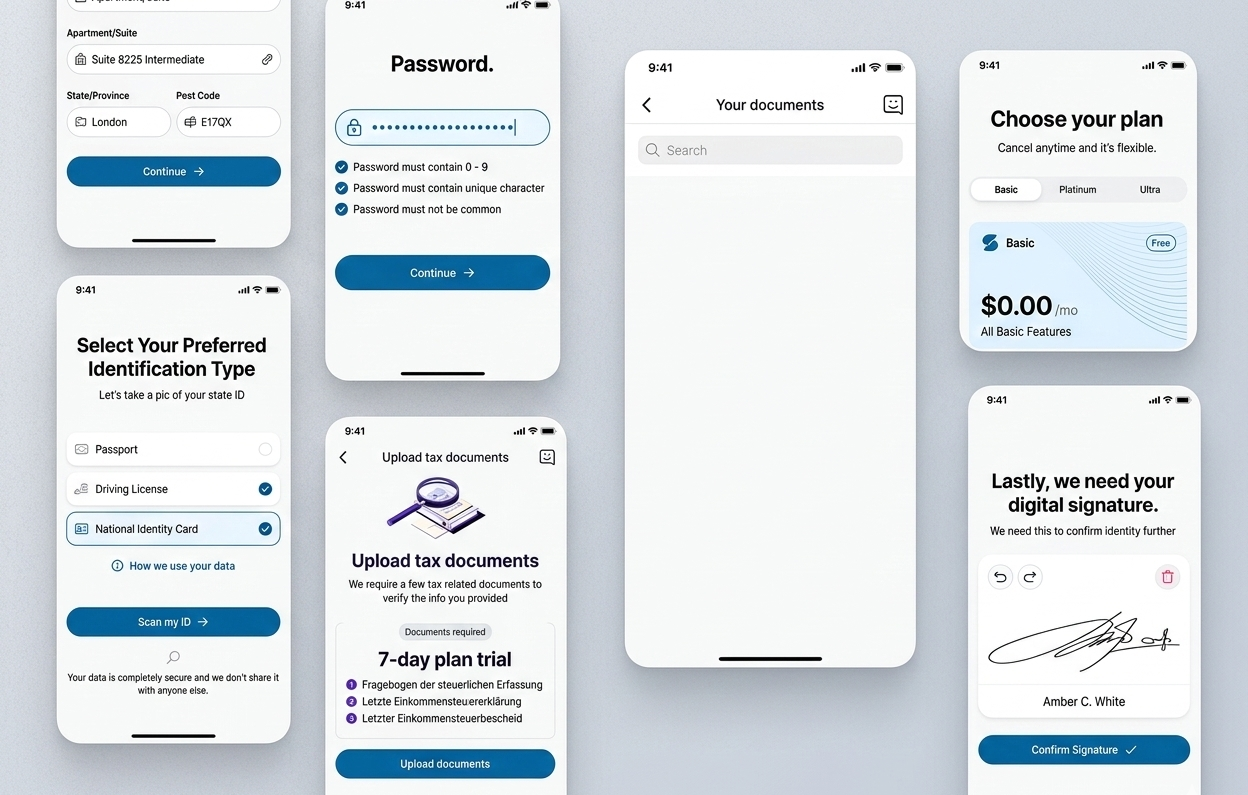
The Three Psychological Barriers Users Experience During Trust-Sensitive Onboarding
Even when users intentionally install a fintech or healthcare app, several psychological barriers appear during onboarding.
The first barrier is the fear of misuse of personal data. Users know that sensitive information has value. When an app asks for identity details or financial access, users immediately question how that information will be stored and protected.
The second barrier is uncertainty about legitimacy. Many legitimate companies look visually similar to fraudulent apps or scam websites. Users must determine whether the app belongs to a trustworthy institution or an unknown actor.
The third barrier is the fear of irreversible actions. Connecting a bank account or submitting verification documents may feel permanent. Users want reassurance that they maintain control and that mistakes can be corrected.
These barriers rarely appear as explicit complaints. Instead, they show up as hesitation, abandonment, or repeated attempts to verify legitimacy before continuing.
Onboarding design must acknowledge these concerns and respond to them directly.
The following checklist helps product teams design onboarding flows that build trust while guiding users toward activation.
The Customer Onboarding Checklist for Trust-Sensitive Mobile Apps
A strong customer onboarding checklist in trust-sensitive environments focuses less on speed and more on clarity and reassurance. Instead of pushing users toward completion as quickly as possible, the goal is to guide them through a sequence of trust-building steps.
The following checklist reflects common patterns used in successful fintech, health, and payment apps.
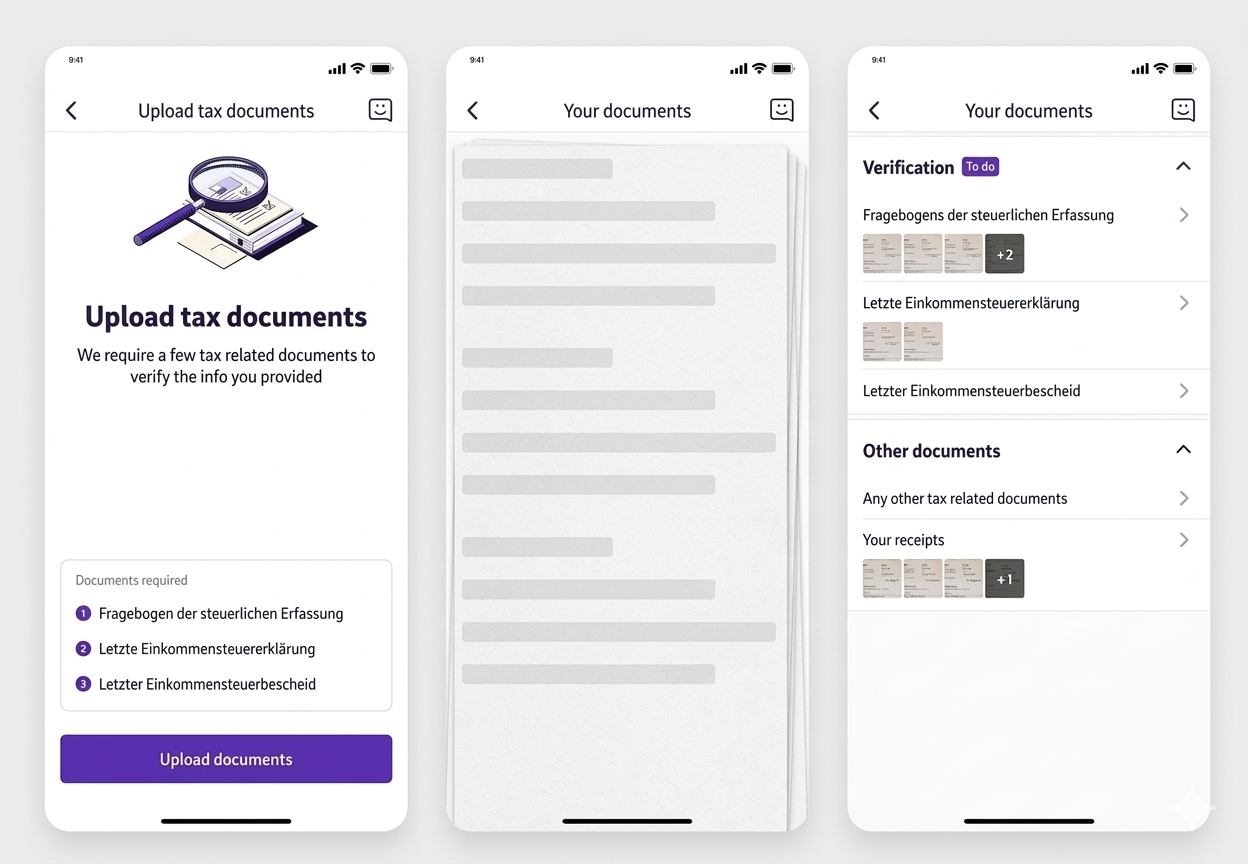
Step 1: Explain Why Information Is Required
Before asking users for sensitive information, explain why the request is necessary. When users understand the purpose of a request, hesitation decreases significantly.
A brief explanation about regulatory requirements, fraud prevention, or security protections can transform a suspicious request into a reasonable step.
For example, a fintech product requesting identity verification might explain that regulations require identity checks to protect both the user and the platform.
Transparency reduces perceived risk before the user even begins the action.
Step 2: Establish Legitimacy Immediately
Users need early signals that the product is trustworthy. These signals should appear within the first screens of onboarding.
Common legitimacy signals include:
- regulatory affiliations
- security certifications
- partnerships with established institutions
- clear company information
These signals reassure users that the product operates within a credible ecosystem rather than appearing as an unknown entity asking for sensitive data.
Step 3: Reduce the Perceived Risk of First Actions
The first meaningful action inside the product should feel safe and reversible. Users should feel comfortable exploring without worrying about irreversible consequences.
Providing previews, confirmation messages, or undo options can reduce the psychological risk of interacting with the product.
When users feel safe experimenting with early steps, they are more likely to continue deeper into the onboarding process.
Step 4: Delay Sensitive Requests Until Context Exists
Sensitive requests should appear only after users understand the product's value.
When identity verification or financial access appears immediately after installation, users may interpret the request as suspicious. However, when these steps appear after users understand the product's purpose, they feel logical rather than intrusive.
This approach is often described as progressive trust building.
| Onboarding Stage | User Understanding | Appropriate Request |
|---|---|---|
| Early stage | User learning about product | Basic account creation |
| Mid stage | User understands product value | Identity verification |
| Later stage | User ready for real usage | Financial or data access |
Progressive disclosure ensures that each request appears at the right moment in the user's mental journey.
Step 5: Provide Clear Progress Visibility
Users should always understand where they are in the onboarding process and how many steps remain.
Progress indicators, step explanations, and predictable sequences help users feel in control of the experience. When users know what to expect, anxiety decreases and completion rates increase.
Even simple indicators such as “Step 2 of 4” can significantly reduce abandonment.
Step 6: Offer Human Reassurance
Even well designed onboarding flows benefit from visible human support.
Support options, contextual help, or accessible assistance channels reassure users that they are not interacting with an unresponsive system. Knowing that help exists increases perceived safety.
This reassurance becomes particularly important during sensitive steps such as identity verification or financial connection.
Together, these steps transform onboarding from a procedural flow into a structured trust-building experience that encourages confident engagement.
The Most Common Customer Onboarding Failures in High-Trust Apps
Many trust-sensitive apps struggle not because onboarding is slow, but because the experience unintentionally creates suspicion.
Identity verification requests often appear too early in the process. When users are asked to upload documents before understanding the product, the request can feel invasive.
This pattern appears frequently in real product discussions.
In a Reddit thread about fintech onboarding, one builder noted that many users abandon apps during KYC simply because the process feels confusing and intrusive before the product’s value is clear.
Another common failure occurs when sensitive data is requested without explanation. A form that suddenly asks for financial or medical information can immediately trigger doubt.
Compliance flows also create problems when they resemble scam patterns. Unexpected permission requests, unclear verification steps, or repeated document submissions may cause users to question the legitimacy of the platform.
Technical failures during verification introduce another risk. When verification fails without clear guidance, users often abandon the process entirely.
The following table illustrates common onboarding failure modes.
| Failure Mode | User Reaction | Result |
|---|---|---|
| Early identity verification | Suspicion | Abandonment |
| Unexplained data requests | Doubt | Hesitation |
| Confusing compliance steps | Frustration | Drop-off |
| Verification errors | Loss of confidence | Exit |
Understanding these patterns allows product teams to diagnose where trust begins to erode.
Most onboarding abandonment occurs during identity verification and permission requests.
Metrics That Actually Measure Trust During Onboarding
Most teams measure onboarding success through completion rates or time to completion. While useful, these metrics do not fully capture trust dynamics.
More meaningful metrics often appear around sensitive steps in the onboarding journey.
Verification completion rates provide insight into how comfortable users feel submitting required documents. Drop off rates at identity verification steps can reveal hesitation caused by unclear communication or perceived risk. This friction is frequently discussed by fintech builders as well. In a Reddit discussion about real-world KYC implementations, one contributor noted that many systems are designed primarily for compliance checklists rather than user experience, which often leads to drop-offs during verification steps.
Abandonment around permission requests also signals trust breakdown. If users frequently exit after requests for financial access or health data, the explanation and context may be insufficient.
Another useful metric is the first trusted action rate. This measures how many users proceed to meaningful engagement after completing onboarding.
Time to confidence can also be revealing. This reflects the time it takes for users to feel secure enough to interact with core product functionality.
Tracking these metrics allows teams to diagnose trust gaps rather than simply measuring onboarding speed.
| Metric | What It Measures | What It Reveals |
|---|---|---|
| Verification Completion Rate | Percentage of users who complete identity verification | Indicates how comfortable users feel submitting sensitive documents |
| Identity Verification Drop-off | Users who exit during KYC or verification steps | Reveals hesitation caused by unclear instructions or perceived risk |
| Permission Request Abandonment | Users who leave after financial or data access requests | Signals lack of trust or insufficient explanation for permissions |
| First Trusted Action Rate | Users who perform a meaningful action after onboarding | Shows whether onboarding successfully builds enough confidence for engagement |
| Time to Confidence | Time taken before users interact with core product features | Indicates how quickly users feel safe enough to use the product |
How Digia Helps Teams Detect Onboarding Failure Modes
Understanding where onboarding fails is not only a design challenge. It is also a visibility challenge. Product teams often see drop-offs in analytics dashboards but struggle to identify what actually caused the hesitation.
This is where platforms like Digia become valuable.
Digia allows product teams to modify onboarding flows dynamically without shipping a new app release. Screens, sequences, copy, and interaction prompts can be adjusted directly from a centralized dashboard.
Instead of treating onboarding as a static flow that changes only during major updates, teams can continuously experiment with different explanations, step orders, and trust signals.
This flexibility becomes especially important in trust-sensitive apps where small details influence user perception. Even minor delays or unclear confirmation messages can introduce uncertainty.
By enabling rapid experimentation, Digia helps teams identify the exact moment where user confidence breaks down during onboarding.
Over time, this creates a feedback loop where onboarding evolves through continuous improvement rather than remaining fixed as a static checklist.
Designing Onboarding for Confidence, Not Just Completion
In trust-sensitive apps, finishing onboarding does not guarantee success.
A user may technically complete every step but still feel uncertain about the product. When that happens, engagement often stops immediately after onboarding ends.
Effective onboarding focuses on building confidence throughout the experience rather than pushing users toward completion as quickly as possible.
When users understand why information is required, when legitimacy is clearly communicated, and when sensitive actions feel safe and reversible, the onboarding journey becomes a natural progression instead of a forced sequence.
The real outcome is not the final screen of onboarding. The real outcome is the moment when users feel comfortable enough to continue interacting with the product.
Conclusion
Trust Is the Real Goal of Customer Onboarding
In fintech, healthcare, and payment platforms, onboarding is not simply a tutorial or a checklist.
It is the first negotiation of trust between the product and the user.
Every request for information, every verification step, and every explanation contributes to that negotiation. When these moments are handled thoughtfully, onboarding becomes a bridge that connects curiosity with confidence.
When they are handled poorly, even interested users may walk away before experiencing the true value of the product.
A customer onboarding checklist for trust-sensitive mobile apps must therefore prioritize clarity, transparency, and reassurance.
Because in environments where trust matters most, activation begins only after confidence is established.