





There is a common belief in modern engineering teams that once enough tests are automated, quality becomes predictable. Pipelines run on every commit, dashboards show green builds, and coverage metrics create a sense of control. On the surface, it feels like testing has been industrialized.
That confidence is often misleading.
Automation did not eliminate the need for testing. It shifted the problem. The challenge is no longer executing tests at scale, but deciding what actually deserves to be tested and how. The real bottleneck has moved from execution to thinking, from running checks to understanding risk.
“Automation verifies what you already know. Testing is about discovering what you don’t.”
This distinction is where most teams start to struggle.
What Automated Testing Does Exceptionally Well
Automation works best in environments where behavior is stable and expectations are clearly defined. When the system is predictable, automation becomes both efficient and reliable.
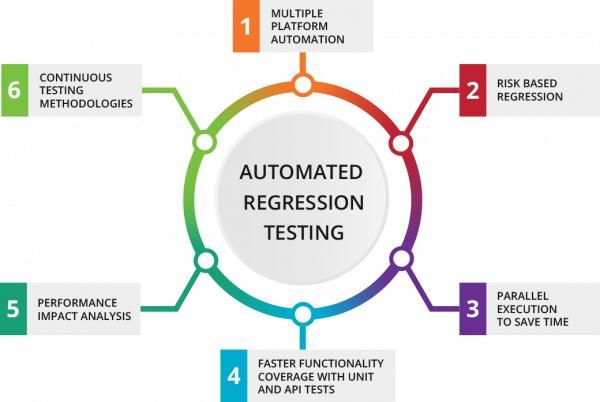
Automated tests handle repetitive execution far better than humans ever could. Scenarios that need to be validated across hundreds of inputs or configurations can be executed consistently without fatigue or variation. This makes automation ideal for regression testing, where the goal is to ensure that previously working functionality continues to behave correctly over time.
In continuous integration and delivery pipelines, automation provides rapid feedback. It allows teams to detect issues early, reduce the cost of fixes, and maintain development velocity. Without automated validation, modern release cycles would slow down significantly.
However, all of this effectiveness depends on one assumption. The system behavior being tested must already be understood.
Where Automation Breaks Down and Misleads Teams
Automation rarely fails in obvious ways. Instead, it creates subtle distortions in how teams perceive quality.
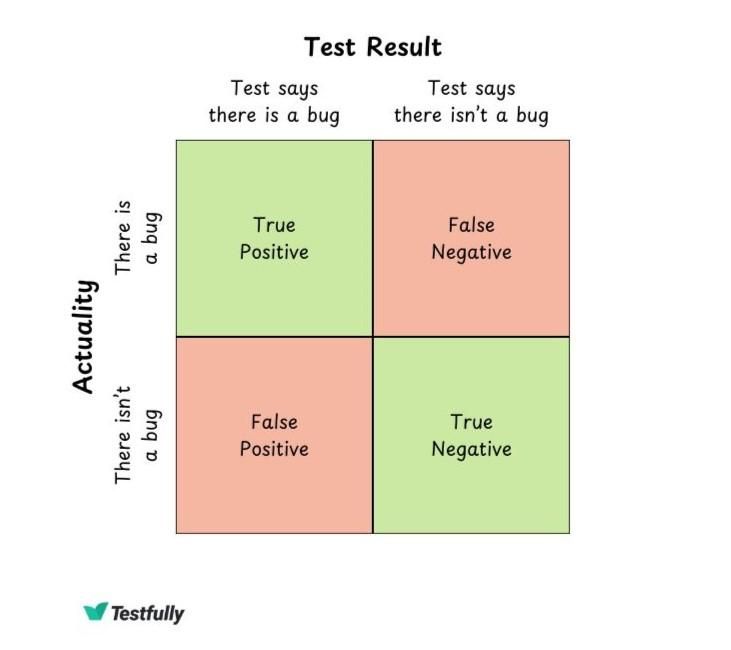
A passing test suite often gives the impression that the system is working correctly. In reality, it only confirms that the system behaves as expected under predefined scenarios. Anything outside those scenarios remains invisible. This leads to false confidence, where teams trust metrics more than actual product experience.
Another issue emerges over time in the form of brittle test suites. As applications evolve, automated tests often struggle to keep up. Minor UI changes, timing inconsistencies, or dependency updates can cause failures that are not tied to real defects. Maintaining these tests begins to consume significant effort, sometimes rivaling feature development itself.
Automation also struggles with nuance. It can verify whether an interaction succeeds, but it cannot evaluate whether that interaction is intuitive or frustrating. Many of the most impactful product issues exist in this gray area, where correctness is not enough.
What Should Never Be Fully Automated
Certain aspects of testing are fundamentally human. Attempting to automate them often leads to wasted effort or misleading results.
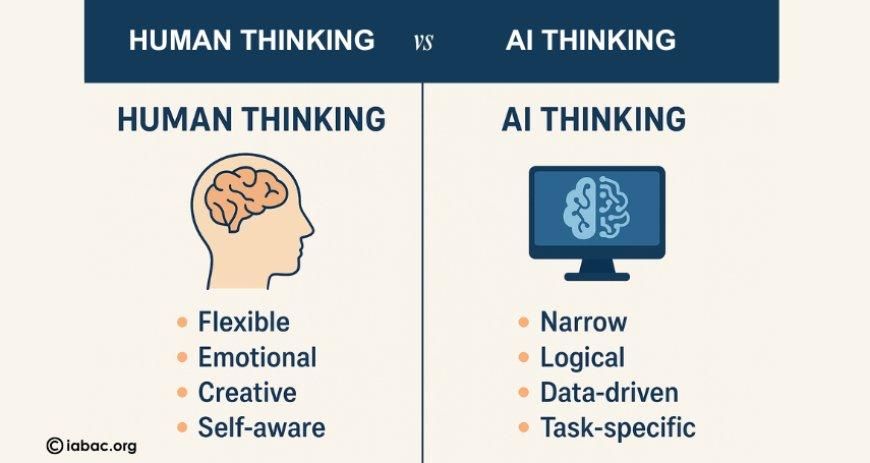
Exploratory testing is one such area. It relies on curiosity and the ability to navigate systems without predefined paths. Testers actively learn, adapt, and investigate unexpected behaviors. This process cannot be reduced to scripts without losing its value.
Usability and experience are equally resistant to automation. A system may function correctly while still confusing users. These issues are often subtle and contextual, requiring human perception rather than rule-based validation.
There is also the challenge of unknown edge cases. Automation depends on known inputs and expected outputs. Many critical failures occur outside these boundaries, in scenarios no one anticipated during test design.
Early-stage products present an additional constraint. When requirements are still evolving, automating too early introduces rigidity. Tests become tightly coupled to assumptions that may soon change, leading to constant rework.
Manual Testing: The Role Most Teams Undervalue
Manual testing is often framed as less efficient, but this view ignores its strategic importance. Its strength lies not in scale, but in adaptability and insight.
Experienced testers develop pattern recognition over time. They begin to notice inconsistencies and unusual behaviors that fall outside defined requirements. This ability allows them to identify risks that automated systems would never flag.
There is also a category of issues that can be described as “feels wrong.” These are not functional failures, but they impact user trust and experience. They often emerge in areas like navigation flow, responsiveness, or visual hierarchy. Manual testing is uniquely suited to uncover these problems.
Another advantage is flexibility. When product requirements shift, manual testers can immediately adjust their approach. They do not require refactoring or maintenance. They simply change how they explore the system.
Human Intuition vs Scripted Logic
The distinction between manual and automated testing becomes clearer when viewed through their core capabilities.
| Dimension | Automated Testing | Manual Testing |
|---|---|---|
| Purpose | Validation | Discovery |
| Strength | Speed and consistency | Adaptability and intuition |
| Limitation | Limited to predefined scenarios | Limited scalability |
| Output | Pass or fail signals | Insights and observations |
Automated tests are designed to prove that specific conditions produce expected results. They operate within strict boundaries and provide clear outcomes. Manual testing, on the other hand, thrives in ambiguity. It explores, questions, and uncovers behavior that was never explicitly defined.
Both approaches are necessary, but they solve different problems.
The Hybrid Testing Strategy That Actually Works
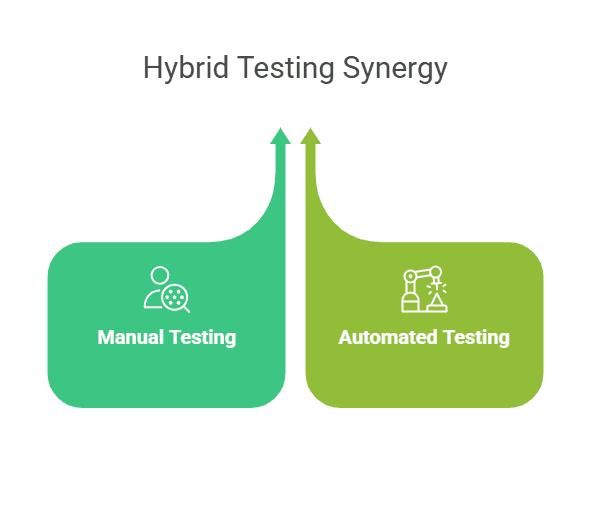
Effective testing strategies are not built around choosing one approach over the other. They are built around aligning each method with the type of problem it solves best.
Automation should be applied to stable, repeatable scenarios where consistency and speed are critical. These include regression checks, core workflows, and system integrations that need continuous validation.
Manual testing should focus on areas of uncertainty, where risk is not fully understood. This includes new features, complex user interactions, and scenarios where behavior cannot be easily predicted.
A practical way to approach this balance is through decision criteria:
- Automate scenarios that are stable, repeatable, and clearly defined
- Use manual testing when behavior is evolving or requires interpretation
- Reevaluate this balance regularly as the product matures
As systems grow more stable, automation coverage can expand. During periods of rapid change, manual exploration becomes more valuable.
A Practical Framework: Deciding What Goes Where
Instead of relying on preference or habit, teams benefit from a structured way to decide how to test.
| Scenario Type | Recommended Approach |
|---|---|
| Core business logic | Automated |
| Frequently used workflows | Automated |
| New feature exploration | Manual |
| UI and usability validation | Manual |
| Edge case discovery | Manual first, then automate if repeatable |
| Regression validation | Automated |
This framework helps prevent over-automation while ensuring that critical areas receive appropriate attention.
The Hidden Cost of Over-Automation
One of the less discussed problems in testing is over-automation. Teams often assume that more automated tests lead to higher quality. In practice, this can create inefficiencies.
Large test suites require maintenance, infrastructure, and execution time. When poorly managed, they slow down development rather than accelerate it. Flaky tests introduce noise, making it harder to distinguish real issues from false alarms.
There is also an opportunity cost. Time spent automating low-value scenarios is time not spent exploring high-risk areas. This imbalance can lead to systems that are well-tested on paper but fragile in real-world usage.
Common Mistakes Teams Make With Test Automation
Several patterns appear repeatedly in teams that struggle with testing effectiveness:
- Automating unstable features too early
- Treating coverage metrics as a proxy for quality
- Ignoring the cost of maintaining test suites
- Underinvesting in exploratory and manual testing
These mistakes often stem from a misunderstanding of what automation is meant to achieve.
The Real Problem Isn’t Manual vs Automated
Framing testing as a choice between manual and automated approaches oversimplifies the problem. The real issue lies in how each method is applied.
Many teams use automation as a substitute for thinking. They prioritize execution speed over understanding, assuming that more tests will compensate for gaps in insight. This leads to systems that are heavily instrumented but poorly understood.
Testing is not about running checks. It is about building confidence in a system through both validation and discovery.
Conclusion: Automation Scales Execution, Humans Scale Understanding
Automation plays a critical role in modern software development. It enables speed, consistency, and reliable validation at scale. Without it, maintaining quality in complex systems would be extremely difficult.
At the same time, automation has clear limits. It cannot question assumptions, interpret ambiguity, or identify issues that were never anticipated. These responsibilities remain firmly in the domain of human testers.
The most effective teams recognize this balance. They use automation to handle what is known and repeatable, while relying on human judgment to explore what is uncertain.
Because in the end, quality is not just something you verify.
It is something you understand.