


TL;DR: Personalization is one of the highest-ROI levers in mobile growth, and most teams chase it without understanding how it breaks. This article covers the four failure modes that quietly erode trust (cold start, segment drift, the filter bubble, and over-personalization), the fundamental tension between adaptation and predictability, and the concrete patterns that high-performing teams use to resolve it. Decision makers get a direct audit checklist at the end.
Why Teams Bet Big on Personalization
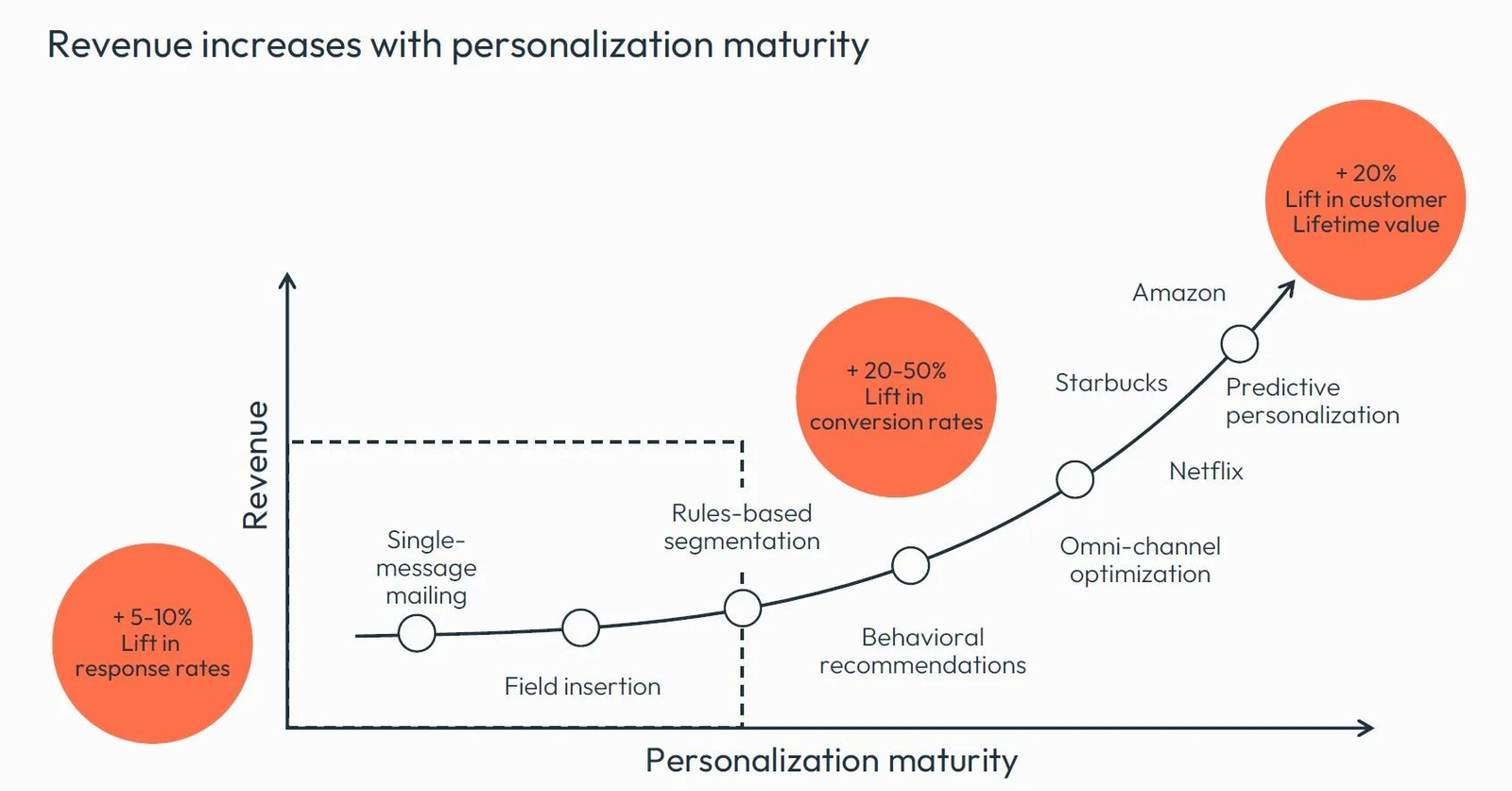
The business case is well-established. McKinsey's research shows that companies excelling at personalization generate 40% more revenue than average performers, with most teams seeing a 10 to 15% revenue lift from personalization investments, and company-specific results ranging from 5 to 25% depending on sector and execution quality.
Consumer expectations have moved in the same direction. 71% of consumers now expect companies to deliver personalized interactions, and 76% report frustration when those expectations go unmet. That number has climbed steadily since 2020, and the gap between expectation and delivery is still wide: 85% of companies say they provide personalized experiences, but only 60% of customers agree.
On mobile specifically, the stakes are higher. Screen real estate is limited. Attention windows are short. A 2025 analysis found that mobile users tolerate friction less than ever, with bounce rates up 54% year-over-year and error-related session exits jumping 254% from 2024 to 2025. Personalization is how product teams compete for attention without abusing it.
At the retention level, the data holds up. 1:1 personalization in mobile apps consistently drives a 5 to 20 percentage point retention lift compared to non-personalized alternatives. Apps with personalized onboarding flows see 40% higher retention over generic flows. Fitness apps using visible progress and behavior-based content nearly double retention over static alternatives, according to Adjust.
So teams invest. They build behavioral models, create segmentation logic, trigger personalized nudges and recommendations. The early results validate the investment. And then, somewhere between month three and month twelve, something breaks.
The engagement numbers plateau or dip. Support tickets reference confusing UI behavior. A segment that was modeled as high-intent converts poorly. Churn appears in a cohort that the system categorized as well-served. The personalization is working technically. The product is failing quietly.
This is the personalization paradox, and it has four failure modes.
The Four Failure Modes Nobody Audits
Most post-mortems on personalization focus on the model. The features, the weighting, the prediction accuracy. The failure is assumed to be a data quality or model quality problem. Sometimes that is correct. Most of the time, the failures are structural, present before the model runs, and visible in the experience long before they show up in retention dashboards.
Cold Start: Personalizing a User Who Does Not Exist Yet
Personalization requires behavioral signal. Behavioral signal requires behavior. New users have neither.
A new user facing low-quality recommendations might have a bad first impression and decide to stop using the service entirely. That is a research finding from Deezer's deployment on 14 million active users, but the pattern holds across verticals. Roughly 25% of users abandon an app after the first use. The window for establishing value is the first session, which is precisely the session where personalization has no data to work from.
Most teams handle this by falling back to popularity-based recommendations or globally relevant content. That is a reasonable engineering decision. Where the approach breaks down is product-level: the default experience is rarely designed with the same care as the personalized experience, because the team assumes most users will be past cold start quickly.
The problem is also broader than new users. The cold start problem resets for users who return after extended inactivity, creating a "continuous cold start" condition where even established users periodically become strangers to the model. A user who was active six months ago and returns today may have changed their behavior, their intent, and their needs entirely. The model carries the old profile. The user encounters irrelevant experiences. They leave again, this time faster.
Netflix's approach is instructive. Rather than defaulting to popularity, Netflix asks users a targeted series of questions during initial setup to capture explicit preferences before behavioral data exists. The questions are few, specific, and framed around how they improve the experience. 83% of consumers are willing to share data for personalization when they understand a clear benefit from doing so. Onboarding flows that make that exchange transparent convert explicit signal into early personalization without waiting for behavioral data to accumulate.
The cold start problem is not a technical problem. It is a product design problem. The fix is designing the early experience independently from the personalized experience, with explicit signal collection rather than algorithmic inference.
Segment Drift: Confident Signals, Wrong User
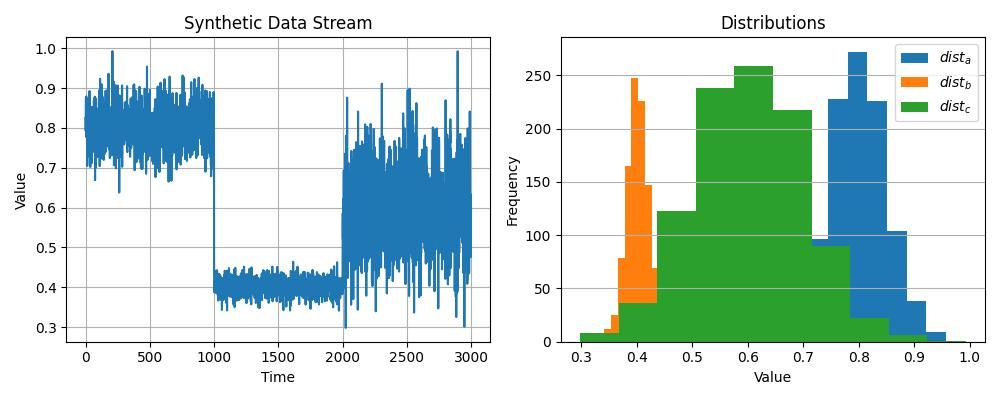
Behavioral models are trained on past behavior. They produce confident predictions based on that past behavior. The problem is that user behavior changes, often significantly, and the model does not know when it has become wrong.
Intent behaves like a heartbeat: it spikes, fades, and resurfaces in a matter of hours or days. Many segmentation systems, even those labeled "dynamic," are built around long-lived identity categories. A user modeled as a casual browser eight months ago may now be a high-intent buyer. The model keeps serving casual-browser content. The user does not convert. The team sees conversion underperformance in that segment without diagnosing why.
This is segment drift. The system is confident. The signals appear clean. There is no error state. The model is doing exactly what it was designed to do, based on a version of the user who no longer exists.
The operational fix is explicit signal decay. Segmentation strategies need decay logic, clean exit criteria, and re-entry conditions built in, so users flow into segments when intent is active, drift out when it cools, and do not carry yesterday's classification into today's session. Old behavioral signals should lose weight over time. Recent behavior should carry proportionally more.
The detection mechanism is also important. Segment drift does not announce itself. Monitoring for users whose behavior diverges significantly from their predicted profile, in either direction, is the early warning system. Without that monitoring, the team discovers segment drift six months after it started, when churn data finally catches up.
The Filter Bubble: Personalization That Caps Lifetime Value
When personalization optimizes for past preferences, it surfaces more of what the user has already engaged with. That is the mechanism. It is also the trap.
Users who receive increasingly similar content see their interest in that narrow band gradually exhaust. Discovery of adjacent content, new features, or alternative use cases drops toward zero. The system is optimizing for short-term engagement metrics, and those metrics look fine. Clicks are consistent with predictions. The user is interacting with what they are served. The longer-term signal, that the user is being served a shrinking slice of what the product offers, does not appear in the engagement dashboard.
A 2021 Pew Research Center study found that 62% of Americans believe social media algorithms reinforce existing beliefs rather than exposing users to new perspectives. The filter bubble effect is documented at scale in content platforms, but the mechanism applies equally to utility apps, e-commerce, fintech, and any product where personalization determines what a user sees.
For content apps, the filter bubble compresses lifetime value directly. Users exhaust interest in the category the system has placed them in. Churn follows, and it looks like category fatigue rather than personalization failure.
For utility apps, the filter bubble keeps users in shallow use patterns. They never discover workflows or features that would make them more dependent on the product. They remain easy to replace by a competitor who surfaces the same narrow functionality with a better interface.
Spotify's Discover Weekly is the most-referenced solution pattern because it is intentional about the problem. A portion of visible surface area is allocated to content explicitly outside the user's established preference cluster. The recommendation is surfaced with enough context (similar artists, related genres) to make the discovery feel relevant rather than random. Simulations of filter bubble formation in short-video platforms confirm that allowing user-specified interests to expand beyond initial categories produces both higher diversity and higher satisfaction scores simultaneously. Discovery and engagement are not in conflict when exploration is designed deliberately.
The filter bubble does not resolve itself. It must be engineered against. Teams that do not build explicit exploration mechanisms into their personalization system are building a ceiling on lifetime value from day one.
Over-Personalization: When Adaptation Breaks the Mental Model
This is the failure mode that receives the least attention and causes the most sustained damage.
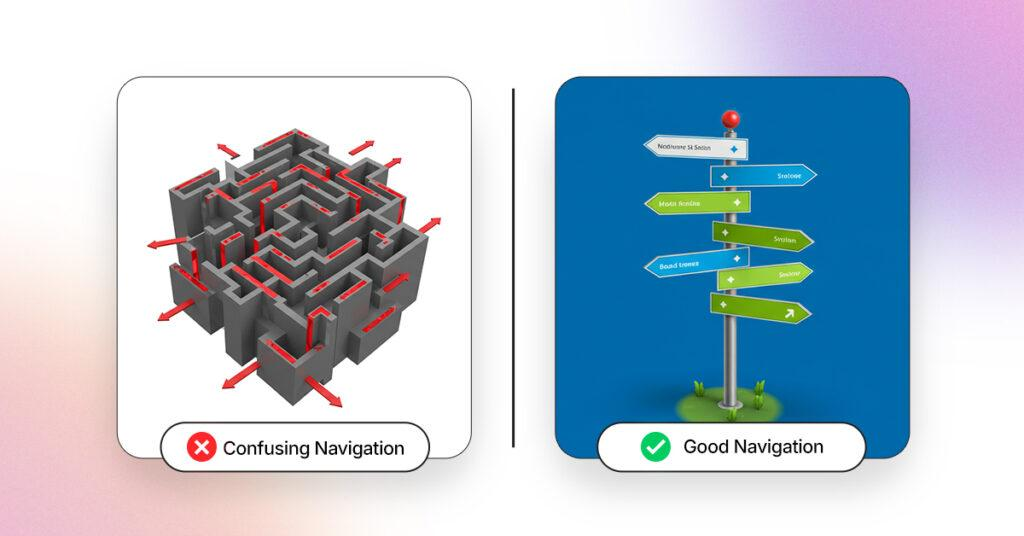
When personalization changes the structure of the product based on user behavior, navigation shifts. The order of options changes. Content appears in different places. Features surface and disappear based on usage patterns the user has no visibility into. From the engineering side, the system is adapting efficiently. From the user side, the product has become unpredictable.
Users do not experience this as "the app is adapting to me." They experience it as "the app is broken" or "I do not understand this app anymore." The mental model they built through prior use, the internal map of where things are and how the product works, is invalidated. They must relearn the interface. That cognitive cost reads as friction.
Trust in UX is built through predictability, consistency, and transparency. According to Jakob's Law, users expect a product to function consistently with their prior experience of it. When a platform behaves inconsistently or unpredictably, it disrupts the user's mental model, leading to hesitation and frustration. Hesitation and frustration are not attitudes that convert.
There is also a related problem: the uncanny valley of personalization. When personalization is precise enough that users cannot explain why they are seeing specific content, but accurate enough to feel surveillance-like, it generates unease rather than delight. 40% of consumers report they will stop doing business with a company after a trust violation. The pattern is consistent across platforms: creepiness emerges when personalization makes its mechanism visible. When users can see the machinery behind the surface, the experience collapses into distrust.
Over-personalization is not a data quality problem. It is a product philosophy problem. The question is not whether the system can adapt the product structure, it is whether it should.
The Predictability Tension
Here is the core conflict that personalization creates in any mobile product.
Users say they want personalization. When asked directly, they consistently indicate a preference for apps that adapt to their behavior. The research on this is unambiguous.
Give those same users an app that changes its behavior based on their data, and a significant portion will feel disoriented and distrustful. They will not attribute that feeling to the personalization system. They will attribute it to the product. Both things are true at the same time.
Predictability is a trust signal. When an app behaves consistently across sessions, users build a reliable mental model. That mental model gives them the confidence to take higher-commitment actions: purchases, sharing, integrating the app into a recurring workflow. Actions with higher commitment require higher trust. Higher trust requires predictability. Personalization, by introducing variability in what users see and how the product behaves, creates risk to that predictability.
The tension is not resolvable by choosing one side. A fully static app loses relevance. A fully personalized app becomes unpredictable. The product decision is which elements carry the most trust weight, and therefore which elements should be protected from personalization.
This is not an abstract design principle. It is a product architecture decision, and it has measurable consequences.
How High-Performing Teams Resolve It
The teams that handle personalization well share a set of patterns. None of them are complicated. Most of them are underbuilt in practice because they require deliberate decisions about what the personalization system is not allowed to do.
Personalize Content, Not Structure
This is the foundational principle. Navigation, core workflows, and interaction patterns stay stable across users and sessions. What changes is what appears inside those structures: which products are surfaced, which features are highlighted, which notifications are triggered, which content fills the screen.
The user always knows where to find the search bar, where the cart lives, how to navigate between sections. They may be pleasantly surprised by what appears in those sections, because the system has learned their preferences. They are never surprised by where things are.
This separation is the difference between feeling understood and feeling disoriented. Inconsistent navigation patterns mean users have to relearn how navigation works on different screens, which is a primary driver of abandonment. Stability of structure is non-negotiable, regardless of how sophisticated the content personalization becomes.
Treat the Cold Start as a Separate UX Problem
The onboarding experience needs to be designed independently from the personalized experience. Teams that do this well use a small number of targeted questions during setup to substitute explicit signal for behavioral data. The questions are framed around value to the user, not data collection for the system.
The goal is twofold: the user feels understood from session one, and the model gets warm faster. A user who has answered three questions about their goals and preferences gives the model enough signal to avoid the generic-content fallback without the user having to wait through multiple sessions of suboptimal recommendations.
Adaptive meta-learning approaches in cold-start personalization systems have demonstrated 5 to 15% improvements in recommendation accuracy with adaptation latency under 300ms in production settings. The technical implementation varies, but the product principle is consistent: onboarding is the solution to cold start, not a fallback.
Build Signal Decay Explicitly
User behavioral data has a shelf life. A signal from six months ago should carry significantly less weight than a signal from last week. Most personalization systems do not implement this by default. Teams that avoid segment drift build explicit time decay into their models and monitor for divergence between predicted and observed behavior.
The monitoring question is: which users are behaving in ways that contradict their current model? Those users have either drifted into a new behavior pattern, returned from inactivity, or been incorrectly classified from the start. All three cases need different handling.
Without this monitoring, segment drift is invisible until it shows up in churn data, by which point it has been running for months.
Allocate Surface Area for Discovery
The filter bubble requires an architectural solution. Some portion of the experience must be explicitly reserved for content outside the user's established preference cluster. The exact allocation depends on the product: content apps need more exploration surface than utility apps. The mechanism matters less than the intention.
The key design constraint is relevance without confirmation. Discovery content should feel adjacent to the user's interests, not random. Spotify's Discover Weekly works because it surfaces music that is new to the user but structurally similar to what they already like. The user is exposed to something genuinely new while the recommendation remains credible.
Research on filter bubble formation confirms that introducing diversity that allows user interests to expand beyond initial categories increases both diversity scores and satisfaction simultaneously. Exploration and engagement are not in conflict. They are in conflict only with systems designed to optimize engagement without considering exploration.
Measure Disorientation, Not Just Engagement
Standard A/B testing measures clicks, conversions, and session length. None of these metrics detect over-personalization damage. A user who clicks through a personalized bottom sheet and then exits the conversion flow without completing it generated a positive engagement metric and a negative outcome.
Teams that detect over-personalization early add explicit disorientation metrics: "found what I was looking for," "understood what the app was doing," and behavioral proxies like navigation abandonment rates, back-button frequency, and time-to-first-meaningful-action across sessions.
Personalization should offer a benefit so clear and immediate that it outweighs any feeling of being tracked. The trust equation breaks when users feel the value they receive is less than the value of the data they have provided. If the measurement system cannot detect when that equation has broken, the team has no early warning.
Give Users Control
This does not require surfacing a complex preference management interface. It requires giving users a clear way to indicate "show me something different" or "reset my preferences" when the system has drifted. The mechanism creates an escape hatch from the filter bubble, a correction mechanism for segment drift, and a trust signal that the product is working with the user rather than around them.
Decision Maker Audit Checklist
If you are evaluating a personalization strategy or reviewing one that is already live, these are the questions that surface structural risk before it shows up in dashboards.
Cold start
- What is the experience for a first-session user, and when was it last reviewed independently of the personalized experience?
- Does the onboarding flow collect any explicit signal (preferences, goals, use case) before behavioral data exists?
- How does the system handle users returning after 30 or more days of inactivity?
Segment drift
- Does the behavioral model apply time decay to older signals, or does it treat six-month-old behavior as equally valid as last-week behavior?
- Is there active monitoring for users whose observed behavior diverges significantly from their predicted model?
- How does the system classify a user whose intent changes category, from consideration to purchase, or from active to lapsed?
Filter bubble
- What percentage of surface area is explicitly allocated to content outside a user's established preference cluster?
- When was the last time discovery content was audited for actual diversity against user preference vectors?
- Is there a mechanism for users to indicate interest in categories they have not previously engaged with?
Over-personalization
- Which structural elements of the product are protected from personalization? Is that list explicit and enforced?
- Is there any metric in place to detect user disorientation or navigation confusion across sessions?
- What is the mechanism for users to signal that they want less personalization or to reset their profile?
Trust
- Is it transparent to users that their behavior is informing what they see?
- What is the team's definition of "creepy" for the product, and how is that threshold operationalized?
- What happens to user data that is more than six months old, and does the personalization system account for its reduced validity?
If more than four of these questions produce uncertain answers, there is a structural gap in the personalization system, not just a model quality problem.
Key Takeaways
Personalization is not a product strategy. It is a capability that amplifies the strategy that already exists. If the underlying product has weak content, personalization will surface that weak content to the most relevant users more efficiently. If the product has confusing navigation, personalization will expose users to that confusion in the categories they care about most.
The four failure modes are structural. Cold start affects every app with new users. Segment drift affects every app whose users' lives change over time. The filter bubble affects every app that optimizes for past preferences. Over-personalization affects every app that extends personalization from content into structure.
None of these failure modes announce themselves in short-term engagement metrics. All of them appear eventually in retention and churn data. The teams that catch them early are the ones that designed their measurement systems to detect them, not just to measure the engagement gains they were hoping for.
The best personalization is invisible. Users feel understood. The product feels relevant. They cannot explain why, and they do not think to ask. There is no moment of "wait, why did it show me that?" and no moment of "where did that feature go?" The product adapts, and the user experiences it as a product that simply works for them.
That invisibility is the goal. Most teams build systems that are visible in ways that erode trust. The failure modes are predictable. The fixes are available. The gap is mostly attention.
Further Reading
From Digia Engage
- 5 Bottom Sheet Experiments That Increase Conversion Rates
- Why Most In-App Nudges Fail (And How to Fix Their Timing)
- Designing Non-Annoying Nudges: Frequency, Placement, and Context
- In-App Nudges: Tooltips, Bottom Sheets, Persistent Banners
- Inline Widgets for Personalized Recommendations
Sources
- McKinsey: The value of getting personalization right or wrong is multiplying - McKinsey & Company, Next in Personalization 2021
- McKinsey: What is personalization? - McKinsey, 2023
- Personalization statistics 2026 - Marketing LTB, April 2026
- 2025 Mobile app trends: the state of mobile experiences - Fullstory, September 2025
- Mobile app personalization: framework, 14 strategies and real-world examples - CleverTap, 2026
- A semi-personalized system for user cold start recommendation on music streaming apps - Deezer / ArXiv, 2021
- Cold-start personalization approaches - Emergent Mind, February 2026
- The user cold-start problem: rethink your personalization capabilities - Kahoona, 2023
- Rethinking mobile app retention: 3 trends for 2026 - OneSignal, February 2026
- Simulating filter bubble on short-video recommender systems with large language model agents - ArXiv, 2025
- The ethics of personalization: when UX crosses the line from helpful to harmful - UX Magazine, March 2026
- What is overpersonalization in UX and how to avoid it? - Eleken, July 2025
- 16 personalized user experience examples and best practices - UX Pilot, January 2026
- 4 fundamental mobile UX principles you should know by now - Proto.io
- Building user trust in UX design: proven strategies for better engagement - The Finch Design Agency, February 2025
- Relevant, not creepy: a product manager's guide to navigating the uncanny valley of personalization - Mattia Dallago / Medium, June 2025
- Cultivating consumer trust: mastering the balance between AI-driven personalization and privacy - Advertising Week, October 2025
- AI in marketing: personalization without creepiness - Walturn, March 2026
- The complete guide to creating user-friendly mobile navigation in 2025 - Secuodsoft, September 2025
Want to run personalized in-app experiences without making the product unpredictable? Digia Engage lets growth teams trigger behavior-based nudges, inline widgets, and personalized content from one dashboard, no app release needed. Book a demo to see how it works.