




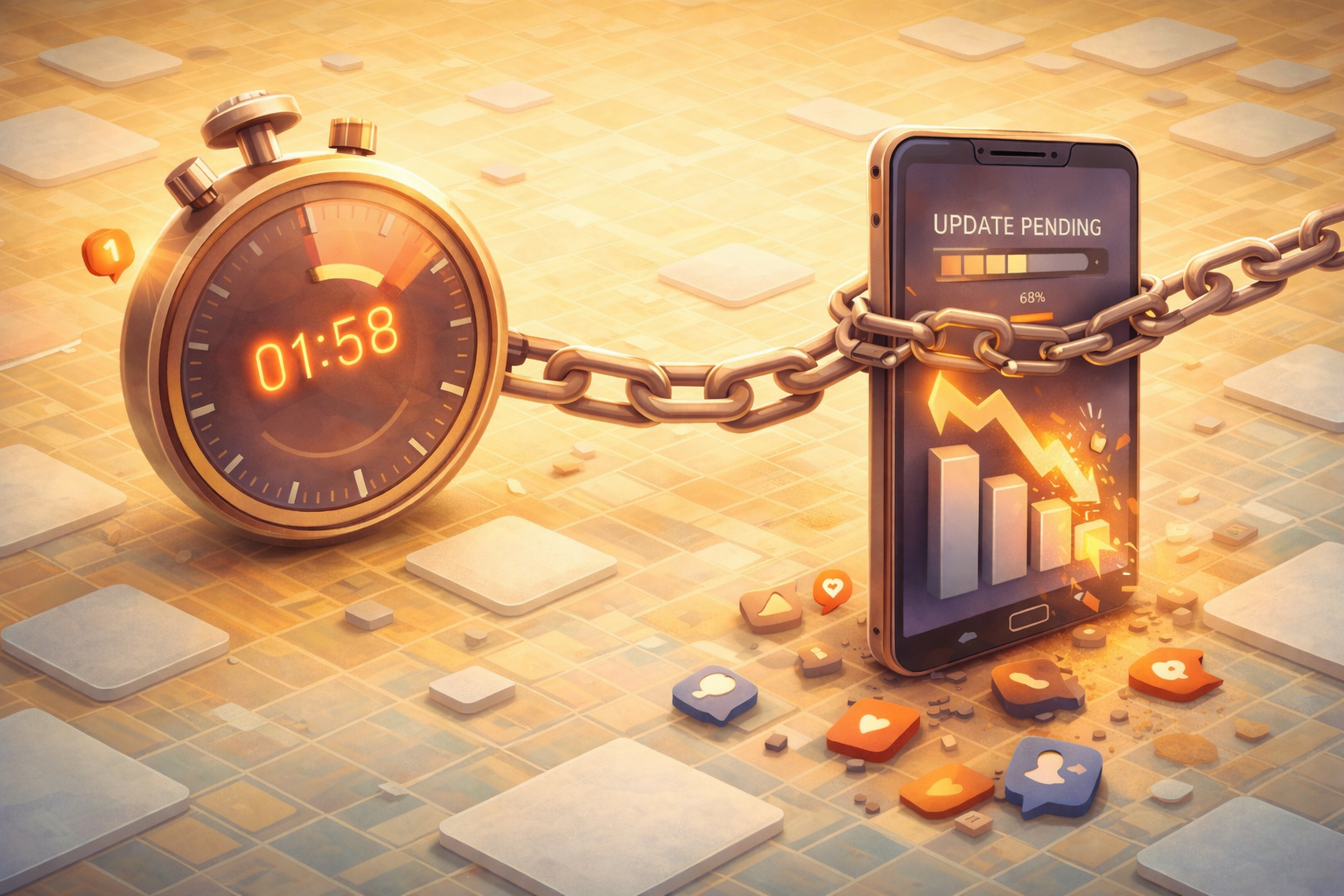
Mobile App Engagement isn’t just another dashboard line item. It’s a behavioral signal - the reflection of whether users find your product meaningful, relevant, and worthy of their limited attention.
Yet too often, teams approach engagement the way they do crash fixes or feature requests: ship it in the next release. Push it through sprint planning. Queue it for app-store approval. Celebrate the KPI bump when DAU spikes next quarter.
That mentality is not just outdated - it’s harmful. When engagement waits on release cycles, it’s already lagging behind users, not meeting them where they are.
This article is part of a broader pillar on mobile app engagement, where we examine why engagement is often misunderstood, mismeasured, and misapplied in modern product systems. While the pillar connects multiple dimensions, this piece dives deeper into one of its most critical structural constraints: how release cycles shape and often limit engagement itself.
In this article, we will explore what release-bound engagement really means, how it weakens feedback loops, why common engagement best practices fail under these constraints, and the hidden costs of slow iteration. We will also look at how high-performing teams rethink engagement as a continuous system rather than a release-driven outcome, and what it takes to build products that can respond to user behavior in real time rather than after the moment has passed.
This article dives into why tying engagement to release cycles fails, the psychological and technical mechanics behind that failure, and how product teams should truly think about engagement - not as something you add, but something you cultivate continuously.
What “Release-Bound Engagement” Really Means
Before we talk about why engagement fails, we need to be precise about how it’s usually implemented. It work almost always starts with a real signal. A user drops off during onboarding, Feature adoption stalls, Notifications stop getting opened, etc. The team agrees that something needs to change and what happens next is familiar.
A user struggles today.
The issue is noticed later.
A fix is planned for the next sprint.
The release waits for review on the Apple App Store or the Google Play Store.
The update rolls out gradually.
This pattern is so normal that it rarely gets questioned. Engagement follows the same process as everything else because, structurally, it lives in the same place: inside the app binary.
This is what we mean by release-bound engagement - the logic that can only be updated by shipping a new version of the app.
In practice, this usually means:
- Onboarding flows that change only when a new version is released
- Notification rules hard-coded into the app
- Personalization logic compiled into builds rather than adjusted at runtime
- Experiments planned around release schedules instead of user behavior
None of this feels like a mistake and the problem becomes visible only when you follow the timeline from user behavior to product response.
By the time the engagement change reaches users, it is responding to a moment that has already passed.
This delay is not incidental. It is the defining characteristic of release-bound engagement. The decisions here are locked weeks before they ever meet real user context. What reaches users is not a response to behavior, but a prediction made in advance.
Over time, this constraint reshapes how teams think, because iteration is slow and expensive, engagement work starts to resemble feature delivery rather than behavioral learning. Product managers hesitate to propose small experiments that require a full release, Designers over-specify flows because revision is costly and Engineers optimize for fewer changes, not faster feedback.
Gradually, the questions teams ask begin to change.
Instead of asking how to help users at the moment they struggle, teams ask what can realistically be shipped in the next release window.
What makes this especially dangerous is that it doesn’t fail loudly - Metrics still move. DAU might spike after a release and Retention curves may show short-term improvement. These signals create the impression that efforts are working.
But what’s actually happening is coarse adjustment. Changes are too infrequent and too generalized to reflect real user behavior. Teams see movement, but they don’t learn why it happened or which users it helped. The feedback loop weakens without anyone explicitly noticing.
This is the core issue with release-bound engagement.
Engagement isn’t slow because teams hesitate. It’s slow because it’s being forced through systems designed for stability, not learning. And that mismatch shows up most clearly in what breaks next: the feedback loop.
How Release-Bound Engagement Collapses the Feedback Loop
Engagement doesn’t improve because teams ship more ideas but it improves only when teams can learn faster than users lose interest and teams learn faster than users drift away.
That learning depends on a feedback loop that looks deceptively simple:
Observe → Learn → Experiment → Measure → IterateWhen this loop runs quickly, engagement evolves and When it slows down, engagement calcifies.
Release-bound engagement slows the loop at every step.
Consider a common situation now.
A consumer app sees a clear drop-off during onboarding. Users sign up, move through one or two screens, then disappear. The team agrees the onboarding flow needs work.
A revised flow is designed and approved. But instead of going live, it’s scheduled for the next release. It ships weeks later, bundled with unrelated fixes and features, and rolls out gradually.
By the time the change reaches users, the context has shifted. New acquisition channels explain different behavior. Some users see the new flow, others don’t. Notifications were adjusted in the same release. Marketing ran a campaign during rollout.
The metrics move - slightly. Or maybe they don’t.
What’s missing is clarity.
Was the onboarding change responsible?
Did it help one cohort and hurt another?
Or did nothing at all?
There’s no clean answer, so the team waits. Small follow-up tweaks feel unjustifiable because each one requires another release. The next iteration gets bigger, slower, and more generalized.
This is how the feedback loop collapses in practice.
Not because the idea was wrong, but because the distance between seeing a problem and seeing the result of a change becomes too large to support learning.
Why Best Practices Fail When Engagement Is Release-Bound
When mobile app engagement metrics starts to dip, teams helpfully reach for best practices and talk to most product teams and they’ll quote engagement best practices:
- Add push notifications
- Personalize content
- Gamify flows
- Reward usage
None of these ideas are wrong. But when engagement is tied to release cycles, they consistently underperform - because best practices only work when they can be tuned continuously.
Onboarding is a good example. In theory, it should evolve as teams learn where users hesitate. In practice, release-bound onboarding ships as a fixed flow. If it helps some users but confuses others, teams can’t adjust in real time.
The same pattern appears with notifications and personalization. Timing, frequency, and relevance are central to making them work, but hard-coded logic forces teams to choose broad defaults. When results disappoint, the easiest response is to add more and more messages, more nudges, more mechanics, rather than improve precision.
This is how best practices turn into coarse optimization.
The failure isn’t in the practices themselves. It’s in trying to apply them inside a system that can’t adapt.
When engagement is release-bound, best practices lose their sensitivity. What should help users starts compensating for a system that can’t respond fast enough.
The Hidden Cost of Slow Engagement Iteration
Slow engagement iteration doesn’t just delay improvement - it quietly changes team behavior.
When every engagement change requires a release, iteration becomes expensive. Each idea needs justification. Each adjustment has to feel “worth shipping.” Over time, small, precise changes disappear, replaced by larger, heavier updates that can justify the cost.
This creates the first hidden cost: missed moments. Engagement opportunities are time-bound. When iteration is slow, teams consistently arrive after the moment has passed - and lose the chance to learn from it.
The second cost is organizational caution. Product managers hesitate to propose narrow experiments. Designers over-design flows because revision is costly. Engineers optimize for stability over learning. Engagement work slowly shifts from exploration to mobile app engagement risk avoidance.
But the most damaging cost shows up in the patterns teams adopt. When precision becomes hard, teams compensate with intensity. Instead of improving timing and relevance, they increase frequency. Instead of clarifying value, they add nudges. Engagement becomes louder, not smarter.
This is how unhealthy patterns form - not through bad intent, but through system pressure.
Because feedback arrives late and blended, early signs of user fatigue are easy to miss. Short-term metric lifts feel like validation. Long-term erosion stays invisible. Over time, engagement drifts away from usefulness and toward compulsion.
The paradox is subtle but consistent: the slower engagement becomes to iterate, the more aggressive it has to become to show results.
And once engagement reaches that point, teams may still be shipping - but they’re no longer building trust. They’re compensating for a system that can’t adapt fast enough.
Engagement Is a Relationship - Not a Release
Now the Question is- What High-Performing Teams Do Differently
Teams that consistently build healthy engagement don’t rely on better tactics.
They rely on a different mental model.
They stop treating engagement as something that ships occasionally and start treating it as something that evolves continuously. Engagement is no longer a release item or a quarterly initiative. It becomes a living system shaped by real behavior, not a schedule.
This shift shows up first in how change is allowed to happen.
India is one of the fastest-evolving mobile ecosystems in the world, with hundreds of millions of users adopting smartphones, digital payments, and app-first services in a highly compressed time frame. From fintech and commerce (UPI apps for example) to mobility and content, user expectations shift quickly - often faster than product teams can safely plan releases.
In theory, faster app-store approvals should help, yet App Store or Play Store take 1-2 days on an average for a review cycle but in practice, it barely matters.
Even a one- or two-day delay is enough to miss critical engagement moments when behavior is changing in real time.
High-performing teams separate engagement logic from core releases. Stability-critical functionality still moves carefully through release cycles, but engagement moments - onboarding steps, prompts, content ordering, messaging logic - aren’t forced to wait. They’re designed to change independently of the app binary.
Practically, this often means moving engagement surfaces to server-driven UI and logic.
| Aspect | Release-Bound | Server-Driven |
|---|---|---|
| Iteration Speed | Weeks/months | Hours/days |
| Feedback Loop | Slow, noisy | Fast, clear |
| Cost | High (per release) | Low (runtime) |
Instead of hard-coding flows into releases, teams define engagement experiences that can be adjusted from the server: which screens appear, what content is shown, how steps are ordered, when prompts appear. The app becomes a stable renderer and Engagement becomes configurable.
This changes how teams work.
High-performing teams don’t chase engagement numbers as outcomes. They use them as signals. DAU spikes don’t end the conversation - they start one. The question shifts from “Did the metric move?” to “What did users actually experience?”
As feedback loops shorten, something important happens: engagement becomes calmer.
When teams can respond quickly, they don’t need to rely on pressure. They don’t need louder notifications, heavier nudges, or stacked mechanics. Relevance replaces volume. Precision replaces intensity.
This is where the relationship framing becomes clear.
And that explains why some teams build engagement that feels timely, respectful, and durable - while others keep shipping engagement that always arrives a little too late.
Where Digia Fits in
At some point, teams that take engagement seriously run into a practical constraint:
They understand that engagement needs to evolve continuously -
but their tools are still optimized for shipping binaries.
This gap is exactly where Digia Studio sits.
Digia isn’t an engagement framework, a growth SDK, or a metrics tool.
It doesn’t tell teams what engagement should look like.
Instead, it changes a more fundamental constraint:
It removes the requirement that meaningful UI, logic, and experience changes must wait for an app-store release.
By decoupling experience updates from release cycles, teams can:
- Adjust onboarding flows without forcing updates
- Tune engagement moments based on live behavior
- Run controlled experiments without fragmenting app versions
- Roll back changes instantly when something doesn’t work
Importantly, this doesn’t replace release cycles - it respects them.
Core functionality, stability-critical code, and architectural changes still ship through normal releases. But engagement logic - the part that needs to adapt - no longer has to wait.
In practice, teams using this approach stop treating engagement as a quarterly initiative and start treating it as an operational system. That distinction matters more than any single feature.
Conclusion - Engagement Can’t Wait for App Store Permission
Most engagement doesn’t fail because teams lack effort, ideas, or intent.
It fails because engagement is asked to operate inside systems that were never designed to respond to human behavior. When relevance has to wait for a release, timing is lost. When learning is delayed, engagement becomes heavier. When feedback loops stretch, teams compensate instead of adapting.
Over time, engagement stops feeling responsive and starts feeling imposed.
The teams that break out of this pattern don’t chase better tactics. They change the constraints. Revealingly, they don’t try to “optimize engagement” - they remove the friction that prevents engagement from evolving at the pace users do.
This is the quiet shift that matters.
When engagement can change without waiting for a release, teams learn faster, experiment safely, and stay aligned with real behavior. Engagement becomes calmer, more relevant, and more durable - not because it’s engineered more aggressively, but because it’s allowed to adapt.
Releases still matter. Stability still matters. But engagement isn’t a release artifact.
It’s a relationship.
And relationships don’t improve on a shipping schedule - they improve through timely response.
The question for modern mobile teams isn’t how to add more engagement. It’s whether engagement needs permission to change at all.