


TL;DR
- Urban Company's Insta Help, Snabbit and Pronto all promise a helper at the door in 10 to 15 minutes. Each built a different booking journey to deliver that promise.
- This article follows one booking from the first screen to the second booking, in eight steps, and compares what each app has publicly documented at every step.
- Snabbit and Pronto put the speed promise in the app's name. Urban Company carries it as one category inside a much larger app and words it as a range with a qualifier.
- The apps scope a job differently. Snabbit sells hours and Pronto asks for tasks and then for details about the home. Insta Help launched on an hourly price.
- First-order pricing is where the journeys diverge most, with reported offers ranging from ₹49 an hour to ₹1 for a first visit. Every one of those prices has already moved at least once.
- Pronto is the only app of the three that documents recurring bookings, and it reports a median of two days between a customer's first and second booking. Snabbit has a favorites screen for repeat experts.
- The least documented part of every journey is the failure path: no helper available, a slipping ETA, a rating that cannot be left for a visit that never happened.
- Sourcing note: We did not run live bookings. Every statement comes from the companies' own listings, filings and press releases, from named reporting, or from user reviews, and each links to its source. Our interpretation is labelled "Our read." Where a step is not publicly documented, the table says so.
It is 8:40 on a weekday morning. The regular helper has not turned up, guests arrive at noon, and three apps on your phone promise someone at the door in ten to fifteen minutes.
Those apps sell one promise, and each built a different booking journey to deliver it. The differences sit in small decisions: how the job is described, how long it is said to take, what the first booking costs and what the fourth costs, what the screen shows while you wait. Together they decide whether the promise feels kept.
The category is large enough to study closely. Urban Company reported about 51,520 Insta Help bookings on a single day in February 2026 and then crossed one million monthly bookings in March. The Ken's February figures put Insta Help at 840,000 orders, Snabbit at 830,000 and Pronto at 340,000. At those volumes, every extra tap in a booking flow costs real bookings.
How This Comparison Was Built
We did not place live bookings. The comparison draws on public material only: store listings, company filings and press releases, reporting from named publications, and user reviews. Each statement links to its source. Where we interpret, the sentence starts with "Our read." Where a step is not documented, we say so and leave it blank.
Four limits apply.
- Urban Company has published no step-by-step description of the Insta Help booking flow that we could find. The only screen-level source for its app is Digia's own earlier teardown of the core order screen, which covers the main services flow.
- Prices in this category change often because all three companies have discounted heavily. Each price below carries the source and month of the report.
- User reviews are individual accounts. They show what customers say went wrong. They do not measure how often it happens.
- The complaint about missing tracking on Pronto rests on one March 2026 review, and the app may have changed since.
The Three Booking Journeys at a Glance
| Step | Urban Company Insta Help | Snabbit | Pronto |
|---|---|---|---|
| 1. First screen and promise | A category inside the main Urban Company app. Stated turnaround: 10 to 15 minutes from booking, and as quickly as 15 minutes subject to availability | A single-purpose app. Store title carries the number: House Help in 10 mins | A single-purpose app. Store title carries the number: House Help in 10 Mins |
| 2. Choosing the job | Cleaning, dishwashing, laundry and meal preparation | Sorted by area and chore: bathroom, kitchen, laundry, ironing, organising, full home | Tasks first, including one room or light cooking help |
| 3. Scoping the job | Launched with an hourly price from ₹49 | Hourly bookings up to four hours | After tasks, the app asks about the home |
| 4. Choosing when | Not publicly documented beyond the 10 to 15 minute turnaround | Instant or scheduled. The Instant card carries an ETA badge, 6 min in the screenshot | Instant and scheduled, plus recurring, and a named professional for daily service |
| 5. Price and payment | ₹49 an hour at launch, then ₹99 an hour with a ₹100 discount in February 2026 reporting | ₹198 for the first three visits in February 2026, then base pricing of ₹169 to ₹199 an hour by May | ₹1 for a first visit, then ₹25 for 30 minutes in February 2026, with price shown before booking |
| 6. The wait | Core order screen is one continuous surface with map, professional card and stepper. Not confirmed for Insta Help | Live expert tracking with maps | Not in the listing. One March 2026 review reports no in-app tracking and no service timer |
| 7. Arrival and handoff | Not publicly documented | Customer shares an OTP | Professional arrives in uniform |
| 8. After the visit | Core flow has a rating and tip module. One review says rating opens only after the service | Favorites screen lists past experts with a visit count and shows two empty slots under "Add 2 Experts to unlock". What unlocking gives is not shown | Reported median of two days between first and second booking |
Each cell is sourced in the matching step section below.
The blank cells matter as much as the filled ones. A team auditing these journeys should start with them.
Step 1: The First Screen and the Promise
Snabbit and Pronto put the number in the product name. Both App Store titles read "House Help in 10 mins" or close to it. Snabbit's About page goes further and says the team obsesses over the 10-minute promise.
Urban Company words it differently. Its filings say Insta Help delivers within 10 to 15 minutes from the time of booking, and a summary of its offer document says a professional can arrive as quickly as 15 minutes, subject to availability. Insta Help also sits inside the main Urban Company app as one service category. Snabbit and Pronto have their whole app to themselves.
Our read. A promise in the app name is made before the first screen loads, so every first booking becomes a test of the title. A range with a qualifier gives the screen room to be honest when supply is thin, and it costs some punch. Neither choice is free.
Naming belongs to this step. Urban Company launched the service in a Mumbai pilot on 17 March 2025 as Insta Maids and renamed it the next day after criticism of the word, saying that dignity, respect and progress start with the name. A product name is microcopy that thousands of people read before they book, and this one was rewritten within about a day.
Step 2: Choosing the Job
Urban Company's releases describe Insta Help tasks as cleaning, dishwashing, laundry and meal preparation. Snabbit's listing lists its services by area and chore: bathroom cleaning, kitchen cleaning, laundry, ironing, organising and full home cleaning. Pronto's listing says the user picks tasks first, and a March 2026 review describes task-level choices such as one room or light cooking help.
Our read. The first choice shows which model of the problem each app holds. Snabbit sorts by place in the house, Pronto by task and Urban Company by chore type. The closer a label sits to the way a user would describe the problem to a family member ("the dishes are piling up"), the fewer decisions the first screen needs. This is worth testing on your own first-time users before you copy anyone's taxonomy.
Step 3: Scoping the Job, in Hours or in Homes
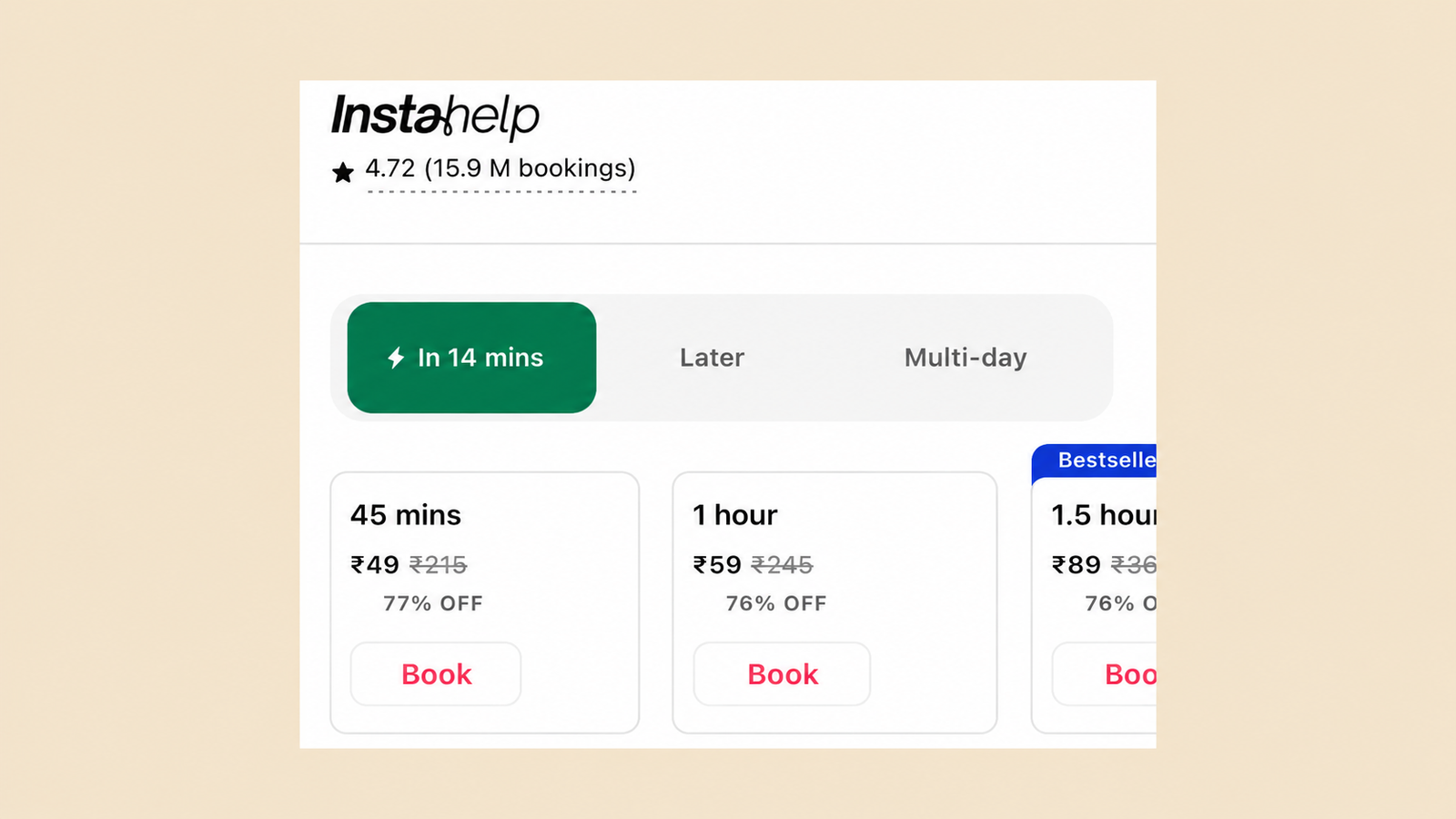
Snabbit sells time. Its listing says users can book hourly services of up to four hours, and early coverage of the app described users choosing a service and a duration, with an arrival time attached. Urban Company launched Insta Help with an hourly price, starting at ₹49 an hour in the Mumbai pilot.
Pronto's listing describes a different second step: after choosing tasks, the user tells the app about the home.
Our read. Hours put the estimate in the user's head. How long do two bathrooms take? A wrong guess surfaces later as an extra booking or a wasted hour. Asking about the home moves the estimate to the app, at the cost of a data-entry step on the first booking. When you audit any booking flow, check whether the screen tells you how long the job will take in your home or only what an hour costs.
Step 4: Choosing When
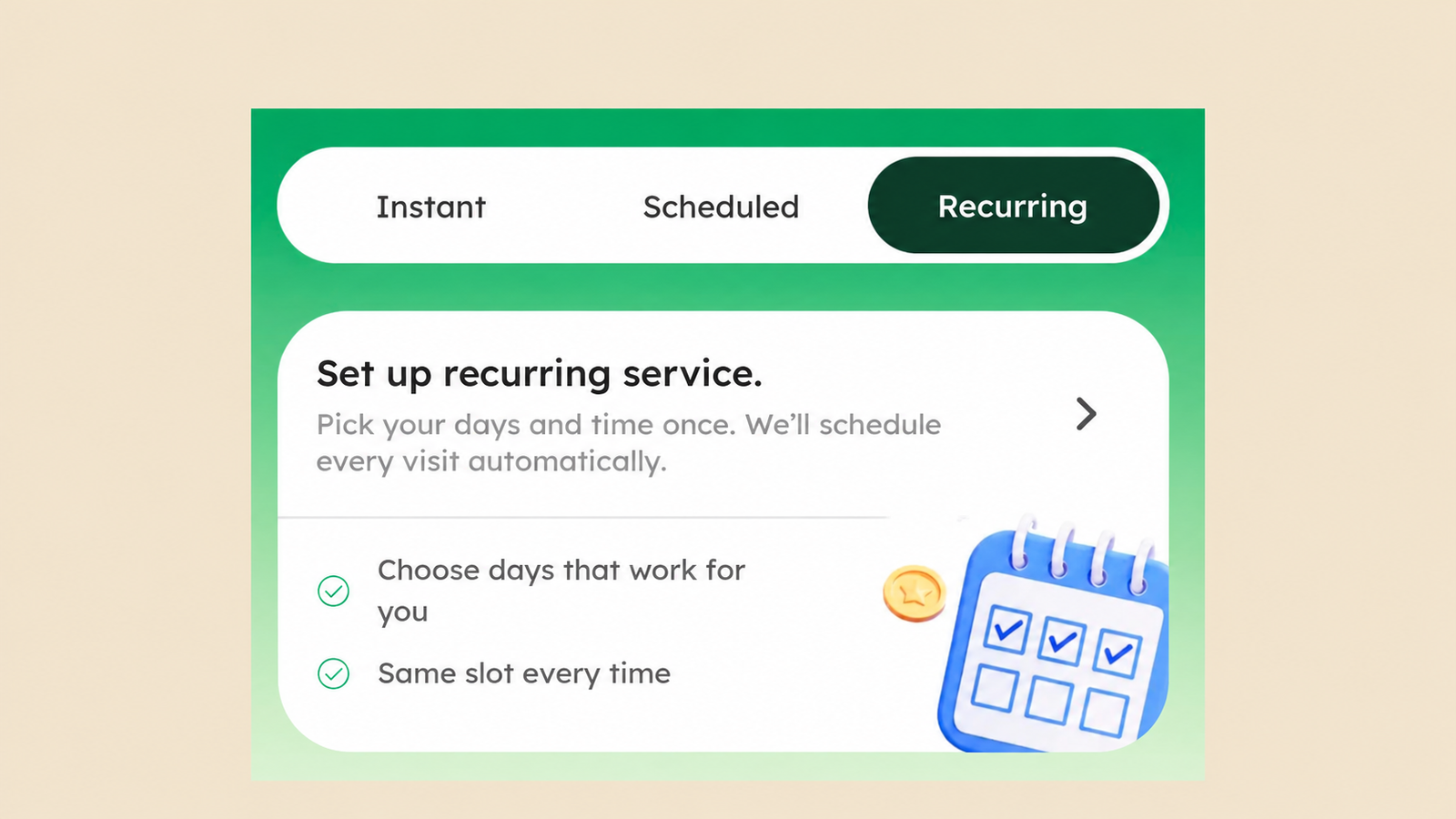
Snabbit offers instant booking or scheduling in advance. Pronto lists three timing options: instant and scheduled, plus a recurring option.
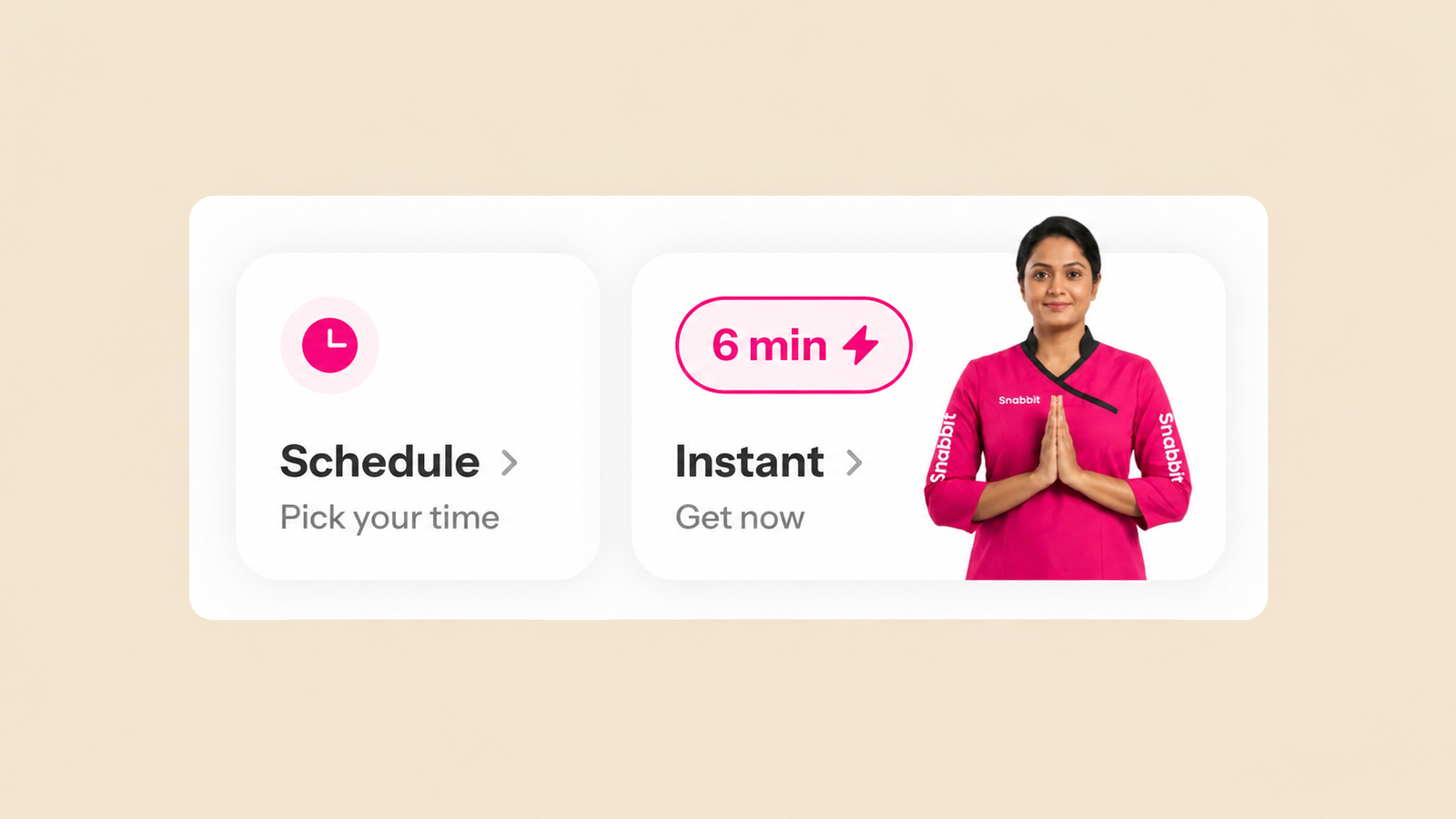
Our read. An ETA on the choice card puts the speed promise at the moment of decision. The screenshot does not show whether the number is live or fixed, and that is worth checking in your own flow.
A customer who opts for daily service can select a specific professional to come every day. For Insta Help, the documented promise is arrival within 10 to 15 minutes of booking, and we found no public description of how scheduling works.
Our read. For a chore that repeats, this step decides whether the first booking becomes a habit. Pronto's founder told TechCrunch that the median gap between a customer's first and second booking is two days, and that the top 10 percent of users place nine or more orders a month. A customer who returns within two days is already recurring in behaviour, so a recurrence option at booking time meets them where they are.
Step 5: Seeing the Price and Paying
Pronto's listing promises transparent pricing and tells users to "View pricing in the app before you book". Snabbit's About page promises no hidden charges. Underneath both sit introductory offers that moved quickly.
Urban Company launched Insta Help at ₹49 an hour. The Ken's February 2026 report describes a door-to-door Urban Company representative offering ₹99 an hour with a ₹100 discount,

₹198 for a customer's first three Snabbit visits, and ₹1 for a first Pronto visit followed by ₹25 for 30 minutes. By May, Snabbit's founder said discounting had been reduced and base pricing sat between ₹169 and ₹199 an hour. Pronto's CEO told Reuters that there will be a lot of discounting for a long time.
Customers describe the price step in reviews. One Play Store review says Insta Help prices rose sharply after the first three services, and a review on the same page says the price for the same service was far lower on a second phone number. These are individual accounts. They are not a measured rate.
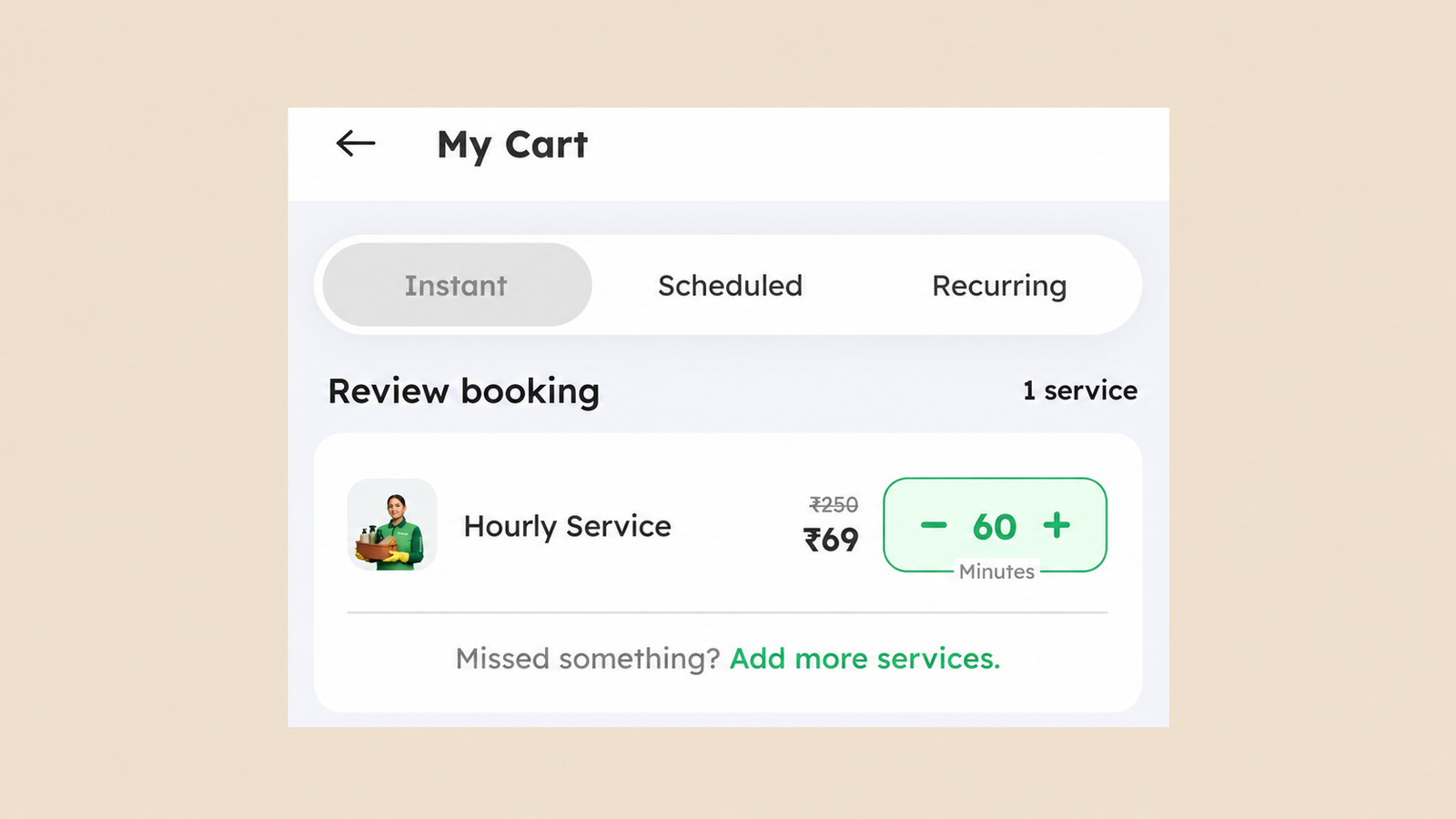
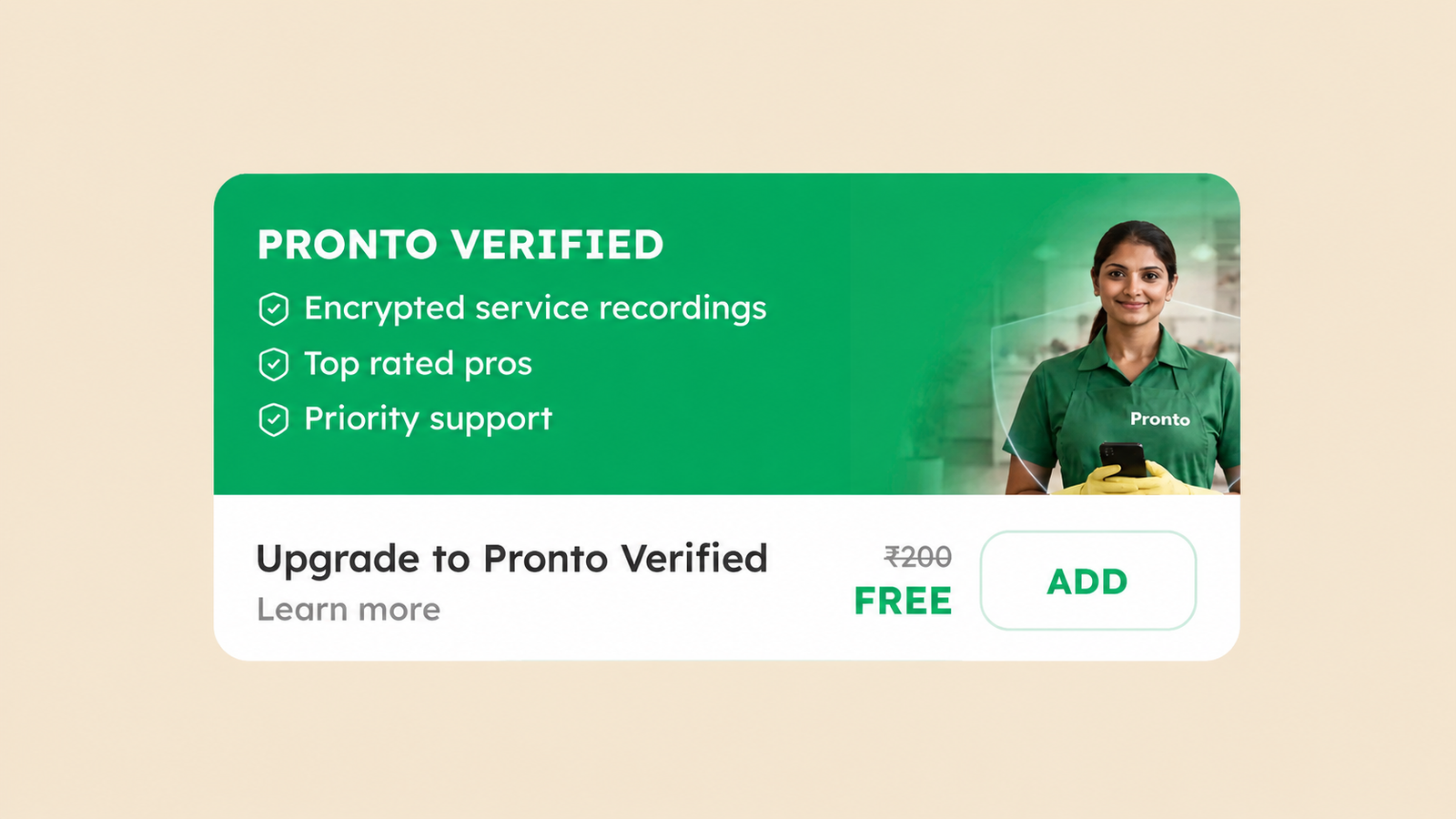
A screenshot of Pronto's cart screen shows the pattern this article recommends below. A 60-minute hourly service appears at ₹69 with ₹250 struck through beside it, and the Pronto Verified upgrade appears at ₹200 struck through and marked free.
Payment steps are the least documented part of the three journeys. Snabbit's listing names smoother, more reliable payments among its recent changes, and that is the only payment detail any of the three has published that we found.
Our read. An introductory price is a statement about the second booking. If the screen for booking one shows only the offer price, the app has scheduled a surprise for booking four. The cleanest fix is to show the regular price beside the offer price on the booking summary. Digia's Rapido teardown covers how price anchors work on a choice screen, and the e-commerce and quick commerce piece covers sticker shock when an offer ends.
Step 6: The Wait Between Book and Arrive
Snabbit's listing lists live expert tracking with maps among its recent changes. Its founder has said a Snabbit professional travels an average of 247 metres between jobs, roughly a five-minute walk. Pronto's founder said 70 to 80 percent of demand comes from within 500 metres of each hub. Those distances mean the map on a wait screen covers a very short trip.
On the Urban Company side, Digia's earlier teardown of the order screen describes one continuous surface from confirmation through live tracking to completion, with a status strip, a map, a professional card and a progress stepper. That teardown covers Urban Company's main services flow, and we have not confirmed that Insta Help uses the same screen.
The wait is also where user reports describe the journeys breaking. The March 2026 review of Pronto reports delays of 40 to 50 minutes with inaccurate arrival times and no service timer, from a single reviewer who may be describing an older version. On Insta Help, a Trustpilot review describes a call after booking saying the helper could not come on time, and a Play Store review describes a support chat that kept offering only reschedule or cancel.
Our read. Under a 10-minute promise, this screen is the product for ten minutes. It has one job, which is to answer whether someone is coming and when. Cross-sell belongs on it only while the ETA is healthy. If the ETA slips, the screen should say so before the user has to ask. Digia's guide to suppression logic covers which states should block a promotion entirely.
Step 7: Arrival and the Handoff
Snabbit's listing ends its flow at the door, with the customer sharing an OTP with the expert. Pronto's professionals arrive in uniform, and its founder says the company runs in-house training and a multi-step verification that includes court record checks.
A screenshot of Pronto's cart screen also shows a "Pronto Verified" upgrade, with ₹200 struck through and the price shown as free. It lists three benefits, led by encrypted service recordings. The screen does not say what happens after a customer taps ADD.
Snabbit describes its experts as background-verified and trained. On the worker side, Snabbit's founder described an SOS feature that mobilises response teams and a system called Kavach that detects distress signals.
Our read. The OTP is the only handoff step in these listings that asks the customer to do something. It confirms that the person at the door is the person the app sent, which matters when strangers enter homes. Uniforms and verification claims do similar work in clothing and copy, and a user cannot act on either of them. Pronto Verified sits earlier, as an option the customer can add at booking. Which cue earns more trust is worth testing in your own product.
Step 8: After the Visit and the Second Booking
Pronto is the only one of the three with published repeat data, the two-day median gap between first and second booking. Its recurring schedule and named-professional option appear in its listing and press release. For Urban Company, Digia's teardown describes a rating and tip module and a cross-sell surface on the core order screen. A Trustpilot reviewer reports that the app did not allow a rating until the service was done, which leaves no way to rate a helper who never came. A screenshot of Snabbit's favorites screen shows an "Add to Favorites" list with a visit count beside each expert.
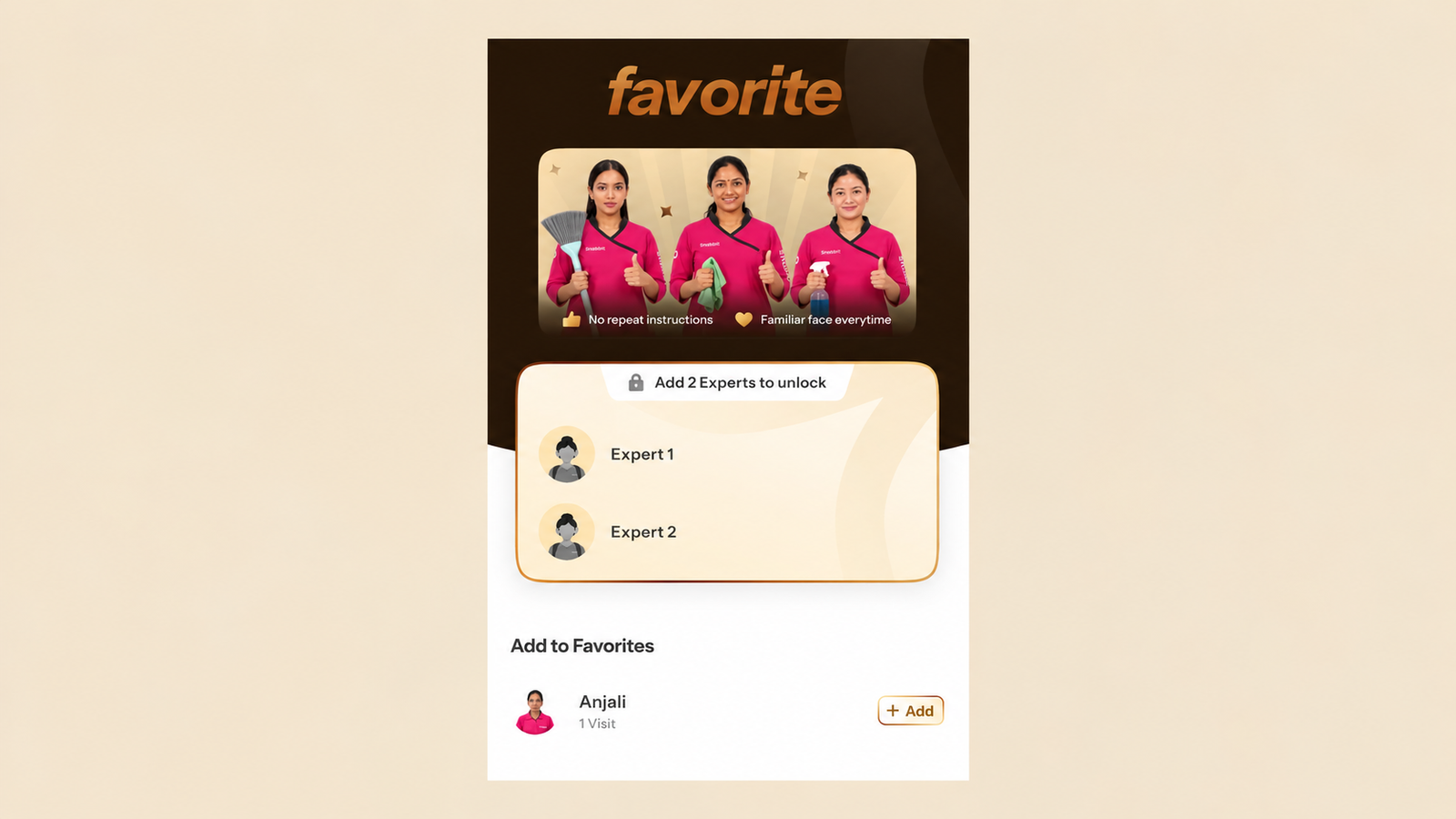
Two empty expert slots sit under "Add 2 Experts to unlock", and the screen promises "No repeat instructions" and "Familiar face everytime". It does not show what unlocking gives. We found no other public description of Snabbit's post-visit screens.
Our read. The minutes after a good visit are the cheapest time to win the next booking. The rebook control should name the professional whenever the pool is deep enough to honour it. Snabbit's favorites screen takes the same idea and asks the customer to pick people after a visit. The two-expert gate suggests the feature works best once a customer has used a few helpers, though that is our inference and the screen does not say. A rating step that opens only after completion leaves the worst outcome, the no-show, without a feedback channel, so it needs its own path.
Where Each Journey Breaks
Supply sits behind every failure. Pronto's CEO described the platform as "very supply-constrained" while bookings grew from 3,000 a day in December to more than 26,000. Inc42 reported a worker crunch at Snabbit that sent some users to other apps. Urban Company's own February 2026 filing said long-term growth would depend on retention and the availability of trained professionals.
In a booking journey, a supply shortage appears as a screen: no helper available, a delayed ETA, a cancellation after confirmation, or a rating screen for a visit that never happened. We found no public description of the no-supply screen in any of the three apps. That is the screen to audit first.
The economics explain why prices keep moving. The Week reported Insta Help losing about ₹381 per order, citing a quarterly EBITDA loss, and Inc42 later put the figure at ₹447. The Week also reported Snabbit burning about ₹75.9 crore a month during its discount period. Any booking screen built around today's offer price will change when the offers do.
Support is the third weak point in user reports. The same Play Store review that mentions the chat loop says that asking for customer care only returned options to cancel or reschedule. Again, this is one reviewer, and the useful question for your own app is simpler: can a customer with a late helper reach a person?
What Other Booking Apps Can Borrow
| Pattern | Seen in | Works when | Breaks when | Other apps where it fits |
|---|---|---|---|---|
| Speed promise in the app name | Snabbit, Pronto | Supply is dense enough to meet it nearly every time | Night hours or new neighbourhoods thin out supply | Cabs and quick delivery |
| Range with a qualifier | Urban Company Insta Help | The app can show live availability beside the range | The qualifier is buried below the fold | Services inside multi-category marketplaces |
| Home profile instead of hours | Pronto | Job size scales with home size | Users do not know the details, or the home is unusual | Cleaning and pest control |
| Recurrence offered at first booking | Pronto | The chore repeats weekly or faster | Needs are one-off | Tutoring and fitness |
| Named professional on repeat | Pronto (named professional), Snabbit (favorites) | The relationship matters and the pool is deep | The pool is small, so the same person is often unavailable | Salon and physiotherapy |
| Handoff code | Snabbit | A stranger enters a home or takes custody of goods | Low-risk deliveries, where it only adds a step | Repairs and rides |
| Regular price shown beside the offer price | Pronto (cart screen, per screenshot) | Introductory offers run for a set number of orders | Prices vary by user in ways you cannot explain | Subscriptions, delivery fees |
Where In-App Experiences Fit Along the Journey
Most of the weak points above are moments, and moments are what in-app experiences handle well. Each of the following can be built as a native nudge or widget that a growth team edits from a dashboard without waiting for an app release.
A price step-up preview. A bottom sheet on the booking summary that shows the regular price after an introductory offer ends, triggered on the first booking made under the offer.
A no-supply fallback. When instant booking is unavailable, a sheet that offers the next scheduled slot or a notify-me option, so the user gets a next step in place of a dead end.
An ETA slip message. An inline strip on the wait screen that appears when the ETA moves by more than a threshold you set.
A rebook and recurrence widget. A card after completion that offers the same professional and a recurring plan, shown when a second booking falls inside your own median repeat window. Pronto reports two days for its users. Yours will differ, so measure it.
Suppression rules. Block promotions during the wait, after a late arrival, after a failed payment and while a complaint is open. Digia's guide to behaviour-triggered campaigns covers the trigger, delay and exception structure behind these rules, and the piece on recovering users with contextual prompts covers the fallback pattern.
Digia Engage renders these as native components on top of the engagement platform a team already runs, such as CleverTap or MoEngage, and the CEP-layer architecture explainer shows how the pieces connect. We have no information about whether any of the three apps in this comparison use it.
The Audit to Run on Any Booking Journey This Week
- Install all three apps and capture the first screen of each. Note where the time promise appears and how it is worded.
- Book the cheapest instant job at an off-peak hour and again at a peak hour. Time the arrival against the promise.
- Before confirming, note what the summary says about duration and about the regular price.
- Open the wait screen and check the ETA and the helper details on the map. Note whether anything promotional appears.
- Test the no-supply state by booking in a thin-supply area or late at night. Record exactly what the app says when no helper is free.
- Cancel at three different points in the journey and record the refund copy at each one.
- Complete a booking and find the rebook path. Count the taps needed to book the same helper again.
- Contact support during a delay. Record whether a person is reachable and how long that takes.
- Repeat step 2 after a week to see whether the offer price has changed.
Key Takeaways
Urban Company's Insta Help, Snabbit and Pronto sell the same promise of help in 10 to 15 minutes, and the booking journeys behind it differ at nearly every step. Comparing the journeys step by step shows more than comparing the promises.
The speed promise lives in different places. Snabbit and Pronto put it in the app name, so every first booking tests the title. Urban Company words it as a range with a qualifier inside a larger app, which leaves room to be honest when supply is thin.
Job scoping differs in a way users feel. Snabbit sells hours, which leaves the estimate with the user. Pronto asks about the home, which moves the estimate to the app. When auditing a flow, check whether the screen says how long the job will take in your home.
Introductory pricing is a statement about the second booking. Reported first-order offers ranged from ₹49 an hour to ₹1 for a first visit, and all of them have since moved. Showing the regular price beside the offer price is the cleanest way to avoid a surprise on booking four.
Pronto is the only app of the three that documents recurring bookings, and it reports a two-day median gap between a first and second booking. Snabbit lets customers save favorite experts. For a repeating chore, offering recurrence at the first booking matches the behaviour the company itself describes.
The wait screen carries the whole promise for ten minutes. Its one job is to say whether someone is coming and when, and it should state any delay before the user asks.
The failure path is the least documented part of all three journeys. No public source describes the no-supply screen in any of the apps, so that screen and the support path are the first things to audit in your own product.
Further Reading
From Digia Engage:
- Urban Company's Post-Order Screen: Anatomy, Cross-Sell Mechanics, and the User's Journey to a Second Booking: the screen-level source for Urban Company's order screen used in steps 6 and 8
- How Rapido's Ride-Option Screen Steers Your Choice: how price anchors and framing work on a choice screen
- In-App Experiences for E-commerce and Quick Commerce Apps: compressed decision windows and sticker shock after offers end
- How Zepto's Onboarding Gets Users to Their First Order in Under 3 Minutes: a first-booking journey from the quick commerce side
- When Not to Show a Nudge: Building Suppression Logic: the states that should block a promotion
- Behaviour-Triggered In-App Campaigns: The Complete Guide: triggers, delays and holdouts
- Recovering Abandoning Users With Contextual In-App Prompts: fallback prompts when a journey stalls
- State of In-App Engagement in India 2026: the wider market these apps operate in
- Digia Engage: native in-app experiences on top of an existing CEP
External Sources:
- Snabbit: House Help in 10 mins, App Store listing, Snabbit (booking flow, hourly options, OTP handoff, live tracking and payment release notes)
- Pronto: House Help in 10 Mins, App Store listing, Pronto (task, home and timing flow, price shown before booking)
- We're Building India's Most Trusted Home Help Platform, Snabbit (promise and pricing language)
- InstaHelp crosses 50,000 daily bookings, Urban Company investor relations (task list, turnaround and launch date)
- InstaHelp crosses 1 million monthly delivered bookings, Urban Company investor relations (March 2026 volume)
- Urban Company, issue highlights, JK BFSL (arrival "subject to availability" wording from the offer document)
- Urban Company launches 15-minute Insta Maids at ₹49/hr, MyPunePulse (launch date, price and tasks)
- Urban Company Renames Insta Maids to Insta Help After Backlash, Outlook Business (the rename and its statement)
- How Urban Company turned the tables on Snabbit, The Ken (February 2026 orders and first-order pricing)
- Snabbit's Micromarket Push, Inc42 (base pricing, 247 metre figure, safety systems, worker crunch)
- Why InstaHelp Isn't Helping Urban Company's Finances, Inc42 (per-order loss estimate)
- Tech vs living wages, The Week (per-order loss and discount-period burn)
- Bain bets on Indian domestic work startup Pronto, TechCrunch (timing modes, hub radius, verification)
- India's Pronto formalizes house help, TechCrunch via Yahoo Finance (repeat-booking data)
- Indian instant home services startup Pronto raises $20m, DealStreetAsia (supply constraint and booking growth)
- Instant home services boom lifts Pronto's valuation, Enterprise AM (CEO comment on discounting)
- Pronto Raises $2M, Business Wire (three timing options and named professional)
- Pronto: $2 Million Raised For India-Based House Help Platform, Pulse 2 (uniformed arrival)
- Pronto App Review, Flickonclick (task-level booking and the tracking and delay complaints, March 2026)
- Snabbit: The 15-minute maids of India, Tech Geography (early booking flow with service and duration)
- Urban Company reviews, Trustpilot (individual Insta Help reviews)
- Urban Company app reviews, Grand Screen (individual Play Store reviews)
Digia Engage ships native nudges, widgets and surveys on top of a CEP such as CleverTap or MoEngage, and a growth team edits them from a dashboard without an app release. If your booking journey has a price step, a wait screen or a no-supply state that needs work, book a demo and we will walk through how each one is built.