


TL;DR:
- The EleFant scaled from one contextual upsell to 10 live in-app experiences in its first 30-day term on Digia Engage.
- The portfolio reached 60,869 impressions and 11,337 clicks; the top experience (a toy-view-screen membership upsell) hit a 36.6% click-through rate.
- Three advance-booking placements produced 299 downstream completions, and the growth team launched an app-education video campaign without engineering support.
- Key takeaway: The most narrowly targeted, in-context placement outperformed broader messaging because it met users at the moment of intent.
Sourcing note: Every figure and quote in this article is drawn directly from Digia's published case study.
Overview of The EleFant
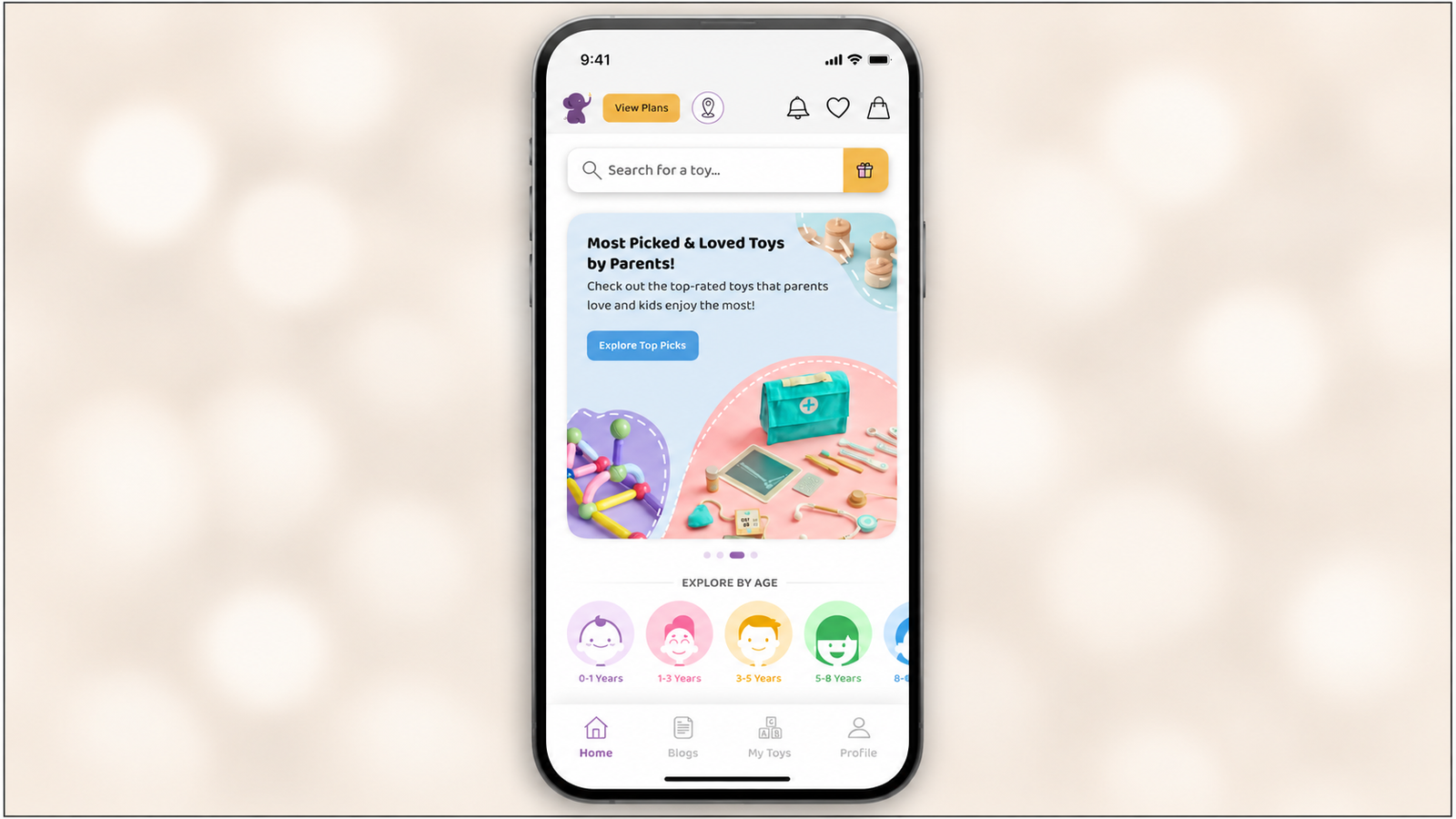
The EleFant is a subscription-led toy discovery and booking platform that lets families borrow, play with, and return toys instead of buying them outright - parents browse a curated library filtered by their child's age and developmental stage, book toys for home delivery, and rotate them out for new ones as their child grows, so the app serves the family across the full toy lifecycle, from first discovery to return and re-booking. That model depends on a specific chain of behaviour working smoothly inside a single app session: a parent has to land on the right toy for their child, understand why one membership tier is worth more than another, and complete a booking before the intent fades. Each link in that chain is a point where the journey can stall - a browser who can't find a fit, a member who never looks past the entry plan, a booking that's started but not finished - and it plays out across several distinct growth initiatives spanning membership sign-up and upgrade, booking completion, the educational content that explains a toy's developmental value, and plan discovery for users who haven't yet seen what a higher tier unlocks, each with its own trigger, moment, and screen where the right in-app experience could move the family one step further.
The Challenge
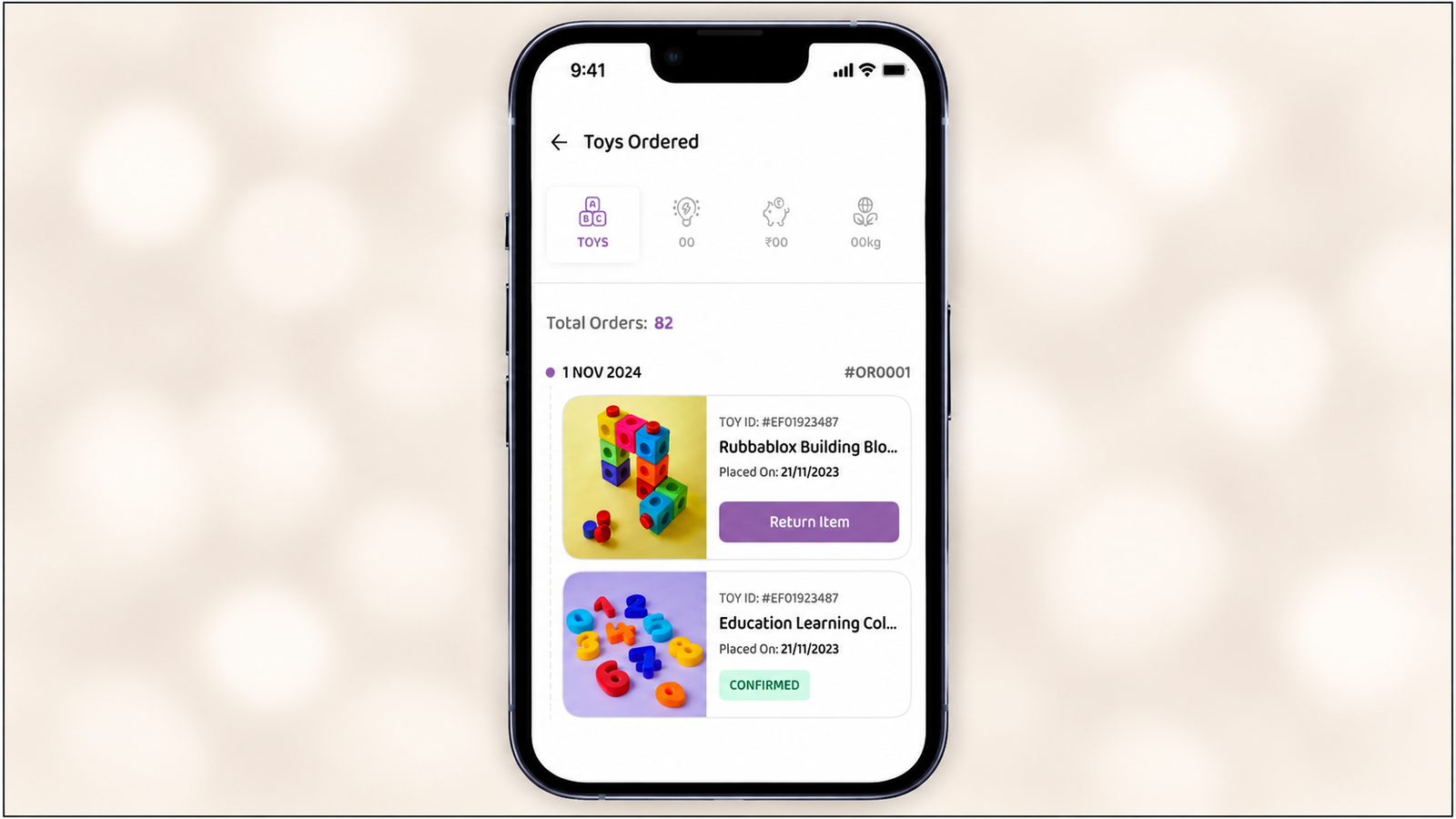
Several of The EleFant's most important journeys depended on users discovering the right feature or proposition entirely on their own:
- Membership value lived only on the pricing screen. Tier differences were real, but users had to go looking for them - most never did.
- No upgrade prompt at the point of intent. A family weighing a booking, hitting a plan limit, or browsing toys beyond their tier saw nothing explaining what moving up would unlock.
- Advance booking existed but was never surfaced. The feature worked, but nothing pointed users to it when a toy was already out, a child was approaching the next age band, or a return was about to free a slot.
- Discovery, not design, was the bottleneck. Features underperformed because users couldn't find them, not because they were built wrong.
- Every new experience needed a release. A nudge, banner, or contextual sheet meant a ticket, a sprint, a build, and app store approval before it could even be tested.
- Iteration was slow and single-threaded. With that overhead, the team could realistically work on only one journey at a time, and refining a live experience took as long as launching it.
- No repeatable system for in-app experiences. The team needed a way to launch, measure, and adjust across membership, booking, and discovery in parallel, without each idea becoming its own engineering project.
This is a specific and common shape of problem: the features already exist, the value proposition is real, and the gap is entirely in discovery and timing - not in what the product itself offers.
The Solution
The EleFant built four distinct experiences across its first term with Digia Engage:
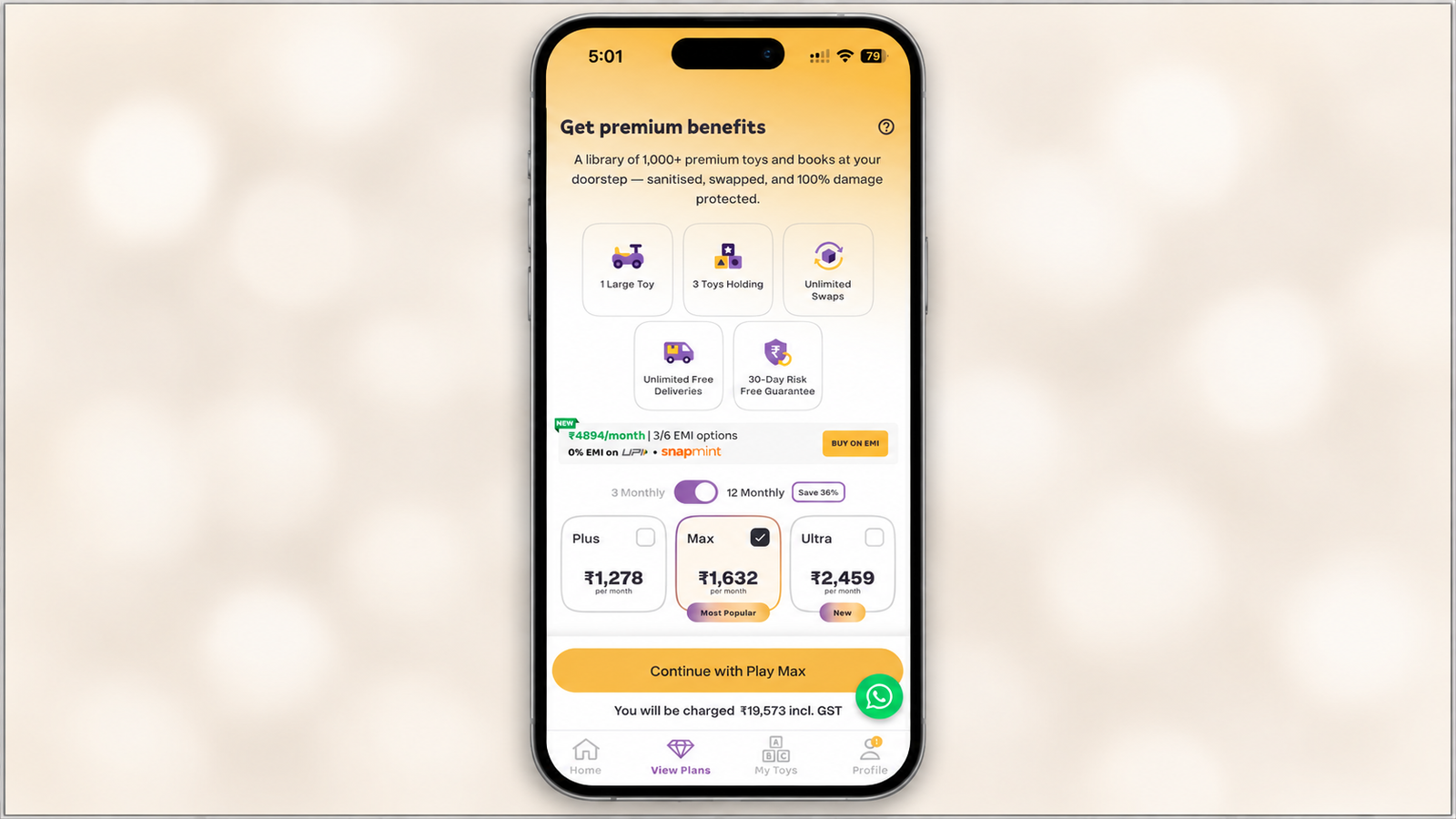
- Contextual membership upsell - shown on toy-view screens, presenting the subscription proposition at the exact moment a user was actively considering a toy.
- Guided app-install video - shown at app launch, built and launched independently by The EleFant's own team after Digia onboarding, with no Digia involvement in the build.
- Advance-booking widgets - placed across the home screen, order-history screen, and all-toys screen to improve discovery of an existing but under-used feature.
- Max-plan home-screen banner - communicating the membership proposition to a broad audience rather than a single intent moment.
What's worth noticing is the deliberate variation in targeting breadth:
- Narrow - the membership upsell fires only when a user is evaluating a specific toy.
- Broad - the Max-plan banner reaches everyone who opens the home screen.
- Middle - the advance-booking widgets sit across three screens chosen for their relevance to that one action.
- Self-serve - the install video proved the team could ship an experience end-to-end without Digia in the loop.
- Parallel, not sequential - all four ran at the same time, not one after another.
This is not one tactic repeated four times. It is four different placement strategies tested in parallel - which is precisely what let the results below compare approaches against each other rather than report a single undifferentiated outcome.
Impact and Results
| Outcome | Result | Why it matters |
|---|---|---|
| Contextual membership upsell CTR | 36.6% - highest-performing experience in the portfolio (July) | The membership pitch appeared on toy-view screens, at the moment a user was actively weighing a purchase |
| Portfolio scale | 5 → 10 active experiences over the 30-day term | Growth teams could expand across journeys without a release cycle per experience |
| Total reach | 60,869 impressions · 11,337 clicks | Volume generated across the full portfolio in one term |
| Advance-booking completions | 299 completions from the three advance-booking placements | A trackable downstream action, not just a click , the prompt connects directly to a completed booking |
ndependently built and launched the app-education video campaign
Proof the team could run experiences end-to-end without further Digia support
Source: Digia × The EleFant case study
"Digia gave us a practical way to put the right message in front of users at the right moment. We were able to expand quickly across membership, education, and booking journeys while building confidence to launch experiences ourselves."
- Vaaneet Kapoor, Product and Growth, The EleFant
Why the Contextual Upsell Outperformed Everything Else
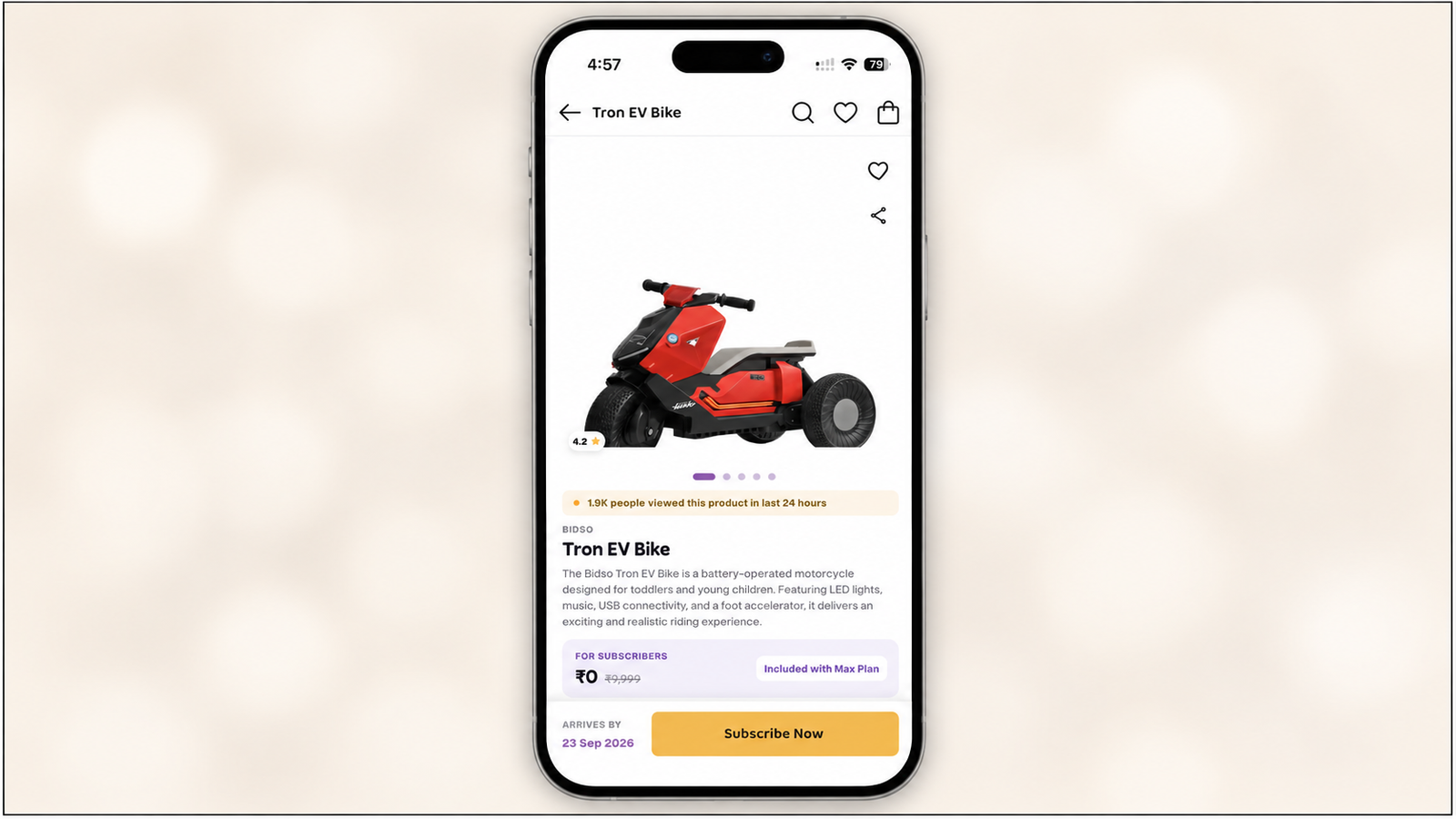
A 36.6% click-through rate on a single experience is worth examining specifically, because it is not simply "the membership pitch was good." It is a direct result of where and when that pitch appeared.
The membership upsell fired on toy-view screens, at the exact moment a user was already evaluating a specific product and weighing whether to commit to it. This is a fundamentally different moment than a home-screen banner shown to every user regardless of what they are currently doing, because the toy-view screen user has already demonstrated active purchase intent through their own behaviour, before the campaign ever appeared. The campaign is not creating interest from nothing. It is meeting interest that already exists and offering a specific, timely reason to expand the decision the user was already in the middle of making, from "should I book this specific toy" to "would a membership make this and future decisions easier."
This is the same underlying principle documented across contextual placement generally: a message that arrives at the moment a user's own behaviour has already signalled relevant intent consistently outperforms the same message broadcast to an undifferentiated audience, because the targeting itself, not just the creative, is doing a meaningful share of the persuasive work.
What the Advance-Booking Widgets Show About Discoverability
Advance booking was already available as a feature before Digia Engage was introduced. The gap was not capability. It was that users needed clearer prompts at the moments where the feature was most useful. The fix was not building a new feature. It was placing discovery surfaces for an existing feature across three specific, relevant screens, the home screen, order history, and the all-toys screen, rather than leaving discovery to chance or to a single, easily-missed mention somewhere in the app.
The 299 downstream completions this produced is a meaningfully different kind of result than an impression or a click count, because it measures the actual behaviour the business needed, not just attention captured along the way. This distinction matters for any team evaluating a similar rollout: a widget can generate strong click volume without producing the downstream action a business actually needs, and The EleFant's result specifically ties the in-app placement to a completed booking, not merely a tap.
What Self-Serve Execution Actually Demonstrates
The EleFant's own team independently created and launched its app-education video campaign, which is a different kind of result from the click-through and completion numbers above, because it is not measuring a specific campaign's performance. It is measuring whether the underlying capability transfer actually happened.
A vendor relationship that requires ongoing, campaign-by-campaign support to launch anything new is a materially different arrangement than one where a growth team, once onboarded, can conceive of a new experience and ship it without waiting on external help. The education video campaign is the specific, concrete evidence that this transfer occurred within the same 30-day window as the rest of the results, not as a separate, later milestone.
The Three Things The EleFant's Own Team Identified
Context drives interest. The membership offer drew its strongest engagement when presented on the toy-view screen, confirming directly what the click-through rate data already suggested: the placement, not just the offer itself, was doing significant work.
Discovery needs placement. Advance booking became easier to find when it appeared across relevant app touchpoints, which reframes a feature-discovery problem as a placement problem specifically, not a feature-quality or messaging problem.
Self-serve creates momentum. Once onboarded, the team could launch an education campaign independently, which is the team's own confirmation that the capability transfer, not just the campaign results, was a genuine and valued outcome of the engagement.
Key Takeaways
The single highest-performing experience in this rollout was also the most narrowly targeted, a contextual upsell shown only at the moment a user was already evaluating a specific product, which produced a 36.6% click-through rate against a broader home-screen banner running in parallel.
Scaling from 5 to 10 active experiences within a single 30-day term is a direct demonstration of iteration speed, not just campaign volume, since each additional experience represents a new placement or journey tested rather than a variation on the same idea repeated.
Advance-booking discoverability was solved through placement across three specific, relevant screens rather than a feature change, producing 299 downstream completions, a result measured by completed action rather than surface-level engagement alone.
Self-serve campaign execution, demonstrated by The EleFant's own team independently building and launching its app-education video, is evidence of genuine capability transfer within the same window the other results were produced, not a separate, later milestone.
The team's own stated learnings, context drives interest, discovery needs placement, self-serve creates momentum, align directly with what the underlying performance data shows, which is a meaningful confirmation that the results reflect real, replicable principles rather than a one-off outcome.
Explore Similar Case Studies
- Probo - shipping feature rollouts and in-app experiments without app store dependencies
- Dezerv - a growth team running experiments independently with no dev queue for in-app changes
- BBlunt - a full e-commerce app launched with native in-app experiences built on Digia
- Omli Kids - parent-trust flows and kid-safe journeys refined without another app release
- Datamuni - in-app flows shipped without waiting on app store approvals
- Unlock.fit - personalised in-app journeys walking users through fitness goals
Integration takes under 20 minutes. After that, your growth team runs campaigns without an engineering ticket. Get a demo or view pricing.
External Sources:
- The EleFant | India's #1 Toy Subscription & Library for Kids - theelefant.ai (Mini / Plus / Max plan structure; 1,000+ toy and book catalogue for ages 0–12; the "90% of kids outgrow a toy in under 16 days" claim behind the rotation model)
- The EleFant on Google Play - play.google.com (app listing; the membership, booking, and toy-discovery flows referenced throughout this article)
- The EleFant Franchise Model deck - theelefant.ai (9,000+ active customers; 18+ cities; scale context for the impression and click volumes in the results)
- The Elefant on Shark Tank India: Sharks Debated The Elefant's Toy Subscription Model Scalability - StartupArticle (Season 4 pitch at ₹60 lakh for 1%; sharks' questions on pricing, user behaviour, and subscription reliance - the adoption problems the in-app experiences targeted)
- The EleFant: India's First Mobile App-Based Toy Library Redefining Sustainable Parenting - Inc91 (founder background; parent-side pain points of clutter, cost, and outgrown toys that the membership proposition answers)
The contextual upsell, cross-screen booking widgets, home-screen banner, and self-serve video campaign described in this article are native to Digia Engage's Nudges, Widgets, and In-App Video product lines - each targeted, placed, and edited from a dashboard after launch, without an app release. Book a demo to see how a toy-view upsell or a booking prompt can go from idea to live in the same week, or read the full EleFant case study for the complete results breakdown.